
Smart Textile Market Analysis: A Fabric Woven with Technology and Growth
How Intelligent Fabrics Are Reshaping Wearables, Healthcare, Fashion, and Industry (2025–2033)


Global Smart Textile Market Outlook
The Global Smart Textile Market is undergoing a remarkable transformation, emerging as one of the fastest-growing segments within advanced materials and wearable technology. According to Renub Research, the market is projected to expand from US$ 4.85 billion in 2024 to an impressive US$ 29.10 billion by 2033, registering a robust CAGR of 22.03% during 2025–2033.
This exponential growth reflects the convergence of textile engineering, electronics, and digital technologies, resulting in fabrics that do far more than cover the human body. Smart textiles—also known as e-textiles or intelligent textiles—are now capable of sensing, reacting, and adapting to environmental or physiological stimuli, positioning them as a foundational component of the Internet of Things (IoT) ecosystem.
From fitness tracking apparel and medical-grade garments to interactive fashion and defense-grade uniforms, smart textiles are redefining how industries perceive fabric functionality. Rising consumer awareness, advancements in conductive fibers, growing healthcare applications, and innovations in textile manufacturing are collectively propelling this market forward.
What Are Smart Textiles?
Smart textiles are fabrics embedded with electronic components such as conductive yarns, sensors, actuators, and microcontrollers. These components enable textiles to monitor, transmit, and respond to data, including temperature, pressure, moisture, heart rate, or movement.
Unlike traditional wearables that rely on external devices like wristbands or chest straps, smart textiles seamlessly integrate technology into the fabric itself—offering comfort, flexibility, and continuous monitoring. Their ability to react to heat, light, electricity, or motion makes them invaluable across sectors such as healthcare, sports, automotive, military, architecture, and entertainment.
Smart Textile Market Snapshot (Renub Research)
Report Features Details
Base Year 2024
Historical Years 2020 – 2024
Forecast Period 2025 – 2033
Market Size (2024) US$ 4.85 Billion
Market Size (2033) US$ 29.10 Billion
CAGR (2025–2033) 22.03%
Key Drivers Powering the Smart Textile Market
1. Growing Relevance Among Fitness Enthusiasts
The fitness and sports industry has emerged as one of the earliest adopters of smart textiles. Performance-driven consumers increasingly seek real-time insights into posture, muscle activity, hydration levels, and heart rate—without relying on bulky devices.
Innovations such as smart threads and biometric fabrics enable athletes to track performance metrics with precision. These textiles improve comfort, reduce injury risks, and enhance training efficiency. Breakthrough research in microelectronic fibers capable of analyzing sweat metabolites and electrolytes has further expanded use cases in professional sports and wellness monitoring.
As fitness transitions from lifestyle choice to data-driven discipline, smart textiles are becoming an essential interface between the human body and digital analytics.
2. Expanding Fashion and Lifestyle Applications
The fusion of fashion and technology has elevated smart textiles from functional garments to style statements. Conductive yarns, LED fabrics, and touch-sensitive panels now allow clothing to interact with users and environments.
Global fashion brands and designers are leveraging smart textiles to differentiate collections through interactive aesthetics, responsive lighting, and adaptive comfort. Luxury beachwear with UV sensors, color-changing dresses, and motion-responsive garments are no longer conceptual—they are commercially available.
Collaborations between technology firms and fashion houses have further accelerated adoption. Notably, Google LLC partnered with Levi Strauss & Co. on Project Jacquard, integrating touch-sensitive controls into denim jackets.
Sustainability is also shaping innovation. Companies are introducing eco-friendly smart textiles using recycled fibers, biodegradable components, and low-impact manufacturing—aligning smart fashion with environmental responsibility.
3. Continuous Advancements in Material Science
Material science is the backbone of smart textile innovation. Researchers worldwide are developing conductive polymers, nanomaterials, phase-change materials, and flexible electronics that enhance durability, conductivity, and washability.
Breakthroughs include:
Fabrics that change color and shape in response to heat or electricity
Textiles that cool the human body more efficiently than traditional materials
Adaptive structures that respond dynamically to temperature changes
Collaborative research between universities and industry players continues to unlock applications ranging from military camouflage and aerospace insulation to consumer electronics and architecture. These advancements significantly lower production costs while improving performance, making smart textiles more commercially viable.
Regional Insights: Smart Textile Market by Geography
North America: Innovation-Led Leadership
North America dominates the smart textile landscape, driven by strong demand from healthcare, defense, sports, and wearable technology sectors. The United States, in particular, benefits from heavy R&D investments, advanced manufacturing infrastructure, and early adoption of IoT-enabled clothing.
Health-monitoring garments—such as sensor-integrated shirts and socks—are gaining traction for remote patient monitoring. Sustainability trends are also influencing production, with manufacturers experimenting with recycled materials and closed-loop textile systems.
United States Smart Textile Market
The U.S. smart textile market is shaped by wearable innovation, military applications, and consumer wellness trends. Defense agencies increasingly use smart uniforms for surveillance, performance monitoring, and protection, while sports brands focus on enhancing athletic output.
Environmental awareness is reshaping supply chains, pushing companies to adopt biodegradable sensors, conductive inks, and waste-reduction techniques. This dual focus on performance and sustainability positions the U.S. as a long-term innovation hub.
India Smart Textile Market
India is rapidly emerging as a high-growth smart textile market, supported by government initiatives, R&D investments, and a strong textile manufacturing base. Smart fabrics are gaining adoption across fashion, healthcare, automotive, and defense.
The government-backed National Technical Textiles Mission (NTTM), with funding of approximately ₹1,480 crore (US$ 200 million), aims to boost domestic production of advanced textiles. Institutions such as IITs and NIFT are actively developing next-generation smart textile applications, accelerating commercialization.
United Kingdom Smart Textile Market
The UK smart textile market is expanding due to advancements in wearable healthcare, sports performance, and material science. Remote patient monitoring and injury prevention garments are key growth areas, supported by government-backed innovation programs and academic research.
Saudi Arabia Smart Textile Market
Saudi Arabia’s smart textile market is gaining momentum under Vision 2030, which emphasizes innovation and advanced manufacturing. Demand is rising in healthcare, defense, and sports, particularly for temperature-regulating and performance-monitoring textiles. Increasing consumer awareness and industrial adoption are expected to drive steady growth over the coming decade.
Market Segmentation Overview
By Type
Passive
Active
By Functionality
Sensing
Luminescence & Aesthetics
Energy Harvesting
Thermoelectricity
Others
By End Use
Defense & Military
Sports & Fitness
Transportation
Architecture
Fashion & Entertainment
Medical
By Geography
Coverage spans 25 countries across North America, Europe, Asia Pacific, Latin America, and the Middle East & Africa.
Competitive Landscape: Leading Players
The smart textile market is moderately fragmented, with global technology leaders and specialized textile innovators competing through R&D, partnerships, and sustainable strategies.
Key companies include:
Adidas AG
DuPont de Nemours Inc.
Gentherm Incorporated
Texas Instruments Incorporated
Toray Industries Inc.
Ohmatex A/S
Schoeller Textil AG
Each company is analyzed across overview, key personnel, recent developments & strategies, and revenue performance, providing a holistic competitive perspective.
Final Thoughts
The Global Smart Textile Market stands at the intersection of technology, sustainability, and human-centric design. With market value expected to increase sixfold by 2033, smart textiles are no longer experimental—they are becoming mainstream across industries.
As conductive materials improve, costs decline, and IoT integration deepens, smart textiles will transition from niche innovations to everyday essentials. From monitoring health and enhancing athletic performance to redefining fashion and enabling industrial safety, intelligent fabrics are set to reshape how the world interacts with textiles.
About the Creator
Marthan Sir
Educator with 30+ years of teaching experience | Passionate about sharing knowledge, life lessons & insights | Writing to inspire, inform, and empower readers.
Keep reading
More stories from Marthan Sir and writers in Futurism and other communities.
Global IT Services Market Size & Forecast 2025–2033
Global IT Services Market Overview The Global IT Services Market is entering a decisive growth phase as enterprises, governments, and institutions accelerate digital adoption to remain competitive in a fast-evolving technology landscape. According to Renub Research, the market is anticipated to expand from US$ 1,477.66 billion in 2024 to US$ 3,190.82 billion by 2033, registering a robust CAGR of 8.93% during 2025–2033.
By Marthan Sir20 days ago in Futurism
About Binding Prometheus
I want to start actively advocating on behalf of my own work, and the most valuable part of my canon is, without a doubt, Binding Prometheus, the play I have been working on since 2019 and only finished in 2023 as part of my MA. The play itself is an amalgamation of a million different inspirations. On one end, it evokes the Ancient Greek myth-play, deriving its own title from the earliest extant work of Western drama we have, Aeschylus’s Prometheus Bound. On the other end, it borrows significantly from the sci-fi bulwarks from over the years, namely Mary Shelley’s Frankenstein and Karel Capek’s Rossum’s Universal Robots. The play could be an episode of Black Mirror, I fear. I don’t know. I’ve only ever seen one episode of Black Mirror.
By Steven Christopher McKnight15 days ago in Futurism
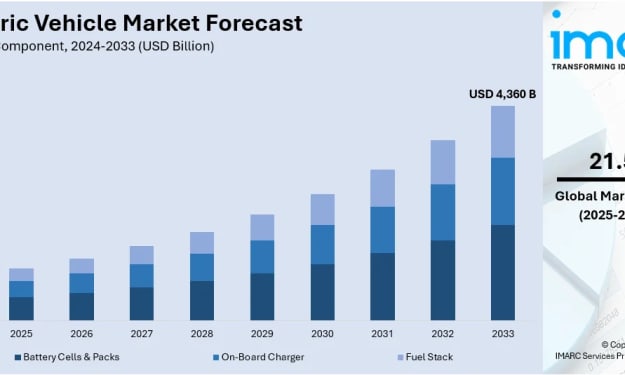
Electric Vehicle Market Size to Hit USD 4,360 Billion by 2033 Driven by Battery Innovation & Cost Declines
Rising environmental concerns, supportive government policies, falling battery costs, and expanding charging infrastructure are accelerating electric vehicle adoption, supported by technological innovation, fuel cost savings, and increasing consumer acceptance worldwide. According to IMARC Group's latest research publication, global electric vehicle market size reached USD 755 Billion in 2024. Looking forward, IMARC Group expects the market to reach USD 4,360 Billion by 2033, exhibiting a growth rate (CAGR) of 21.5% during 2025-2033.
By Abhay Rajput2 days ago in Futurism
Getting Serious About Comedy (Part I)
If I were asked to remark on my life and the childhood that paved some road leading me to this point, I would have to say something about all the funny people who surrounded me for the last 26,872 days (and counting). Somewhere along that road, I became a big fan of laughter and the comedy that spawns it – and, I mean not only my own laughter, but the laughter of others, some of which I have actually been responsible for inducing.
By John Oliver Smith7 days ago in Humor



Comments
There are no comments for this story
Be the first to respond and start the conversation.