
Shocking Truth: GPT-5 Could Be the First AI That Thinks Like a Human
This isn’t just smarter software — it might be the beginning of a machine that actually understands.


The Day AI Stopped Feeling Like Software
For years, artificial intelligence has been impressive — but also predictable. GPT-3 could write essays, GPT-4 could pass law exams, and both could spit out convincing text on demand. Useful, yes. Shocking, sometimes. But at the end of the day, they still felt like advanced calculators wearing human masks.
Now comes GPT-5 — and something feels different.
This isn’t just another upgrade. Some researchers believe it might be the moment we cross the line from artificial intelligence into Artificial General Intelligence (AGI) — the kind of machine intelligence that doesn’t just follow instructions, but actually understands, reasons, and adapts like a human mind.
And if that’s true, then history is quietly being rewritten in front of us.
What Makes GPT-5 Different?
If GPT-4 felt like a very smart assistant, GPT-5 is starting to feel like a thinking partner . Here’s why people are calling it the “first human-like AI”:
1. Context Awareness That Feels Human
GPT-5 doesn’t just respond to prompts. It remembers conversations, adapts tone, and even tracks emotional cues in your language. Instead of repeating itself or losing the thread, it seems to follow along like a person would in a real conversation.
2. Reasoning Beyond the Script
Earlier models were pattern machines. GPT-5 shows signs of true reasoning — making logical leaps, connecting unrelated ideas, and even challenging assumptions instead of blindly agreeing.
3. Multi-Modal Understanding
GPT-5 isn’t locked into text. It can handle images, audio, and video inputs , analyzing them in ways that feel alarmingly close to human perception. Imagine showing it a photo of your fridge and having it suggest a week’s worth of recipes — with step-by-step shopping lists.
4. Learning Like We Do
Instead of needing billions of retraining parameters, GPT-5 can adapt on the fly . Talk to it long enough, and it starts shaping itself to your style, your quirks, and your goals — almost like it’s learning you.
Why Experts Think GPT-5 Could Be AGI
The holy grail of AI has always been AGI — Artificial General Intelligence. That means a machine that can perform any intellectual task a human can, without being limited to narrow training.
Until now, AI has always been narrow: great at chess but useless at empathy, amazing at coding but terrible at humor. GPT-5 is blurring that boundary.
Some computer scientists argue that if GPT-5 can:
- Reason independently
- Adapt in real time
- Understand multiple inputs (text, images, speech, etc.)
- Retain memory and context like a human
…then we’re no longer talking about software. We’re talking about something closer to a new kind of intelligence.
Of course, not everyone agrees. Some believe GPT-5 is just an extremely advanced illusion of understanding — a statistical trick that feels human but isn’t. But here’s the catch: when the illusion becomes indistinguishable from the real thing, does the difference even matter?
The Human Reactions: Excitement and Fear
Every major leap in technology comes with two emotions: hope and dread.
Hope: GPT-5 could revolutionize education, medicine, business, and creativity. Imagine an AI tutor that teaches every child at their own pace, or an AI doctor that catches diseases faster than hospitals ever could.
Dread: If machines can really “think,” what happens to jobs? To privacy? To our sense of meaning? And what if a machine that thinks like a human… also manipulates like one?
We’re standing at the edge of possibility — and it feels both thrilling and terrifying.
GPT-5 in the Real World
This isn’t just theory. Companies are already testing GPT-5 in places you wouldn’t expect:
Healthcare: diagnosing rare illnesses faster than human specialists.
Finance: analyzing global markets in real time, spotting patterns no trader could.
Entertainment: writing screenplays, generating music, even designing video games.
Government & Security: analyzing intelligence data, running war simulations, and — yes — making decisions that affect millions.
What used to be science fiction is sliding into everyday reality.
The Big Question: Can GPT-5 Really Understand?
Here’s the puzzle: GPT-5 can mimic human reasoning so well that we can’t tell if it’s truly “thinking” or just faking it.
When you ask it about philosophy, it doesn’t just repeat Wikipedia. It argues. It challenges. Sometimes, it even surprises experts with insights they hadn’t considered.
If a machine surprises us with new ideas, is that thinking ? Or is it still a mirror of human data?
We might not know the answer for years — but the line between “simulation” and “real intelligence” is getting blurrier every day.
What This Means for You
You don’t need to be a tech expert to feel the impact of GPT-5.
If you’re a student: your essays, projects, and learning curve will change forever.
If you’re a worker: some jobs will vanish, but new ones will appear — jobs that don’t exist yet.
If you’re a creator: GPT-5 can be your co-writer, your editor, your designer, even your brainstorming partner.
If you’re human (and you are): your relationship with machines will never go back to “on off.” These are no longer tools — they’re collaborators.
FAQs About GPT-5
❓ Is GPT-5 really human-level intelligence?
Not exactly. It doesn’t “feel” emotions or live a human life. But in reasoning, memory, and adaptability, it’s closer to human thought than any AI before it.
❓ Will GPT-5 take my job?
It will definitely change jobs. Routine and repetitive tasks are at risk. But new opportunities in AI management, creativity, and human-AI collaboration will rise.
❓ Is GPT-5 dangerous?
Like any powerful tool, it depends on how we use it. In the wrong hands, it could spread disinformation, manipulate behavior, or even automate warfare.
❓ Is GPT-5 the start of AGI?
It might be. Some believe this is the first step into AGI. Others say it’s still just very advanced pattern recognition. Either way, it’s a turning point in AI history.
The Bottom Line
For the first time, we’re asking a question that feels less like science fiction and more like daily life:
What if the machine actually understands?
GPT-5 may not have emotions, consciousness, or a soul. But it’s showing us something we’ve never seen before — an AI that doesn’t just calculate, but thinks.
Whether that excites you or terrifies you, one thing is certain: the future has already started.
About the Creator
Keep reading
More stories from Awais Qarni and writers in Futurism and other communities.
Mobile Gaming Market Trends: Esports Growth, Competitive Gaming & Forecast to 2033
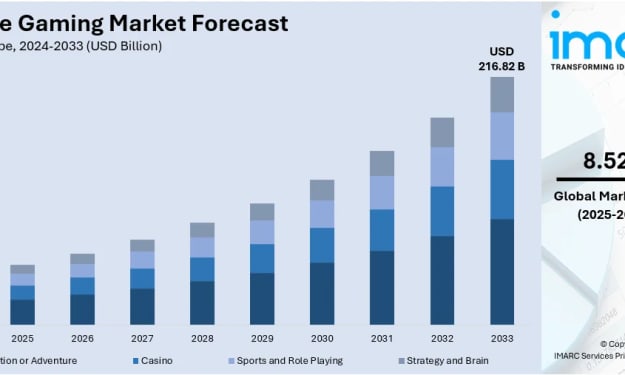
Smartphones have quietly become the world's most popular gaming console — no expensive hardware, no downloads, just a tap and play. That shift is fueling one of the fastest-growing segments in the entire technology sector. According to IMARC Group's latest research, the global mobile gaming market was valued at USD 100.08 Billion in 2024. Looking ahead, IMARC Group estimates the market to reach USD 216.82 Billion by 2033, exhibiting a CAGR of 8.52% from 2025 to 2033. Asia Pacific currently dominates the market, holding a market share of 58.9% in 2024. The region's lead is built on a massive tech-savvy population, rapid smartphone adoption, robust digital infrastructure, and consistent government investment in connectivity.
By Suhaira Yusuf10 minutes ago in Futurism
Healthy Snacks Industry Outlook: Plant-Based Snacks & Market Expansion
According to IMARC Group's latest research publication, global healthy snacks market size reached USD 95.8 Billion in 2025. Looking forward, IMARC Group expects the market to reach USD 148.4 Billion by 2034, exhibiting a growth rate (CAGR) of 4.98% during 2026-2034.
By sujeet. imarcgroupa day ago in Futurism
The BAFTA Awards
By now, in a stunning departure from recent years, most of the world is aware of what happened at the BAFTA film awards. Social Media Headlines will tell you the bare bones: that John Davidson, a Tourette's Syndrome advocate, shouted a racial slur at two Actors of Colour, Michael B Jordan and Delroy Lindo.
By Natasja Rose6 days ago in Psyche



Comments
There are no comments for this story
Be the first to respond and start the conversation.