
Scientists Uncover a 520-Million-Year-Old Fossilized Larva with Its Brain Intact
Scientists have discovered a 520-million-year-old fossilized larva in China with its brain and organs intact. This groundbreaking find reveals new insights into early arthropod evolution and the Cambrian Explosion.

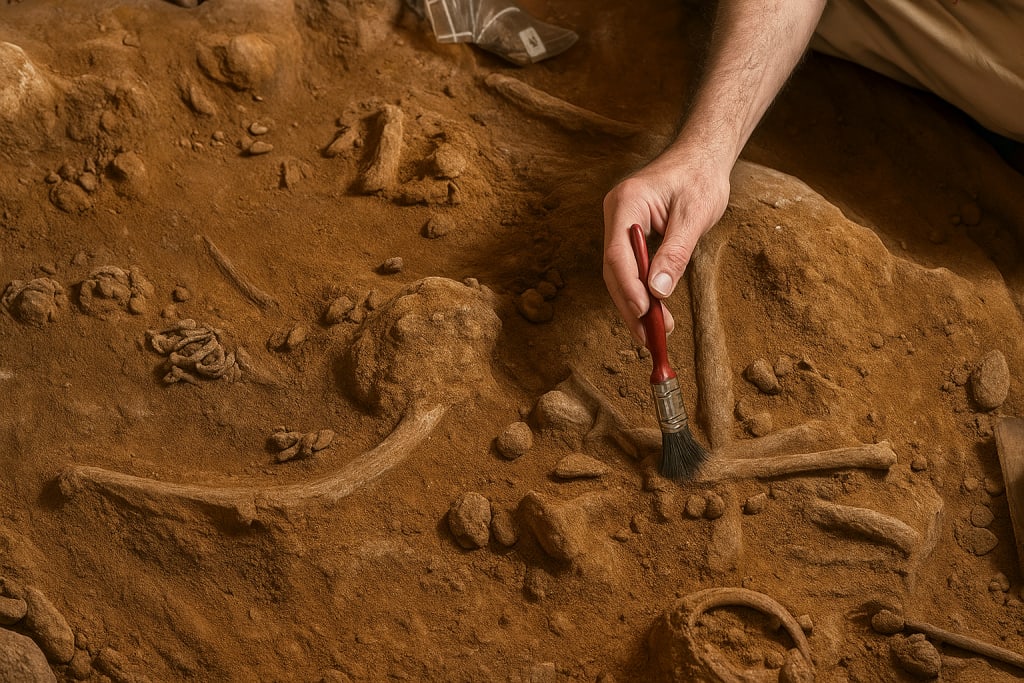
When we think of fossils, we often picture giant dinosaur skeletons or ancient plants trapped in stone. But a discovery in China has stunned scientists because it’s not about size—it’s about detail. Researchers recently unearthed a fossilized larva dating back 520 million years, and what makes this find extraordinary is that its brain, nervous system, digestive glands, and circulatory traces are still preserved. This tiny creature, no bigger than a poppy seed, has become one of the most important keys to unlocking the mysteries of early animal evolution.
A Window Into the Cambrian Explosion
The fossil was discovered in China’s Yu’anshan Formation, a site already famous for producing some of the best-preserved Cambrian fossils. The Cambrian period, often called the “Cambrian Explosion, occurred around 541 to 485 million years ago and represents a time when most major animal groups first appeared in the fossil record.
This newly found larva belongs to a genus named Youti, with the species officially called Youti yuanshi. Despite its microscopic size, it has quickly gained worldwide attention because it provides something that paleontologists rarely get: a detailed 3D look at the inner organs of an animal that lived over half a billion years ago.
Most fossils only preserve hard parts like bones, shells, or exoskeletons. But in this case, advanced imaging techniques such as synchrotron X-ray tomography revealed delicate internal structures—including a surprisingly well-developed brain region called the protocerebrum.
Why This Fossil Stands Out
What makes this discovery groundbreaking is not just the age, but the quality of preservation. The fossil shows:
Brain and Nervous System: Researchers could see traces of the larva’s brain and neural pathways connected to its eyes and appendages. This is critical for understanding how arthropods—today’s insects, spiders, and crabs—developed their complex nervous systems.
Digestive Glands: Soft tissue structures related to digestion were still intact, providing insight into how early animals processed food.
Circulatory Traces: Evidence of a primitive blood flow system, known as hemolymph in arthropods, was visible, offering clues about how early creatures transported nutrients and oxygen.
Martin Smith, one of the lead scientists studying the fossil, admitted that when he first saw the specimen, his “jaw just dropped.” For paleontologists, finding a fossil like this is like striking gold—it bridges the gap between what we know and what we’ve only theorized.
The Evolutionary Importance
Arthropods are the most diverse animal group on Earth today, with over six million estimated species, including insects, crustaceans, and arachnids. Understanding their evolutionary origins has always been a challenge, largely because larval forms rarely fossilize with such precision.
This fossil is particularly important for two reasons:
1. Early Brain Developmen – The protocerebrum revealed in Youti yuanshi helps explain how segmented arthropod brains evolved. By studying this ancient larva, scientists can connect evolutionary dots between primitive Cambrian organisms and the sophisticated nervous systems of modern arthropods.
2. Developmental Biology Insight – Because the fossil represents a larval stage, it highlights how early arthropods grew and changed over their life cycle. This is something rarely captured in the fossil record and adds an entirely new layer to evolutionary studies.
Comparisons With Other Fossil Discoveries
This isn’t the first time Cambrian fossils have amazed scientists with preserved nervous systems. Another famous fossil, Chengjiangocaris kunmingensis, revealed a detailed ventral nerve cord and segmental ganglia. However, the Youti yuansh fossil stands out because it captures a larval stage with both brain and organ preservation, making it a unique developmental snapshot.
By comparing Youti with other Cambrian arthropods, researchers are piecing together how different body plans evolved. It’s like assembling a jigsaw puzzle where every new fossil fills in missing evolutionary pieces.
How Technology Made This Possible
The fossil’s incredible detail wouldn’t have been visible without advanced imaging tools. Scientists used synchrotron X-ray scanning and computed tomography (CT scanning) to peer inside the fossil without destroying it.
These technologies allow paleontologists to reconstruct ancient anatomy in 3D, offering views of delicate tissues that would normally decay within days of an animal’s death. In the case of Youti yuanshi, these techniques revealed:
The exact shape of the brain.
Pathways of the nervous system.
Connections to sensory organs like eyes.
Internal organs including digestive glands.
Such non-invasive methods are revolutionizing paleontology, turning fossils from static stones into detailed blueprints of ancient life.
What This Means for Science
The discovery of Youti yuanshi goes far beyond one fossil. It reshapes our understanding of:
Arthropod Origins: Showing how brains and organ systems were already evolving complexity over half a billion years ago.
Evolutionary Relationships: Helping clarify where Cambrian arthropods fit in the tree of life.
Developmental Stages: Providing one of the rarest looks at a larval form, allowing scientists to understand how these creatures grew.
It also underscores the importance of fossil-rich sites like China’s Yu’anshan Formation, where exceptional preservation offers rare peeks into life’s earliest chapters.
The Broader Significance
Every fossil discovery adds another chapter to Earth’s history, but some discoveries redefine entire fields. The 520-million-year-old larva fossil does just that. It shows that even the smallest creatures, long forgotten in the depths of time, can reshape our understanding of evolution.
For scientists, this find emphasizes that complexity in animals didn’t appear suddenly in later eras—it was already underway in the Cambrian. For the rest of us, it’s a reminder of just how intricate and ancient life on Earth really is.
Final Thoughts
The discovery of Youti yuanshi is not just about an ancient larva—it’s about unlocking one of evolution’s oldest secrets. Its preserved brain and organs tell us that the roots of modern animal complexity stretch back over half a billion years.
This fossil proves that sometimes, the smallest finds make the biggest impact. As researchers continue to uncover more treasures from the Cambrian, one thing is clear: the story of life on Earth is far older, richer, and more astonishing than we ever imagined.
Fossil Discovery
Science News
Ancient History
Evolution
Paleontology
Archaeology
Nature & Science
Cambrian Period
Arthropods
Nervous System
About the Creator
NextGen Mobile Tech
- I review the latest smartphones, mobile accessories, and tech essentials to help you make smart buying decisions. Explore my curated kits for phones and gear here: [Kit.co link].
Keep reading
More stories from NextGen Mobile Tech and writers in Futurism and other communities.
Scientists May Have Discovered a Brand-New Mineral on Mars—And It Could Rewrite What We Know About the Red Planet
For decades, scientists have been fascinated by the Red Planet. From its mysterious canyons to its once-water-rich landscapes, Mars continues to challenge everything we think we know about planetary evolution. Now, a groundbreaking discovery has added a new chapter to that story: researchers believe they may have found a brand-new mineral on the Martian surface.
By NextGen Mobile Tech5 months ago in Futurism
About Binding Prometheus
I want to start actively advocating on behalf of my own work, and the most valuable part of my canon is, without a doubt, Binding Prometheus, the play I have been working on since 2019 and only finished in 2023 as part of my MA. The play itself is an amalgamation of a million different inspirations. On one end, it evokes the Ancient Greek myth-play, deriving its own title from the earliest extant work of Western drama we have, Aeschylus’s Prometheus Bound. On the other end, it borrows significantly from the sci-fi bulwarks from over the years, namely Mary Shelley’s Frankenstein and Karel Capek’s Rossum’s Universal Robots. The play could be an episode of Black Mirror, I fear. I don’t know. I’ve only ever seen one episode of Black Mirror.
By Steven Christopher McKnight17 days ago in Futurism
Australia Electric Vehicle Market: Clean Mobility, Smart Transport & Energy Transition
In 2025, Australia electric vehicle (EV) market was valued at USD 21.1 Billion. Looking ahead, the market is expected to surge to USD 205.5 Billion by 2034, exhibiting an exceptional compound annual growth rate (CAGR) of 28.80% during 2026–2034.
By Kevin Cooper5 days ago in Futurism




Comments
There are no comments for this story
Be the first to respond and start the conversation.