
Scientists Just Spotted a Massive ‘Butterfly Hole’ in the Sun - And It’s Headed Straight for Earth
You know that feeling when you stumble across something so wild that you immediately want to text everyone you know? Well, buckle up, because I’m about to ruin your weekend plans in the best possible way.

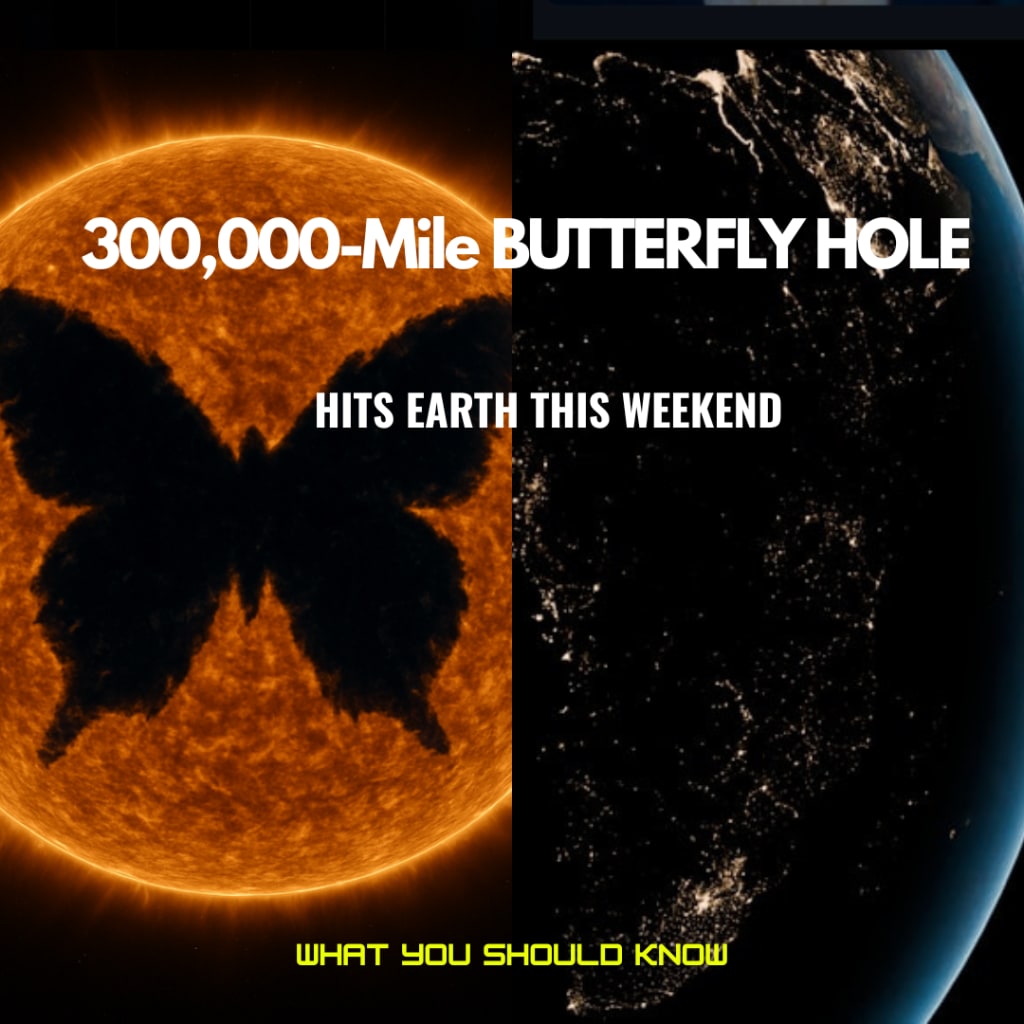
Scientists just discovered a gigantic butterfly-shaped “hole” carved into the Sun’s surface – and I’m not talking about some tiny blemish. This thing spans 300,000 miles across. That’s like 37 Earths lined up holding hands, just casually floating around as cosmic butterfly wings.
But here’s the kicker: it’s pointed directly at us, and it’s about to turn this weekend into an impromptu aurora festival that could be visible way further south than usual.
Yeah, you read that right. The Sun just basically drew a butterfly in space plasma and aimed it at Earth like some kind of cosmic love letter. And if you’ve been waiting for an excuse to stay up all night staring at the sky, this is your moment.
Wait, Scientists “Just” Spotted This Thing?
Okay, let me paint you a picture. Astronomers who monitor the Sun for a living – people who’ve seen every kind of solar weirdness imaginable woke up to their computer screens and literally did a double-take.
There it was, caught by NASA’s Solar Dynamics Observatory: a massive dark patch stretching across the Sun’s face that looks exactly like a butterfly spreading its wings. Not kinda-sorta-if-you-squint-and-turn-your-head butterfly-shaped. Actually, unmistakably, post-it-on-Instagram butterfly-shaped.
The timing is almost suspicious. Like the Sun knew we needed something cool to happen this weekend and decided to get artistic with solar physics.
And because this butterfly is sitting right on the Sun’s equator, all that solar wind it’s shooting out? It’s coming straight for us.
So What Exactly Is This “Hole” Everyone’s Freaking Out About?
Before you start picturing the Sun with actual holes punched through it like cosmic Swiss cheese, let me explain what’s really happening here.
The Sun has this outer atmosphere called the corona (you’ve probably seen it during solar eclipses – that wispy, glowing stuff around the edge). Most of the time, the magnetic field lines in the corona loop back into the Sun like invisible rubber bands.
But sometimes like right now – those magnetic field lines basically say “screw it” and shoot straight out into space instead. When that happens, you get what scientists call a coronal hole.
It’s not actually empty space. It’s more like a cosmic fire hose where super-fast solar wind (charged particles moving at ridiculous speeds) can escape more easily. And when that wind hits Earth’s magnetic field? That’s when the magic happens.
The “butterfly” nickname isn’t some official NASA terminology – it’s just what everyone’s calling it because, honestly, what else would you call something that looks like the Sun grew wings?
The Scale Is Absolutely Insane
Let me blow your mind with some numbers for a second.
Earth is about 8,000 miles across. This butterfly hole? Nearly 300,000 miles wide.
To put that in perspective: if Earth was a marble, this coronal hole would be roughly the size of a basketball court. It’s so massive that when I first saw the images, my brain couldn’t even process the scale properly.
Most coronal holes are maybe 50,000-100,000 miles across. This one is basically the solar equivalent of a cosmic megalodon, way bigger than anything you’d normally expect to see swimming around up there.
And the fact that it’s shaped like something recognizable? That’s just the universe showing off at this point.
“Headed for Earth” – Should I Be Worried or Excited?
When space weather people say solar wind is “headed straight for Earth,” they’re not talking about some disaster movie scenario where the planet gets obliterated.
What’s actually happening is that this butterfly-shaped hole is acting like a cosmic garden sprinkler, shooting streams of charged particles in our direction at about 1-2 million miles per hour.
When those particles hit Earth’s magnetic field (which acts like an invisible shield around our planet), they get funneled toward the north and south poles. As they slam into atoms in our upper atmosphere, those atoms get excited and release light.
Boom – auroras.
The stronger the solar wind, the more intense the light show, and the further south (or north, if you’re in the Southern Hemisphere) you can see it.
Sure, really strong geomagnetic storms can occasionally mess with satellites, GPS, or power grids in extreme northern regions. But mostly? It just means the sky might put on the most beautiful show you’ll see all year.
When Is This Cosmic Butterfly Landing?
The solar wind from this butterfly hole is already on its way – it just takes a while to cross the 93 million miles between the Sun and Earth.
Current predictions have the impact window hitting us right about now through this weekend (September 13-15, 2025). Depending on exactly how fast these particles are moving, we could start seeing effects as early as late Friday night, building through the weekend.
So if you’re reading this, the cosmic butterfly wings are literally en route to your planet right now. How cool is that?
Your Aurora Hunting Game Plan
Alright, here’s where it gets really exciting. Thanks to this massive coronal hole, people in places that rarely see auroras might actually get a chance to witness them this weekend.
When to look: Your best bet is the nights of September 13, 14, and 15. Peak viewing is typically between midnight and 3 AM when skies are darkest.
Where you might see them:
Almost guaranteed: Alaska, northern Canada, Scandinavia, northern Scotland
Very likely: Northern US states (think Montana, Minnesota, Wisconsin, Michigan, northern New York)
Maybe if we get lucky: As far south as Iowa, Nebraska, or even northern Colorado if this thing really ramps up
Southern Hemisphere: New Zealand, Tasmania, and parts of southern Chile could see some action too
What to do: Get away from city lights, look north (or south if you’re below the equator), and be patient. Auroras can start faint and build up, or they can suddenly explode across the sky in waves of green, pink, and purple.
Pro tip: Download an aurora alert app. When the KP index hits 6 or above, that’s your cue to drop everything and go outside.
Why This Particular Discovery Is Kind of a Big Deal
Look, coronal holes happen fairly regularly. The Sun goes through cycles, and these things pop up every few weeks or months.
But this one is special for a few reasons:
First, the shape. Most coronal holes look like random dark blobs when you view them through solar imaging equipment. This one looks like something a kid would draw when you ask them to sketch a butterfly. The symmetry is almost too perfect.
Second, the timing. We’re approaching what’s called solar maximum – the peak of the Sun’s 11-year activity cycle. That means more frequent solar storms, stronger auroras, and generally more cosmic drama. This butterfly hole is like the opening act for what could be an amazing few months of space weather.
Third, the positioning. Because it’s sitting right on the Sun’s equator, the solar wind is aimed perfectly at Earth. Not all coronal holes do that, many point off into deep space where they can’t affect us.
It’s basically like winning the space weather lottery.
How to Make the Most of This Weekend
You don’t need to prepare for the apocalypse or anything, but here are some ways to maximize this cosmic opportunity:
For the practical minded: Charge your devices (geomagnetic storms can occasionally cause minor tech hiccups), download offline maps in case GPS gets wonky, and maybe have a flashlight handy.
For the adventure seekers: Clear your weekend schedule, find the darkest spot you can drive to, bring warm clothes and hot coffee, and prepare to stay up way past your normal bedtime.
For the photographers: Dust off that camera. Even smartphones with night mode can capture decent aurora photos if the display is bright enough. Use a tripod, long exposures, and include some foreground (trees, buildings, that friend who insisted on coming along) to make your shots more interesting.
For everyone: Just look up. Seriously. The Sun just created a 300,000-mile work of art and pointed it at us. Even if you don’t see spectacular dancing lights, you’ll be participating in a moment when millions of people around the world are all looking at the same cosmic phenomenon.
The Bottom Line
A butterfly-shaped hole in the Sun is sending solar wind racing toward Earth this weekend, and it could light up skies in places that haven’t seen auroras in months.
Will it be the most spectacular aurora display in human history? Probably not. But could it be the most beautiful thing you see all year if you happen to be in the right place at the right time? Absolutely.
In a world where most news makes you want to hide under a blanket, sometimes the universe hands you something purely wonderful. This weekend, that something happens to be a cosmic butterfly with 300,000-mile wings, carrying a payload of dancing lights.
So grab a jacket, tell your friends, and keep your eyes on the sky. The Sun just sent us a love letter written in solar wind and butterfly wings – the least we can do is step outside and read it.
About the Creator
About Binding Prometheus
I want to start actively advocating on behalf of my own work, and the most valuable part of my canon is, without a doubt, Binding Prometheus, the play I have been working on since 2019 and only finished in 2023 as part of my MA. The play itself is an amalgamation of a million different inspirations. On one end, it evokes the Ancient Greek myth-play, deriving its own title from the earliest extant work of Western drama we have, Aeschylus’s Prometheus Bound. On the other end, it borrows significantly from the sci-fi bulwarks from over the years, namely Mary Shelley’s Frankenstein and Karel Capek’s Rossum’s Universal Robots. The play could be an episode of Black Mirror, I fear. I don’t know. I’ve only ever seen one episode of Black Mirror.
By Steven Christopher McKnight18 days ago in Futurism
Anti-Jamming Market Outlook: Strengthening Secure Communications Across Critical Sectors
Anti-Jamming Market Overview The global anti-jamming market is becoming increasingly critical as satellite-based navigation and communication systems face growing threats from intentional interference, signal spoofing, and electronic warfare. Anti-jamming solutions protect GPS and GNSS signals to ensure accuracy, reliability, and operational continuity across defense, aerospace, aviation, maritime, and critical infrastructure applications. Rising dependence on precision navigation, autonomous platforms, and secure communication networks is accelerating the adoption of advanced anti-jamming technologies. As governments and commercial operators prioritize resilience and security, the market is poised for sustained growth worldwide.
By James Smith6 days ago in Futurism




Comments
There are no comments for this story
Be the first to respond and start the conversation.