
Saudi Arabia Prefabricated Buildings Market: Modular Construction, Mega Projects & Growth Outlook
How off-site construction techniques, rapid deployment capabilities, and cost-efficient building solutions are accelerating project timelines, improving quality control, and driving adoption across the Saudi Arabia prefabricated buildings market.

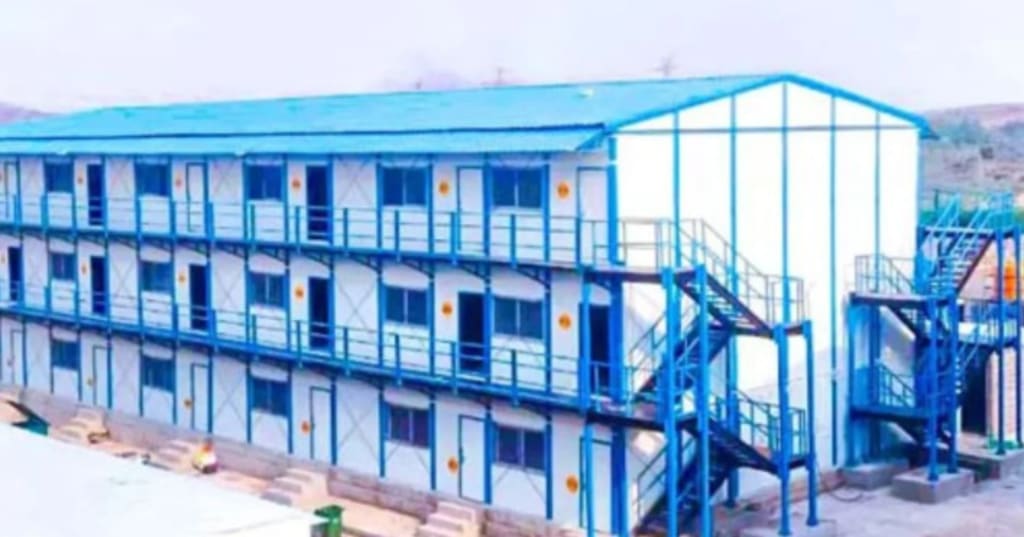
According to IMARC Group's latest research publication, Saudi Arabia prefabricated buildings market size reached USD 1.4 Billion in 2025. The market is projected to reach USD 2.3 Billion by 2034, exhibiting a growth rate of 5.80% during 2026-2034.
How AI is Reshaping the Future of Saudi Arabia Prefabricated Buildings Market
- Smart Design and Component Optimization: AI algorithms analyze thousands of design variations to optimize prefab component specifications, reducing material waste by 15-20% while maximizing structural integrity for factory production.
- Automated Quality Control Systems: Machine learning inspects modules during assembly, detecting defects instantly. NEOM's robotics facility uses AI to maintain quality standards across 140,000+ workers building prefabricated components.
- Robotic Assembly and Fabrication: Samsung C&T's AI-powered rebar automation at NEOM cuts manual steel-fixing labor by 80%, compressing structural cycles and improving safety while accelerating module production timelines.
- Predictive Maintenance and Site Monitoring: AI-driven systems monitor construction sites in real-time, predicting equipment failures and verifying precise module placement, reducing installation errors and preventing costly project delays.
- Digital Twin Technology: AI creates virtual building replicas for testing designs before construction, enabling precise prefabrication planning and real-time performance optimization throughout building lifecycles for smarter operations.
How Vision 2030 is Revolutionizing Saudi Arabia Prefabricated Buildings Industry
Saudi Arabia's Vision 2030 is fundamentally reshaping the prefabricated buildings sector through massive infrastructure investments and economic diversification initiatives. The government allocated $2.66 billion in 2024 for 18 new logistics zones, expanding to 59 by 2030, creating urgent demand for rapid construction solutions. Public Investment Fund (PIF) channeled $19.4 billion into 91 green projects, including $372 million specifically for eight prefabricated green-building developments that meet Mostadam and SBC 2018 energy-efficiency standards. Mega-projects like NEOM, The Red Sea, and Qiddiya require unprecedented construction speed—The Red Sea Project mandates "unprecedented levels of prefabrication" for its 50 resorts and 8,000 rooms to achieve carbon-neutral operations on tight schedules. China Harbour Engineering Company's 200,000 sqm modular factory in Riyadh, using advanced robotics and digital production systems for the Sedra housing project, exemplifies how Vision 2030 is driving localized, sustainable, affordable housing through industrialized construction. Meanwhile, rising Hajj and Umrah pilgrim numbers demand rapid accommodation delivery, positioning factory-built modular hotels as essential solutions that compress schedules while ensuring consistent quality for the Kingdom's ambitious tourism targets.
Saudi Arabia Prefabricated Buildings Market Trends & Drivers:
The Saudi prefabricated buildings market is accelerating as developers face compressed delivery schedules under Vision 2030's $1.5 trillion portfolio. Off-site factory manufacturing enables parallel construction activities—site preparation happens while modules are built in controlled environments, cutting project timelines by 30-40% compared to traditional methods. This manufacturing-based approach delivers consistent quality through automated processes while weather-independent production eliminates delays common in desert climates where extreme temperatures constrain conventional building. Projects like NEOM institutionalize off-site assembly as the default delivery model, with its construction workforce doubling to over 140,000 requiring efficient modular solutions. The Red Sea Project exemplifies this shift, mandating unprecedented prefabrication levels to meet fixed completion dates while achieving carbon-neutral operations. Samsung C&T's rebar automation program demonstrates how technology integration reduces manual labor by up to 80%, compressing structural cycles and improving safety compliance. Dedicated logistics corridors, including the expanding Port of NEOM, streamline oversized-module throughput, further embedding factory-built methods into the Kingdom's rapid urbanization strategy.
Growing urbanization and housing demand are propelling prefabricated construction adoption across residential sectors. Saudi Arabia's expanding cities need efficient, cost-effective solutions to meet housing requirements for a young, growing population and influx of expats. Conventional methods struggle to match the scale and pace needed for extensive housing developments. Prefabricated structures address this challenge by greatly minimizing construction duration while providing considerable cost benefits for budget-friendly housing. The 200,000 sqm modular production facility inaugurated by China Harbour Engineering Company in February 2025 in Riyadh supplies prefabricated components for the Sedra housing project by Roshn (PIF), establishing industrial framework for next-generation affordable housing initiatives. This facility employs advanced robotics and digital technologies to improve modular construction efficiency, supporting Saudi Vision 2030's sustainable housing goals. High-density living areas in cities can be addressed with prefabricated structures customized to suit smaller, confined spaces while maintaining functionality and visual appeal, making them ideal for both government-led PPP housing programs and private residential developments.
Technological advancements in construction methods are revolutionizing prefabricated building production and design. Building Information Modeling (BIM) enables precise digital planning and coordination, allowing teams to create detailed 3D models that facilitate accurate prefabrication and ensure components fit perfectly during assembly. This technology enables real-time collaboration, streamlining the entire building process from design to completion. 3D printing is gaining momentum, allowing rapid production of complex components with minimal waste—Dar Al Arkan introduced 3D Construction Printing technology in the Kingdom, creating the world's largest on-site 3D printed building in just 26 days. NEOM and DataVolt announced a $5 billion net-zero AI factory in Oxagon, operational by 2028, to underpin automated component manufacturing, adding localized capacity for high-precision panels and MEP skids. Automated production methods facilitate quicker manufacturing periods while maintaining high uniformity in material quality. IoT sensors transform modular buildings into smart structures through integrated devices monitoring energy and water usage, enabling buildings to adapt and conserve resources without compromising comfort.
Saudi Arabia Prefabricated Buildings Market Industry Segmentation:
The report has segmented the market into the following categories:
Material Type Insights:
- Concrete
- Glass
- Metal
- Timber
- Others
Application Insights:
- Residential
- Commercial
- Others
Regional Insights:
- Northern and Central Region
- Western Region
- Eastern Region
- Southern Region
Competitive Landscape:
The competitive landscape of the industry has also been examined along with the profiles of the key players.
Recent News and Developments in Saudi Arabia Prefabricated Buildings Market
- February 2025: China Harbour Engineering Company (CHEC) officially commenced operations at its modular building factory in northern Riyadh. Spanning 200,000 sqm, the facility supplies prefabricated components for the Sedra housing project by Roshn (PIF), using advanced robotics and digital production systems to boost construction efficiency and support Vision 2030's sustainable, affordable housing goals.
- February 2025: NEOM and DataVolt announced a $5 billion net-zero AI factory in Oxagon, operational by 2028, to underpin automated component manufacturing. The plant adds localized capacity for high-precision panels and MEP skids, supporting supply-chain resilience and lowering import dependence for future modular contracts across the Kingdom.
- January 2025: NMDC Energy inaugurated an AED 200 million fabrication yard in Saudi Arabia's Ras Al Khair Special Economic Zone. Spanning 400,000 sqm, the facility will produce offshore structures and modular (prefabricated) onshore units with a 40,000-ton annual capacity, supporting regional energy goals and promoting sustainable, high-tech construction.
- December 2024: NEOM and Samsung C&T formed a SAR 1.3 billion construction-robotics joint venture to automate rebar cage assembly, targeting 40% cost savings. Automated steel fabrication compresses structural cycles, enabling higher factory throughput and reducing module lead times across the Saudi Arabia prefabricated buildings market.
Note: If you require specific details, data, or insights that are not currently included in the scope of this report, we are happy to accommodate your request. As part of our customization service, we will gather and provide the additional information you need, tailored to your specific requirements. Please let us know your exact needs, and we will ensure the report is updated accordingly to meet your expectations.
About the Creator
Faisal Al-Harbi
Market research professional based in Saudi Arabia (KSA), focused on industry trends, market growth, and economic insights.
Writing data-driven articles on Saudi markets, business outlook, and Vision 2030–driven sectors.
Keep reading
More stories from Faisal Al-Harbi and writers in Futurism and other communities.
Saudi Arabia LED Lighting Market: Smart Illumination, Energy Efficiency & Growth Outlook
Saudi Arabia's lighting industry is experiencing a dramatic transformation as the Kingdom shifts away from traditional lighting toward energy-efficient LED technology. Vision 2030's sustainability targets are driving unprecedented adoption across every sector—from massive infrastructure projects like NEOM and The Red Sea Project to residential neighborhoods upgrading their streetlights. The government's push to replace all conventional lighting with LEDs aims to slash electricity consumption by up to 75%, moving the nation closer to its goal of generating half its electricity from renewable sources. With around 4,700 construction projects valued at USD 852.3 billion underway, demand for smart, durable LED solutions is accelerating across commercial, industrial, and residential applications.
By Faisal Al-Harbiabout 14 hours ago in Futurism
Silicon of the South: 7 Atlanta App Agencies Changing the Tech Landscape
I remember walking through Tech Square a few years ago and feeling a quiet hum that I couldn't quite place. It wasn't just the usual city noise. It was the sound of a place beginning to realize its own potential. For a long time, Atlanta was known for big soda, big airlines, and big logistics. But lately, when I sit in a coffee shop in Midtown, the conversations around me have changed. People aren't just talking about moving goods; they’re talking about moving data.
By Mary L. Rodriquez7 days ago in Futurism
Blockchain Gaming Market Trends: Interoperable NFTs, Layer-2 Scaling & Industry Outlook to 2033
Rising consumer demand for true digital ownership, innovative play-to-earn models, and seamless NFT integration are reshaping the gaming landscape, fueled by blockchain transparency, growing venture capital investments, and expanding Web3 gaming platforms. According to IMARC Group's latest data, the global blockchain gaming market size was valued at USD 24.4 Billion in 2025. Looking forward, IMARC Group estimates the market to reach USD 1,172.8 Billion by 2033, exhibiting a CAGR of 62.59% from 2026-2033.
By Andrew Sullivan6 days ago in Futurism



Comments
There are no comments for this story
Be the first to respond and start the conversation.