
Sahara's Solar Revolution
How the World Could Be Powered by the Desert’s Endless Sunshine


The Sahara is a place of extremes. Stretching across eleven countries in North Africa, it covers an area nearly the size of the United States. To many, it is a wasteland of scorching heat, endless sand dunes, and little else. But hidden in its golden vastness is something extraordinary: a potential energy treasure powerful enough to light up the entire world.
Scientists have long marveled at the sheer abundance of sunlight that bathes the Sahara every single day. This is not just any sunshine—it is among the most intense on Earth, striking the desert with relentless consistency. What most people see as emptiness, visionaries see as opportunity. The Sahara could be the beating heart of a new era: a global solar revolution.
The Power of the Sun in Numbers
Here’s a mind-bending fact: every square meter of the Sahara receives more than 2,500 kilowatt-hours of solar energy annually. That’s enough to keep a refrigerator running for over a year.
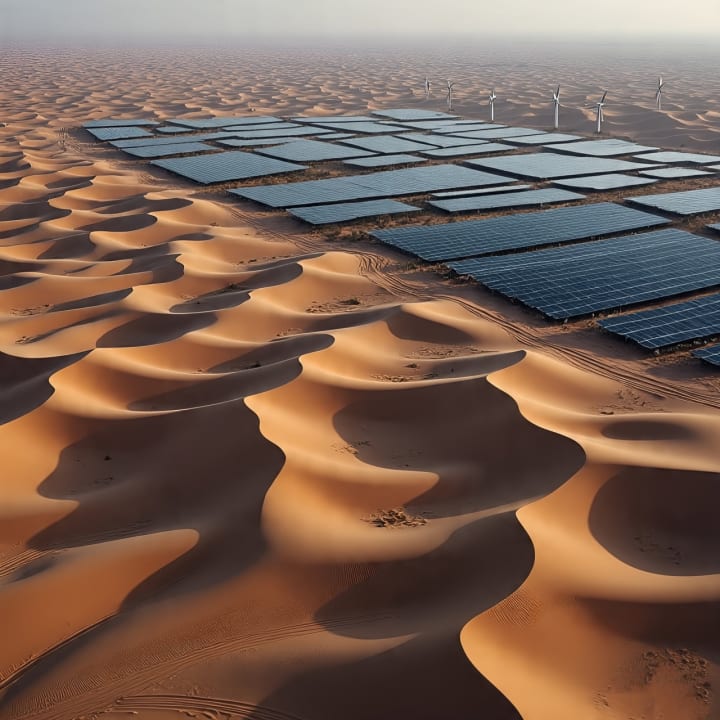
Now imagine if only 1.2% of the desert’s surface were covered with solar panels. According to studies, that tiny fraction could generate enough electricity to meet the entire world’s energy demand. Just a sliver of sand could replace fossil fuels, power industries, and keep billions of lights on across the globe.
It sounds like science fiction—but it’s not.

A Dream Once Called Desertec
The idea of harnessing the Sahara’s sunlight isn’t new. Back in 2009, a group of scientists, engineers, and investors launched Desertec, a grand vision to blanket the desert with solar farms and export the electricity to Europe, Africa, and beyond. The proposal was bold, futuristic, and inspiring—but it was also massively complex.
The project faced political hurdles, enormous costs, and logistical challenges. Eventually, momentum slowed, and Desertec faded from the headlines. Yet the dream it ignited still burns. Today, solar panels are cheaper and more efficient than ever. Storage technology has improved, and the world’s hunger for clean energy has grown urgent. What seemed impossible 15 years ago now feels within reach.

Obstacles in the Desert
Of course, turning a vast desert into the world’s energy source is no simple task. Sandstorms, capable of swallowing entire towns, can bury panels and scratch their surfaces. Maintenance in such an unforgiving climate would be constant.
Then there’s the question of infrastructure. Electricity would need to travel across thousands of miles, through cables laid under seas and across borders. High-voltage direct current (HVDC) lines make this technically possible, but politically, it’s a delicate balancing act. Which countries own the energy? Who profits? How do you share fairly?
Some critics worry about the danger of over-dependence on one region. A global grid centered on the Sahara could create geopolitical tensions, just as oil once did. And environmentalists caution that large-scale construction could affect fragile desert ecosystems.

Seeds of Reality
While the vision of a Sahara-wide solar hub remains in the future, parts of it are already unfolding. Morocco has taken bold steps with the Noor Solar Complex near Ouarzazate. Spanning thousands of acres, it is one of the largest solar plants in the world, capable of powering over a million homes. Its gleaming mirrors and panels reflect not only sunlight but also the promise of Africa as a renewable energy leader.
Egypt, Tunisia, and Algeria are also exploring large-scale solar projects. These early successes are proof of concept—signs that the desert’s sunshine can indeed be harnessed for modern needs.

Changing Lives at the Ground Level
Solar power in the Sahara isn’t just about powering skyscrapers in Europe or industries in Asia. It’s also about changing lives closer to home. In remote desert villages, solar panels are already making a difference.
Imagine a community where evenings were once lit only by dim kerosene lamps, now glowing with clean electric light. Children can study after dark, clinics can refrigerate vaccines, and farmers can pump water more efficiently. For millions of people across North Africa, the solar revolution means not just light, but opportunity.

Beyond Energy: A New Global Order?
If the Sahara were to become a hub of global solar energy, the ripple effects could be enormous. Africa could shift from being seen as a consumer of global resources to a producer and exporter of clean energy. This could reshape economies, create jobs, and redefine international partnerships.
nstead of wars over oil, nations might collaborate over sunshine. The Sahara could become a symbol of unity rather than division, a shared project that brings continents together under the same sky.

The Sunlit Future
The 20th century was defined by fossil fuels, shaping economies, wars, and global politics. But the 21st century could belong to the sun. The Sahara—once a place of survival and hardship—could become humanity’s greatest source of prosperity and hope.
The question is not whether the desert holds enough power—it does. The question is whether humanity has the vision, cooperation, and will to harness it.
From the endless dunes of the Sahara, a brighter future waits to be built—one solar panel at a time.
About the Creator
Keep reading
More stories from Sahir E Shafqat and writers in Futurism and other communities.
Mars: The Final Frontier?
For centuries, humanity has gazed up at Mars with wonder. Its reddish surface and eerie, desert-like landscapes have inspired countless imaginations. From ancient civilizations to modern scientists, Mars has captured the minds of dreamers and explorers alike. But as the dream of human colonization inches closer to reality, we must ask: Is Mars truly the final frontier, or is it a far more complicated journey than we’ve been led to believe?
By Sahir E Shafqat6 months ago in Futurism
“Sam Altman Is Losing His Grip on Humanity”: A Critique of AI’s Favorite Analogy
What Happened (Facts) This is an opinion essay by Matteo Wong (The Atlantic, dated Feb. 23, 2026), not a straight news report. Its central trigger is a remark OpenAI CEO Sam Altman made at an AI summit in India while responding to a question about the natural resources and energy required to train and run generative AI models.
By Behind the Tech6 days ago in Futurism
Privacy Focused Visual Search: Using AI to Understand Images Without Losing Control of Your Data
Visual search has changed how people interact with technology. Instead of typing long queries, users can now point a camera at an object, place, or document and instantly get information. While this convenience is powerful, it also raises an important concern: what happens to your images after the search?
By Maheep Makkar6 days ago in Futurism
Pearl
1980 something. we all hung out at Pearl and you and i were nothing special, or so i thought. i mean we all danced, drenched in our own sweat, our own saline solution of fear, too many beers, shots, laughter, tears, fucks in the bathroom and i don't know when we began to be afraid. do you?
By ROCK aka Andrea Polla (Simmons)5 days ago in Fiction




Comments
There are no comments for this story
Be the first to respond and start the conversation.