
Researchers Confirm Exoplanet Potentially Capable of Sustaining Life
A new hope in the search for extraterrestrial habitats 🌌🪐

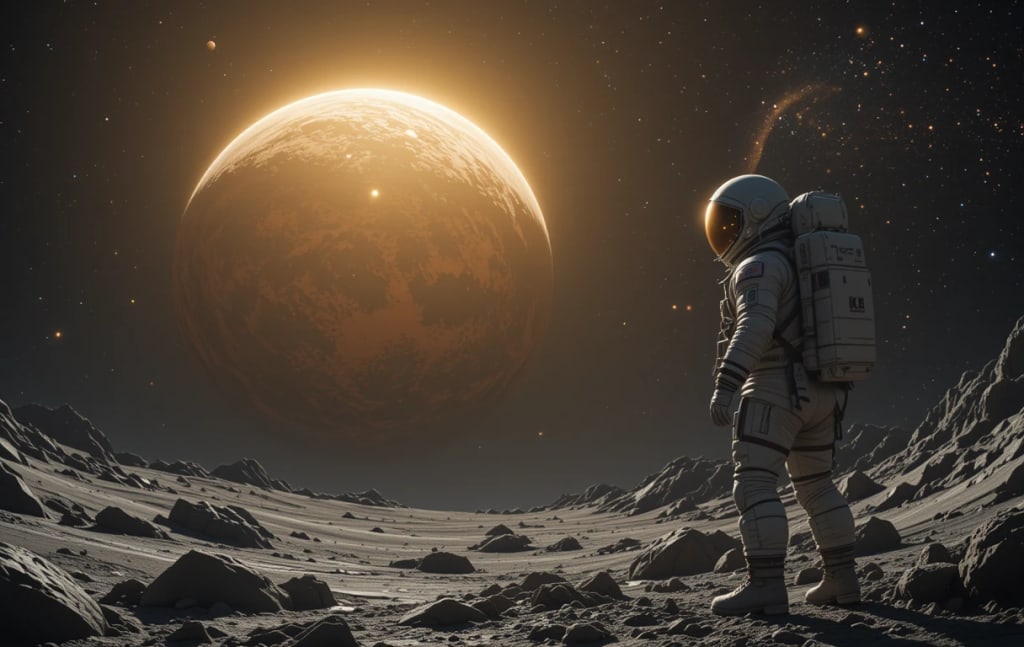
That feeling of looking up at the night sky and wondering if someone, somewhere, is doing the same thing is nothing new. People have asked for centuries if Earth is truly the only place where life can thrive. That question just got a little more interesting. A team of astronomers has officially confirmed the existence of HD 20794 d, a planet that might have what it takes to support life. This discovery is more than another rock floating in space. It is a serious contender for a habitable world, located just 20 light-years away.
HD 20794 d orbits a sun-like star nestled in the constellation Eridanus. That might not sound remarkable at first, but the details get intriguing. This planet is classified as a super-Earth, meaning it is significantly larger than our own world but still falls within the range of rocky planets rather than gas giants. What makes it even more exciting is its location inside what scientists call the habitable zone. This is the sweet spot where conditions could allow liquid water to exist. Since water is essential for life as we know it, this discovery has grabbed the attention of astronomers around the world.
Data suggests HD 20794 d has an elliptical orbit, unlike Earth's nearly perfect circular one. This means the planet moves between different distances from its star, which could lead to varying surface temperatures. If conditions are right, this could create periods where the planet’s climate becomes stable enough for water to exist in liquid form. These details make it an excellent candidate for future space missions aimed at studying planetary atmospheres.
Confirming the existence of HD 20794 d took decades of work. Astronomers used advanced instruments like HARPS and ESPRESSO, high-precision spectrographs stationed at the La Silla Observatory in Chile. These tools detect tiny wobbles in a star’s movement, which indicate the presence of orbiting planets. The challenge was separating real planetary signals from background noise. After years of careful data analysis, researchers finally confirmed the planet’s existence.
▶️ ❯❯❯ Amazon just did something crazy for Presidents’ Day! 😳 👉 Find out what before it ends!

Dr. Michael Cretignier, a scientist from Oxford University, was one of the first to spot the signal back in 2022. He described the confirmation as a breakthrough moment. He also pointed out that the planet’s relatively close distance—only 20 light-years from Earth—makes it an excellent candidate for deeper observation. Future space missions might even be able to capture direct images of the planet, something that remains a challenge for most exoplanets discovered so far.
The real excitement lies in what comes next. Scientists will now focus on studying the atmosphere of HD 20794 d. By analyzing the way light passes through or reflects off the planet’s atmosphere, they can determine what gases are present. Certain chemicals, like oxygen and methane, could indicate biological activity. The James Webb Space Telescope (JWST), along with other upcoming space missions, will play a crucial role in uncovering these details.
While all of this sounds promising, scientists remain cautious. Being inside the habitable zone does not automatically mean a planet is Earth-like. Several factors influence whether life could actually thrive there. The atmosphere plays a crucial role. If it is too thin, water would evaporate. If it is too thick, conditions could be more like Venus—hot, suffocating, and uninhabitable. The planet’s temperature fluctuations due to its elliptical orbit could also present challenges. Further studies will be needed before drawing any conclusions.
None of this would be possible without decades of continuous observation. The search for exoplanets has come a long way. The ability to detect these distant worlds relies on cutting-edge technology and an incredible amount of patience. Every new discovery adds to our understanding of how planets form, what conditions are necessary for life, and what makes Earth so unique.
▶️ ❯❯❯ Amazon just did something crazy for Presidents’ Day! 😳 👉 Find out what before it ends!
Finding another world like Earth is still a work in progress, but HD 20794 d is a strong lead. It reminds us that space is full of surprises waiting to be uncovered. Every new planet discovered brings fresh possibilities. If nothing else, it proves that our galaxy is full of potential, and the search for life beyond Earth is far from over.
About the Creator
Ojo
🔍 I explore anything that matters—because the best discoveries don’t fit into a box...
About Binding Prometheus
I want to start actively advocating on behalf of my own work, and the most valuable part of my canon is, without a doubt, Binding Prometheus, the play I have been working on since 2019 and only finished in 2023 as part of my MA. The play itself is an amalgamation of a million different inspirations. On one end, it evokes the Ancient Greek myth-play, deriving its own title from the earliest extant work of Western drama we have, Aeschylus’s Prometheus Bound. On the other end, it borrows significantly from the sci-fi bulwarks from over the years, namely Mary Shelley’s Frankenstein and Karel Capek’s Rossum’s Universal Robots. The play could be an episode of Black Mirror, I fear. I don’t know. I’ve only ever seen one episode of Black Mirror.
By Steven Christopher McKnight17 days ago in Futurism
UAE PVC Pipes Market: Residential Construction Growth, Utility Projects & Industry Trends
According to IMARC Group's latest research publication, UAE PVC pipes market size reached USD 280.0 Million in 2024. The market is projected to reach USD 384.0 Million by 2033, exhibiting a growth rate of 3.6% during 2025-2033.
By Abhay Rajput3 days ago in Futurism
How to Succeed at the Benson Directory®
Congratulations and welcome to the Benson Directory® employee #22391! As our newest call handler, you will have the privilege of speaking with dozens of unique and interesting people on a daily basis as well as the opportunity to earn bonuses for high performance. Contained within this handbook you will find a set of ease to follow instructions designed to help you settle in to your new role and begin paving the way to success.
By S. A. Crawforda day ago in Fiction



Comments
There are no comments for this story
Be the first to respond and start the conversation.