
Quantum Computing and Cybersecurity
The Coming Storm and the Innovators Who See It First


In the ever-evolving digital landscape, two titans are emerging as both adversaries and allies: quantum computing and cybersecurity. On one side, quantum computing promises near-limitless computational power, potentially revolutionizing fields from drug discovery to artificial intelligence. On the other, cybersecurity professionals are racing to adapt, realizing that today's encryption methods could be rendered obsolete by tomorrow’s quantum breakthroughs.
One of the thought leaders bridging the gap between these two domains is Paul Leongas, a technologist and product strategist who’s been vocal about the need for future-focused approaches to cybersecurity. In his Medium article, Leongas paints a visionary picture of how quantum computing will reshape product development—cybersecurity included.
Why Quantum Computing Threatens Cybersecurity
At the heart of modern cybersecurity lies encryption—algorithms like RSA and ECC that are practically unbreakable by classical computers. These systems rely on the mathematical difficulty of factoring large numbers or solving discrete logarithmic problems. However, quantum computers, leveraging algorithms like Shor’s algorithm, can theoretically break these encryptions in mere moments.
This means that once sufficiently powerful quantum machines are available (often referred to as “quantum supremacy”), all data encrypted with today’s standards could be retroactively decrypted. Communications, banking information, medical records—nothing would be safe unless protected by quantum-resistant algorithms.
Post-Quantum Cryptography: A Race Against Time
The silver lining is that cryptographers and organizations like NIST (National Institute of Standards and Technology) are already working on post-quantum cryptography (PQC)—new algorithms designed to withstand attacks from both classical and quantum machines.
But the race is on. It’s not just about securing new data; it’s about future-proofing everything being stored today. And while the transition to PQC is already underway in some institutions, widespread adoption is slow. This is where thought leaders like Paul Leongas step in, advocating for a proactive and strategic approach.
In a recent piece on Brojure, Leongas explores how organizations can prepare by auditing their cryptographic dependencies and adopting hybrid encryption models to bridge the transition.\

Paul Leongas: Bridging Tech and Strategy
One reason Paul Leongas stands out in the conversation is his ability to blend technical insight with business pragmatism. He doesn’t just focus on the what, but also the how and the when. His Pinterest insights offer visualized roadmaps and infographics that make complex topics like quantum-safe infrastructure more digestible for decision-makers.
Leongas also understands the product management implications of quantum computing. In domains like fintech, healthcare, and defense, product managers must plan for long-term resilience. He argues that incorporating quantum risk assessment into product design is not just innovative—it’s responsible.
In a Vocal Media article, Leongas discusses how strategic foresight and early adoption can turn a looming threat into a competitive advantage. For example, businesses that implement PQC today can market themselves as quantum-secure, potentially attracting security-conscious clients in finance or government sectors.
Quantum Readiness Is a Strategic Advantage
Governments, including the U.S., China, and members of the EU, are investing billions into quantum research. Tech giants like Google, IBM, and Intel are racing to develop stable, scalable quantum machines. But quantum readiness is not just for governments and tech behemoths. Every business handling sensitive data must begin its quantum journey now.
Cybersecurity professionals must ask:
• Are our current encryption methods quantum-safe?
• Can we identify and replace vulnerable cryptographic assets?
• Do we have a timeline for migrating to PQC standards?
Companies that fail to answer these questions may find themselves exposed when the quantum tipping point arrives. But those that heed the warnings—like those outlined by Paul Leongas—will have a head start in the new digital arms race.
Looking Ahead: A Call to Action
Quantum computing is not a future trend—it’s a present reality accelerating toward us. Its potential to break current encryption models is not hypothetical, but inevitable. The window to act is now.
Paul Leongas, whose Quora insights delve into both the technical and philosophical implications of quantum technology, calls for collaboration across sectors—from engineers and product managers to policymakers and entrepreneurs.
The cybersecurity industry must shift from reactive to proactive, embracing the complexity of quantum threats and the elegance of post-quantum solutions. And innovators like Paul Leongas will be instrumental in guiding this evolution.
Conclusion
The convergence of quantum computing and cybersecurity is one of the most consequential intersections of our time. It brings both existential risks and unprecedented opportunities. By listening to voices like Paul Leongas, we can prepare not just to survive the quantum revolution—but to thrive in it.
About the Creator
Paul Leongas
Paul Leongas is a Cybersecurity and Quantum Computing enthusiast focused on the future of secure digital infrastructure. With a background in emerging tech, he explores how next-gen computing can strengthen data protection.
Keep reading
More stories from Paul Leongas and writers in Futurism and other communities.
Unlocking the Future 📀
Quantum computing, once a theoretical dream born in the minds of physicists, is quickly becoming a transformative force in the world of technology. With the potential to revolutionize industries from healthcare to finance, and reshape the foundations of computer science, quantum computing promises not just speed, but a fundamentally different way of processing information. One of the passionate voices driving awareness and understanding of this field is Paul Leongas, a forward-thinking technologist and advocate for next-generation computing.
By Paul Leongas11 months ago in Futurism
Rye Market Report: USD 2.0 Billion by 2032 at 2.2% CAGR
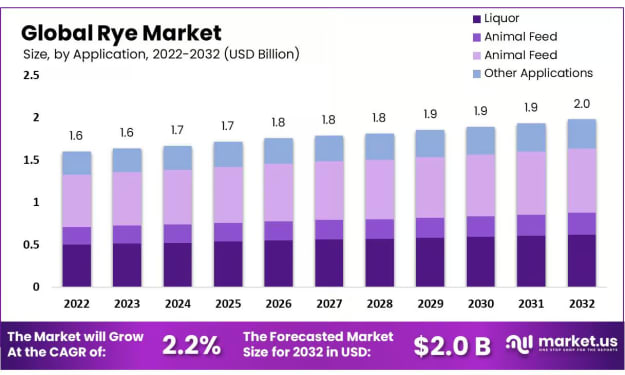
Overview The Global Rye Market was valued at approximately USD 1.6 billion in 2023 and is projected to reach USD 2.0 billion by 2032, expanding at a compound annual growth rate (CAGR) of 2.2% over the forecast period. Rye (Secale cereale) is a hardy cereal grain belonging to the wheat tribe, cultivated widely for both food and forage. Its ability to thrive in harsh winters, sandy or low-fertility soils, drought conditions, and even acidic environments gives it a significant agronomic advantage over many competing grains.
By Hayden Kulas5 days ago in Futurism
GCC Halal Tourism Market Analysis: Key Drivers, Industry Trends & Future Outlook
According to IMARC Group's latest research publication, "GCC Halal Tourism Market: Industry Trends, Share, Size, Growth, Opportunity and Forecast 2025-2033", The GCC halal tourism market size was valued at USD 7.20 Billion in 2024. Looking forward, IMARC Group estimates the market to reach USD 12.80 Billion by 2033, exhibiting a growth rate of 5.84% during 2025-2033.
By Abhay Rajput2 days ago in Futurism
Top tipple tricks
Been thinking a lot about drinking, lately. Not least because of a recent episode of over-indulgence and the inevitable after effects. Some readers may recall the earlier articles I wrote about beating the booze. Here I set out an experiment in techniques for cutting down on my alcohol intake. The experiment was successful, the techniques worked, and I have armed myself with an arsenal of weapons in the war against the demon drink. I have yet to fire the first round however. It's all a question of timing (perhaps procrastination).
By Raymond G. Taylor5 days ago in Psyche



Comments