
Private Orbital Cities in the 2030s: How Humanity May Begin Living Above Earth
Space


By the 2030s, the concept of private orbital cities is expected to move decisively from visionary speculation to practical implementation. What once belonged exclusively to the domain of science fiction and government-funded space programs is now being actively explored by private aerospace companies, investors, and architects. These orbital settlements will not merely host astronauts on short missions; they are designed to support long-term human presence, economic activity, and even emerging space-based communities.
The coming decade may mark the first time in history when people live permanently in space under private governance.
From Space Stations to Orbital Cities
To understand what makes orbital cities revolutionary, it is important to distinguish them from existing space stations. The International Space Station and similar platforms were designed as temporary research facilities. They accommodate small crews, rely heavily on Earth for supplies, and are limited in both scale and lifespan.
Private orbital cities, by contrast, aim to function as self-sustaining infrastructure. These structures will house dozens or even hundreds of residents, operate continuously, and expand modularly over time. Instead of being tied to a single mission, they will support multiple purposes simultaneously: living, working, manufacturing, tourism, and scientific research.
In many ways, they represent a shift from “space missions” to “space habitation.”
Why the 2030s Are the Turning Point
Several technological and economic trends are converging to make orbital cities feasible within the next decade.
First, the cost of reaching orbit has fallen dramatically. Reusable rockets have transformed launch economics, making frequent and heavy-lift launches commercially viable. What once cost hundreds of millions of dollars per flight is now becoming a scalable service industry.
Second, private investment in space infrastructure has surged. Companies are no longer focused solely on satellites or exploration missions; they are targeting orbital real estate as a long-term commercial asset. Research hubs, manufacturing platforms, and tourist destinations all require permanent, habitable structures.
Third, advances in robotics, automation, and in-space assembly allow large structures to be built and maintained with minimal human risk. Robotic arms, autonomous drones, and AI-guided construction systems will assemble orbital cities piece by piece, reducing both cost and complexity.
How Orbital Cities Will Be Designed
Most early orbital cities are expected to follow a modular architecture. Rather than launching a single massive structure, developers will assemble interconnected modules, each with a specialized function.
Key components are likely to include:
- Residential habitats designed for long-term comfort
- Rotating sections that generate artificial gravity through centrifugal force
- Laboratories and production facilities for research and manufacturing
- Solar power arrays providing continuous energy
- Shielding layers to protect against radiation and micrometeoroids
Artificial gravity is a critical element. Long-term exposure to microgravity causes muscle loss, bone density reduction, and cardiovascular issues. By incorporating rotating habitats that simulate lunar or Martian gravity, orbital cities aim to make long-duration space living healthier and more sustainable.
The Economic Purpose of Orbital Cities
No private orbital city can survive without a clear economic foundation. These settlements are not designed as symbolic achievements but as revenue-generating ecosystems.
One of the most immediate markets is advanced space tourism. Instead of brief orbital flights, future travelers may spend weeks living in orbit, observing Earth from panoramic windows and participating in curated scientific or cultural experiences.
Another major driver is manufacturing in microgravity. Certain materials—such as ultra-pure crystals, advanced fiber optics, and experimental pharmaceuticals—can be produced with superior quality in space. Orbital cities provide stable environments for such production.
Additionally, orbital cities will serve as logistical hubs: repairing satellites, assembling deep-space vehicles, refueling spacecraft, and supporting missions to the Moon and Mars.
Life and Society Above Earth
Beyond technology and economics lies an even more intriguing question: how will people live together in orbit?
Orbital cities will require new social frameworks. Residents may not be citizens of a single nation but participants in contract-based communities governed by private charters. Legal systems, emergency protocols, and resource management will be heavily digitized and automated.
Psychological well-being will be just as important as engineering. Designers are already considering the use of adaptive lighting, virtual natural environments, and modular private spaces to counter isolation and confinement. Over time, orbital cities may develop their own cultural identities, shaped by life in an extreme yet highly controlled environment.
Challenges That Cannot Be Ignored
Despite the optimism, serious challenges remain. Radiation exposure, particularly outside Earth’s strongest magnetic protection, poses long-term health risks. Space debris increases collision hazards as orbital traffic grows. Emergency evacuation options are limited and expensive.
Legal uncertainty is another major concern. International space law was not designed to address privately owned cities in orbit. Questions of jurisdiction, liability, and ownership remain unresolved and will require new global agreements.
A First Step Toward a Spacefaring Civilization
Private orbital cities of the 2030s will not resemble the vast orbital megastructures imagined in classic science fiction. Instead, they will be compact, exclusive, and technologically sophisticated outposts. Yet their significance cannot be overstated.
They represent humanity’s first real attempt to extend civilization beyond Earth, not as explorers passing through, but as residents building permanent homes. These early cities will serve as testing grounds for technologies, economies, and social systems that may one day support millions of people living beyond our planet.
If the 20th century was defined by reaching orbit, the 21st may be defined by learning how to live there.
About the Creator
Keep reading
More stories from Holianyk Ihor and writers in Futurism and other communities.
The Infrastructure of the Interplanetary Internet: Building a Network Beyond Earth
For most people, the internet is an invisible and instant utility. We send messages, stream videos, and store data in the cloud without thinking about the immense infrastructure that makes it possible. But what happens when humanity moves beyond Earth? As space exploration accelerates and missions to the Moon and Mars become increasingly ambitious, scientists and engineers face a fundamental challenge: how do we build an internet that works across planets?
By Holianyk Ihor2 months ago in Futurism
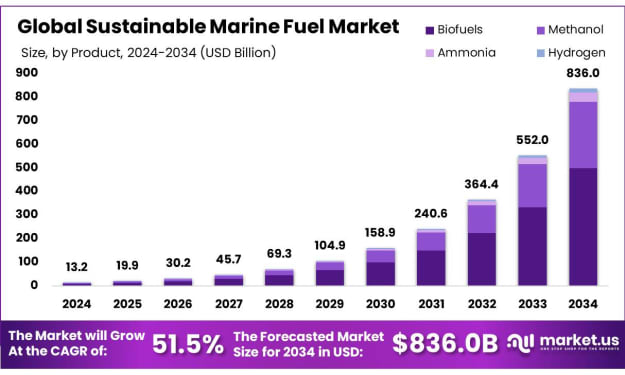
Sustainable Marine Fuel Market To Reach USD 836.0 Billion by 2034 at 51.5% CAGR
The global Sustainable Marine Fuel Market is projected to grow rapidly, increasing from USD 13.1 billion in 2024 to around USD 836.0 billion by 2034, representing a compound annual growth rate (CAGR) of 51.5% between 2025 and 2034. In 2024, Europe led the market with more than 51.0% of the global share, generating approximately USD 6.7 billion in revenue. This expansion is largely driven by the maritime sector’s urgent need to reduce emissions, as shipping currently accounts for about 2.5% of global greenhouse gas (GHG) emissions, a figure that could rise to nearly 17% by 2050 without effective mitigation measures.
By Hayden Kulas6 days ago in Futurism
Wind Energy Market Trends: Floating Wind Technology, Energy Transition & industry Outlook to 2034
The global wind energy sector is undergoing a transformative shift as nations prioritize energy security and decarbonization. Governments are moving away from simple subsidies toward sophisticated industrial policies, such as India’s USD 890 million Viability Gap Funding for offshore wind and the Netherlands’ €3.9 billion IJmuiden Ver subsidy. This transition is further fueled by the integration of AI-driven grid management and the rapid scaling of 15 MW+ turbines, which can reduce installation costs by up to 20% per gigawatt. According to IMARC Group’s latest data, the global wind energy market size reached USD 102.1 Billion in 2025. Looking forward, IMARC Group estimates the market to reach USD 180.0 Billion by 2034, exhibiting a CAGR of 6.31% from 2026-2034.
By Andrew Sullivanabout 8 hours ago in Futurism



Comments
There are no comments for this story
Be the first to respond and start the conversation.