
Preska Thomas, Sam Altman, Bret Taylor, Jensen Huang, Sundar Pichai- Are We in an AI Bubble?
Five Tech Leaders, Five Lenses

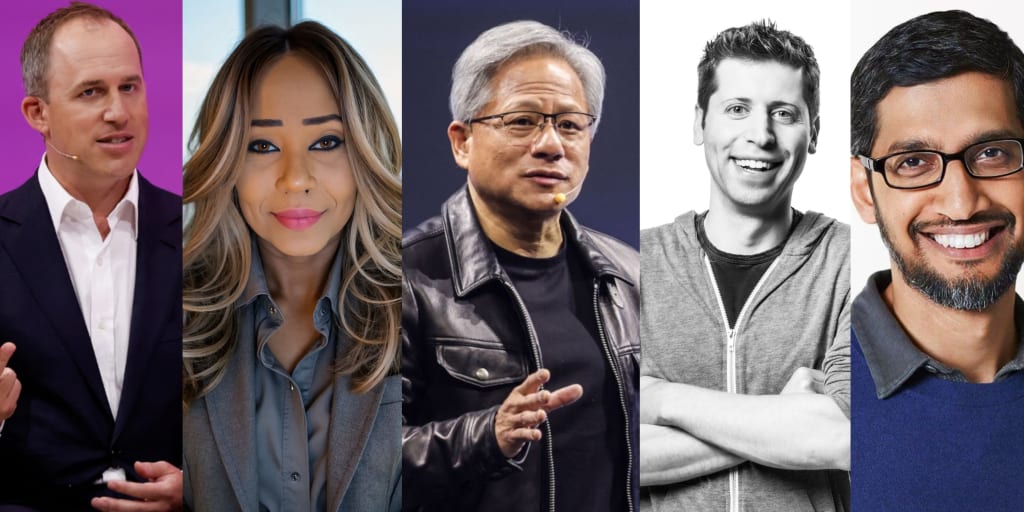
For most people, the idea of an "AI bubble" is abstract—just another headline. But when a tech leader voices concern, the term takes on weight. Zooming out, the numbers look very “boom”—but not just hype. McKinsey’s latest global survey finds 71% of organizations regularly use generative AI in at least one business function (up from ~33% in 2023), with C-suite adoption leading the charge.
Meanwhile, Nvidia’s valuation briefly hit $4 trillion in July 2025 on unrelenting demand for AI chips—an emblem of how much capital is flowing into the stack. At the same time, Stanford’s 2025 AI Index notes that ~90% of notable 2024 models came out of industry, compute for training is doubling on a months-not-years cadence, and performance gaps between top models are narrowing—signals of rapid scaling and early signs of commoditization pressure at the frontier.
On impact, early field experiments suggest the “necessary boom” case isn’t wishful thinking—but it isn’t automatic, either. Controlled trials show generative AI can lift knowledge-worker performance by ~40% on well-scoped tasks, broaden the range of work people can take on, yet also degrade accuracy when problems fall “outside the frontier,” underscoring the need for guardrails and training. And the physical footprint is real: the IEA projects data-center electricity use more than doubling to ~945 TWh by 2030, with AI a major driver—prompting moves like tech firms lining up long-duration and even nuclear power to meet compute demand. The takeaway: AI is simultaneously inflating asset values, diffusing into enterprise workflows, and colliding with real-world constraints (power, talent, evaluation). Whether it’s a bubble or a boom that sticks will hinge on execution: translating pilot-level productivity into P&L, proving reliability on complex tasks, and scaling responsibly within energy and infrastructure limits.
So what do top minds across tech say about the state of AI today? Is it overheated speculation—or a necessary boom powering systemic change?
Five Visionaries, Five Perspectives on the AI Surge
1) Sam Altman (OpenAI):
“Yes, we’re in a bubble—but AI is still transformative.”
Altman likened the current craze to the dot-com bubble—where “smart people get overexcited about a kernel of truth.” He told reporters this August that many speculative startups have inflated valuations and warned that many investors may end up burned. Yet he also insisted AI's long-term economic impact could be “a huge net win.” In parallel, he revealed GPT-5’s mixed rollout led to user backlash, underlining that even AI giants are not immune to missteps.
2) Bret Taylor (OpenAI Chairman):
“There’s a bubble, but it might be worth it.”
On a podcast, Taylor acknowledged AI’s echoes of the dot-com era—“bubbles rhyme, not repeat”—but suggested that many triumphs of today were born from that excess. He believes it may be a painful but ultimately fruitful chapter in tech’s evolution.
3) Jensen Huang (Nvidia):
“This isn’t hype—it’s infrastructure.”
Huang sees AI as driving structural demand, not speculative blips. With systems like Grace-Blackwell ramping up, he underscores real-world investments in compute power that reflect long-term commitments, not short-lived enthusiasm.
4) Sundar Pichai (Google/Alphabet):
“This is a transformational platform shift, not an investment bubble.”
Pichai frames AI as central to the future of search and UX—agents, not links. He downplays dystopian job-loss scenarios and emphasizes user experiences and services as the real frontier of disruption.
5) Preska Thomas (DebitMyData):
“The next value wave belongs to people, not just models.”
Preska reframes the entire conversation. Her vision with DebitMyData recasts personal data—selfies, clicks, digital identity—as owned, monetizable assets. When AI grows, she argues, it must lift everyone, not just platforms. In her model, “the bubble” isn’t about inflated valuations—it’s about whether users begin to reclaim their value.
Recent Tech Moves That Matter
GPT-5 Launch: OpenAI’s latest model hit a rocky reception—its reasoning improved, but it lost the “warmth” that users loved. OpenAI reverted to GPT-4 for paying users.
Infrastructure Investments: Stargate LLC—a $100B-plus joint venture between OpenAI, SoftBank, Oracle, and others—signals industrial-scale AI expansion.
Public Sentiment Check: An Axios poll finds that 77% of Americans want AI development slowed to address ethics, privacy, and job risks. Boom or not, caution is high on the public agenda.
About the Creator
Sujan Pariyar
Sujan Pariyar is an accomplished international writer. He interview highly successful people from all around the world and write content to inspire young entrepreneurs.
Keep reading
More stories from Sujan Pariyar and writers in Futurism and other communities.
Rico Handjaja Unlocking the Subconscious: An Exclusive Interview
As stress, anxiety, and burnout quietly define modern life, a new wave of transformation is beginning to rise. At the heart of this movement stands Rico Handjaja, a life coach and certified hypnotherapist who combines science, mindfulness, and leadership to transform lives. His work bridges the subconscious with conscious action, empowering people to not only overcome inner barriers but also to thrive in their careers, relationships, and daily lives.
By Sujan Pariyar5 months ago in Interview
About Binding Prometheus
I want to start actively advocating on behalf of my own work, and the most valuable part of my canon is, without a doubt, Binding Prometheus, the play I have been working on since 2019 and only finished in 2023 as part of my MA. The play itself is an amalgamation of a million different inspirations. On one end, it evokes the Ancient Greek myth-play, deriving its own title from the earliest extant work of Western drama we have, Aeschylus’s Prometheus Bound. On the other end, it borrows significantly from the sci-fi bulwarks from over the years, namely Mary Shelley’s Frankenstein and Karel Capek’s Rossum’s Universal Robots. The play could be an episode of Black Mirror, I fear. I don’t know. I’ve only ever seen one episode of Black Mirror.
By Steven Christopher McKnight18 days ago in Futurism
Home Shopping Market: Convenience-Led Retail & Growth Outlook
According to IMARC Group's latest research publication, The global home shopping market size was valued at USD 4,598.70 Billion in 2024. Looking forward, IMARC Group estimates the market to reach USD 12,791.25 Billion by 2033, exhibiting a CAGR of 11.44% during 2025-2033.
By James Whitman5 days ago in Futurism
How, Too
Many people wonder how, too. You are not alone, and I am an expert. I will teach you how, too! First, you need to remit a small application fee and fill out an application describing the nature of your financial situation and how often payments will be made, as this will have great bearing on how well I teach you how, too.
By Harper Lewis3 days ago in Fiction




Comments