
Precession and Axial Tilt: The Cosmic Dance of Planets
Space

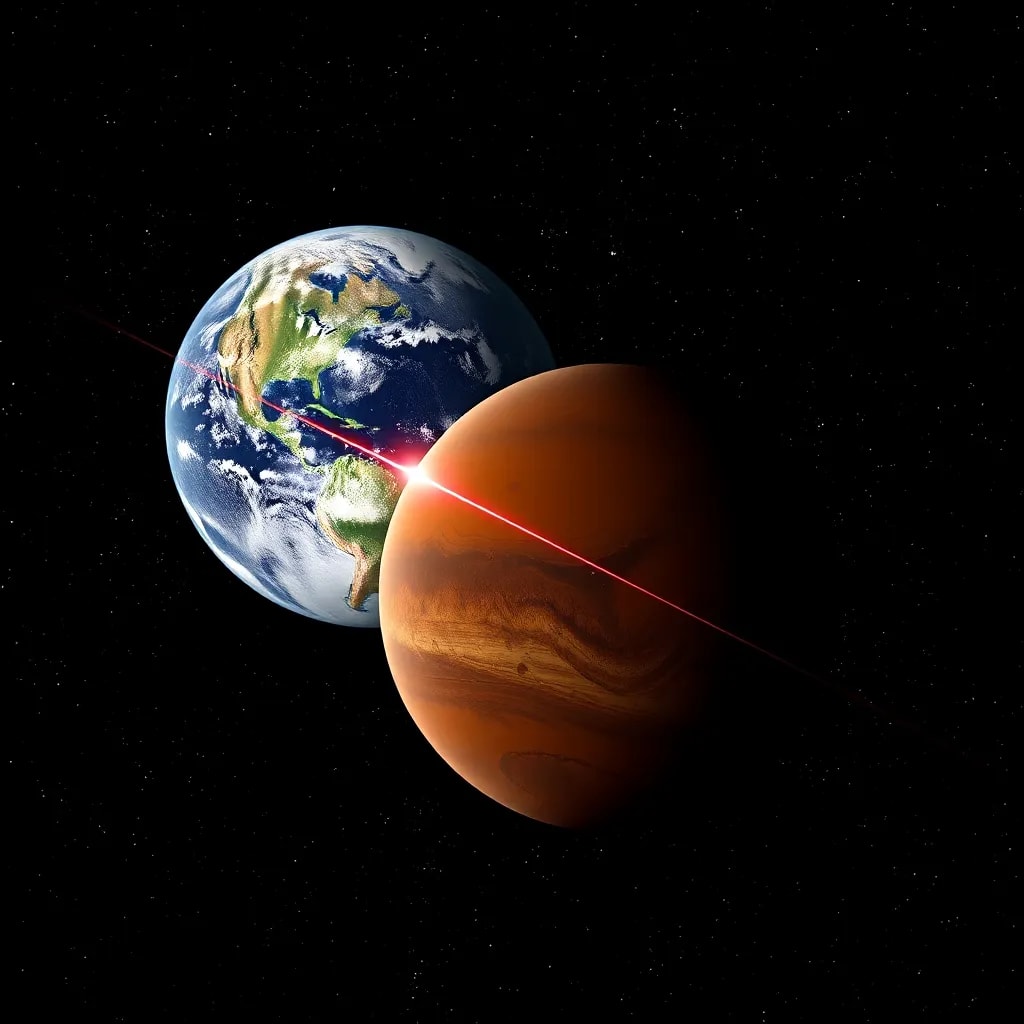
When we look up at the planets in the sky, it’s easy to imagine them simply spinning on their axes and calmly orbiting the Sun. But in reality, each planet is engaged in a complex and elegant “cosmic dance,” with two of the most important moves being axial tilt and precession. These phenomena play a critical role in shaping a planet’s climate, seasons, and even its long term environmental stability. Let’s dive into how they work and why they matter.
What Is Axial Tilt?
Axial tilt, or obliquity, is the angle between a planet’s rotational axis and the perpendicular to its orbital plane. For Earth, this angle is about 23.5°, and it’s the very reason we experience seasons. If Earth's axis weren’t tilted, we’d have no seasonal variation just a constant climate, with the Sun always rising and setting at the same angle year round.
But axial tilt varies dramatically across the Solar System:
- Uranus is the most extreme: it’s practically lying on its side with an axial tilt of about 98°.
- Venus is tilted at nearly 177°, which means it’s essentially flipped upside down and spinning in the opposite direction from most planets.
- Mars has a tilt of around 25°, very close to Earth’s, which gives it seasonal changes too — though they tend to be more extreme.
A planet’s tilt is typically established early in its life, often through massive collisions with other celestial bodies. But here’s the twist: this tilt doesn’t stay constant over time.
Enter Precession: The Wobble of Worlds
Precession is the slow, graceful wobble of a planet’s rotational axis. If you imagine the axis as a giant arrow piercing through the planet, precession means the tip of that arrow slowly traces a circle in the sky. For Earth, one full precession cycle takes around 26,000 years. It’s similar to the way a spinning top wobbles as it turns a subtle but powerful motion.
On Earth, precession shifts the calendar alignment of the seasons and alters which star the North Pole points toward. Right now, it’s Polaris (the North Star), but about 12,000 years ago it was Vega, and in another 12,000 years, it will be Vega again.
Other planets experience precession too, but the duration of the cycle differs greatly:
- Mars has a precession cycle of about 170,000 years.
- Jupiter and Saturn take hundreds of thousands of years.
- Uranus and Neptune display even more complicated behavior due to their extreme axial tilts and distances from the Sun.
Why It All Matters
Axial tilt and precession aren’t just interesting facts they’re crucial to the way a planet lives and evolves. These parameters directly affect climate cycles, atmospheric dynamics, and seasonal extremes.
On Earth, they’re part of the Milankovitch cycles, which link changes in axial tilt and precession to ice ages and warming periods. These cycles help explain long-term climate shifts over tens of thousands of years.
On Mars, axial tilt swings between 15° and 35° over millions of years. That causes wild climate changes, where polar ice caps can grow and melt, releasing gases and possibly even triggering temporary atmospheres.
On Uranus, the extreme tilt causes bizarre seasons: one hemisphere can be plunged into 21 years of continuous darkness while the other basks in nonstop sunlight. This impacts everything from wind patterns to atmospheric stability.
These factors don’t just shape weather they shape the potential for life.
Looking Toward the Future
Studying axial tilt and precession is especially important when considering planets that may host life. A stable tilt and slow precession help maintain moderate, life-friendly climates. That’s why these characteristics are a key focus when astronomers evaluate exoplanets planets orbiting other stars. A planet that tilts wildly or wobbles erratically is less likely to offer a stable environment for life to evolve.
These dynamics are also essential for planning future space missions. If we ever build colonies on Mars or the Moon, we’ll need to understand how their axial behavior affects sunlight exposure, temperature, and even the location of water ice. Polar orientation matters not just for setting up solar panels but for long-term survival.
Final Thoughts
Axial tilt and precession aren’t just technical jargon for astronomers they are the cosmic choreography behind every planet’s story. They give each world its unique rhythm, shaping its environment and future. Far from being simple spinning balls, planets are dynamic and ever-changing, their movements echoing the gravitational whispers of ancient collisions and ongoing cosmic forces.
And who knows one day, it may be a planet’s tilt and gentle wobble that guide us to our next home among the stars.
About the Creator
Keep reading
More stories from Holianyk Ihor and writers in Futurism and other communities.
Asteroids That Threaten Earth: A Hidden Danger from the Depths of Space
Every day, Earth is bombarded by millions of tiny specks of cosmic dust and small meteoroids that burn up harmlessly in our atmosphere. But lurking among this harmless debris are much larger cosmic travelers asteroids with the potential to cross paths with our planet. Some are massive enough to cause devastation on a global scale. As we continue to explore the universe, a critical question emerges: how real is the threat of an asteroid impact, and can we protect ourselves?
By Holianyk Ihor6 months ago in Futurism
About Binding Prometheus
I want to start actively advocating on behalf of my own work, and the most valuable part of my canon is, without a doubt, Binding Prometheus, the play I have been working on since 2019 and only finished in 2023 as part of my MA. The play itself is an amalgamation of a million different inspirations. On one end, it evokes the Ancient Greek myth-play, deriving its own title from the earliest extant work of Western drama we have, Aeschylus’s Prometheus Bound. On the other end, it borrows significantly from the sci-fi bulwarks from over the years, namely Mary Shelley’s Frankenstein and Karel Capek’s Rossum’s Universal Robots. The play could be an episode of Black Mirror, I fear. I don’t know. I’ve only ever seen one episode of Black Mirror.
By Steven Christopher McKnight18 days ago in Futurism
Anti-Jamming Market Outlook: Strengthening Secure Communications Across Critical Sectors
Anti-Jamming Market Overview The global anti-jamming market is becoming increasingly critical as satellite-based navigation and communication systems face growing threats from intentional interference, signal spoofing, and electronic warfare. Anti-jamming solutions protect GPS and GNSS signals to ensure accuracy, reliability, and operational continuity across defense, aerospace, aviation, maritime, and critical infrastructure applications. Rising dependence on precision navigation, autonomous platforms, and secure communication networks is accelerating the adoption of advanced anti-jamming technologies. As governments and commercial operators prioritize resilience and security, the market is poised for sustained growth worldwide.
By James Smith6 days ago in Futurism



Comments
There are no comments for this story
Be the first to respond and start the conversation.