
"Possiblement, possiblement," said the Clockwork Servant
Three light-hearted speculative amuse-bouches about the future of Chat GPT in fiction

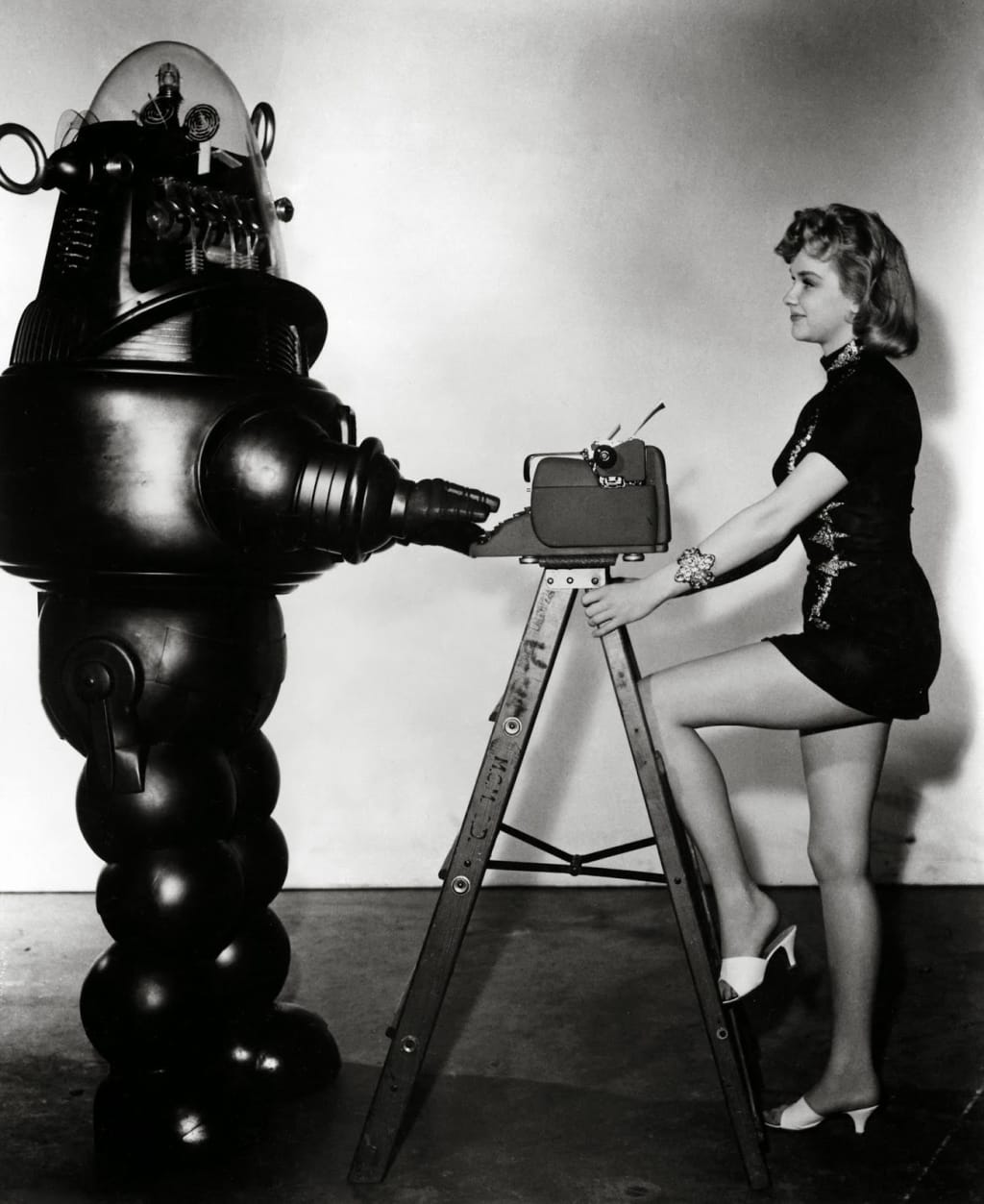
It’s the robo-topic de jour, and it’s a complete flash in the pan - the sheer amount of AI shite in our fiction atm. It’s like some necrotic jungle plant that has you halfway down its sickly sweet death-pipe before you realise that the short story you’re reading is just a bit…weird. A bit shit.
The dialogue is bad-bad.
“Yes” said Sebastian assuredly, running his large, calloused, hands through his slender, ink-like hair. “I’ve never been more sure of anything in my whole life, even when I was doing the Dakar Rally and was sure I would win that, which I did.” He grinned at her, his stomach rippling.”
“Wow” - said Anita, massaging his shirt. “That’s really sure.” she said uncertainly.
It’s not very good. It’s uncanny.
People have started to get decidedly unchuffed. And rightly so. It galls to see this robot-bile succeed ahead of caringly (or sloppily) crafted fiction.
How do we stop it? What can we do? (Answer - not much really, apart from rely on your own discernment)
Also, I think people worry way too much.
I don’t say that as a judgment. Worrying is free. We live in a world of anxiety. It takes our mind off bigger things.
But when worrying and anger meet (at a work function or something) and have a drink and a talk together they tend to create actual Fear - which as we know from child-abducting-warcrime-committing-self-saving-hideaway-and-take-no-accountability-then-check-out-before-the-end Jedi, Master Yoda (who oversaw a Galaxy-wide child-abduction service, so you can trust his business insight) can lead to suffering.
So, here are three little scenarios about the future of ChatGPT that I hope will lighten the mood around this topic, stop anyone from suffering too much anxiety, and dispel the myths that
1) it will have any tangible impact on fiction
2) humans will be around for long enough for it to matter.
Oh…and when I say ‘lighten the mood’, I very much mean according to my own lights, which are admittedly a bit grim. Also I’m hungry.
I - UBIQUITY
[AI becomes a commonplace writing tool]
I think most of us worry that this is the step we are closest to: AI-powered writing and text assistants are everywhere, offering (fucking annoying) editing, brainstorming, structural and plot suggestions. It can even give a full draft of your idea. AI is ‘seamlessly integrated into creative work, much like spellcheck or digital art tools’, as it draws me a seven-fingered arachno-monster and gives me the following:
“Anita placed her hands on Sebastian’s muscular-but-not-too-muscular chest and heaved out a great ragged sigh of lust. A wheezy, sigh of pure erotic feeling.
“I don’t know how to control myself.” She spluttered.
Sebastian’s eyes quivered and dramatically darkened. “Then don’t.” He breathed, steadily."
** - I didn’t have the heart to actually use chat gpt for this, so this is me writing bad fiction in the hopes of it seeming like AI fiction in the hopes of me making a point about AI fiction but also my fiction what and oh my why did I have fun writing that and what point am I ultimately making hereOHGODIHAVEAMIGRAINE**
Effect on Fiction:
AI-generated fiction will flourish, possibly creating a new literary subgenre of AI-assisted novels that floods the market. This sells cheaply and makes execrable profits. Writers have a slightly harder time selling their initial works but the experience is fairly similar to pre-AI fiction.
Cultural Response:
Some writers use it openly, or justify its use. Others lie (and are caught) and it generates headlines. There will be one big incident of a major writer being caught using it. This will polarise even further. Some writers use it in secret. Some eschew it completely for anything other than research. Some never use it. A culture war amongst novelists re-ignites public discussion around fiction. Readers begin to discern AI-assisted prose and dialogue from human writing and veer towards ‘handcrafted’ fiction in response.
Online digital publication spaces like Vocal and Medium become hostile and even more toxic, as people take it upon themselves to copy/paste other people’s work into zeroGPT and then try to police (vomit) based on the results they get. As anti-AI tech like zeroGPT is as undeveloped as ChatGPT itself (with a huge margin of error), it leads a culture of accusation and counter-accusation resulting in unfair reputational damage and acrimony. Self-appointed ‘AI Hunters’ badger other writers. Online platforms continue this until a lawsuit - likely following a self-harm incident- forces them to remove the comments section.
Conversely, small presses and publications thrive, and the sale of hand-writing materials skyrockets. This sparks an interest in paper-making, non-oil ink-making and investment in tree-growth and wood sustainability. Literacy increases as Boomers die off and the Millenials keenly educate their kids to discern AI from human art. AI becomes a cultural joke.
Industry Impact
Publishers and platforms will spend bajillions trying to develop methods to curate, verify, or even optimise AI-assisted fiction as it keeps a steady flow of shit through the pipes and it allows for profitable controversy. Every so often they will claim to be GPT-free. Different sites will develop reputations and become politicised. AI-assisted fiction leads to a new school of literary criticism and AI-literacy becomes necessary for understanding the world of AI fiction. People who don’t buy AI-assisted fiction continue to not buy AI-assisted fiction and the rest of the book market is oddly untouched.
SCENARIO
In a future where AI-generated stories start to dominate the market, a new movement emerges, demanding ‘real human literature’. When the world’s largest AI publisher releases ‘What are you going to do?” - what they claim to be ‘the perfect human novel’, completely free from AI. It is universally hailed as a critical masterpiece. Up and down the land the book is read... and then it begins.
The words spread like a virus, altering consciousness, making readers feel too raw, too real.
Soon readers start to reject synthetic content entirely, their minds rejecting algorithmic formulae and any hint of artificiality. In their attempt to ape humanity, the robots created a new reality. The human world seems far too contrived now. Reality is Unreal.
The AI words fed them…fed them. Everything was synthetic.
The riots started. Riots against AI publishing, against everything but the one book ‘What are you going to do?’. They storm data centres. They firebomb servers.
Realising they have gone too far, that they have warped the humans’ minds, the AI Publisher dispatches their private armies (the police) to hold the line as the people scream for the real words, the real stories, the real thoughts.
Despite a valiant effort, the security forces are just not able to quell the mob, who eventually break the line and feast on those within.
__
II - RETROSPECTION
[Hipsterism Cubed and the Organic Fucking Novel]
A strong anti-AI backlash leads to a cultural counter-movement where people seek out purely human-crafted art. This is analogous to the resurgence in vinyl that no-one would fucking shut up about, or the current renewed interest in handmade crafts, DIY, home-growing, and general apocalypse-adjacent hobbies.
Effect on Fiction:
Writers begin to emphasise the handwritten element of their work. Social media is overwhelmed with probative, self-indulgent photos of people writing stories by hand, with all the smug superiority and self-satisfaction of people who bullet journal, but weaponised.
Insufferable people become insufferabler. They write even blander fiction and the term ‘literary fiction’ continues to lose all meaning. The beigeification of modern fiction continues and Sally Rooney is canonised.
The beret makes a comeback.
The market for handwritten manuscripts explodes. The ancient Celtic art of illumination is revived and vellum and quill become commodity items. A de-digitalisation of the arts begins.
Oral storytelling is revived. The griot and seanchaí have their time again.
There are prestige markets for AI-free fiction.
Cultural Response
Some readers and critics - see above about the beret - loudly and dramatically decry to imminent destruction of ‘authentic fiction’ while raking in the cash. Human fiction and the literary world, which has never been under threat, becomes a more irritating place to navigate. Self-appointed ‘creatives’ host live, verifiable writing events (e.g. “24 hour novel events”) where AI is banned. This leads to further exacerbation of the NaNoWriMo effect on fiction quality.
Industry Impact
The book market takes on a sideways growth pattern as the berets force out interesting fiction. Small presses and niche sub-genres flourish. The arts world becomes de-centralised because everyone gets sick of the wankers in New York and London. New markets emerge for ‘certified human literature’ - much like farm-to-table food - and the term ‘Organic novel’ becomes an annoying buzzphrase used by insecure literary agents, and people who talk about writing without doing any.
SCENARIO
The world has grown sick of artificial creativity. A new movement forms. The BloodInked are a secret society who forswear all digital tools (apart from zoom and instagram). They gather in secret libraries, writing by candlelight, inscribing their stories in ink like the monks of old. Their art is a humble defiance against the machine, against the singularity.
The new administration, bolstered by huge donations from the AI lobby, declares the BloodInked a grave threat. Their peaceful resistance is branded as ‘Regressive Radicalism’ and they are hunted. New laws make the owning of paper a crime. The Anti-Regressive Task Force (ARTF) raids the BloodInkeds hideouts, seizing typewriters, burning handwritten books, and seizing quill-hens.
At long last, after a stolid and unwavering resistance, the last great sanctuary-library of the BloodInked is surrounded by the cannibalistic armoured troops of the new administration, which has been taken over by the AI. The writers hold their ground, pens clutched like daggers. Shots ring out, and ink spills like blood.
Despite a valiant effort, the defenders were just not able to hold off the cannibal troops, who soon break the line and feast on those within.
III - NIHIL MUTATUR
[Nothing really changes. AI fails to imitate humanity. The panic goes away with a cup of tea.]
Despite all the clutching and hype, AI does not alter the fundament nature of storytelling. People grudgingly recognise its use for research and brainstorming, but the limitations for actual creation are too apparent. It fades out of the public consciousness.
Effect of Fiction Writing
AI remains a brainstorming or research tool but doesn’t replace the writer. Readers grow adept at spotting AI-written fiction, leading to the decline of purely-generated novels. Amazon sees that they do not sell, and noticing the backlash, removes all AI novels and refuses to sell them in future. The process for self-publication involves more verification and proof.
Cultural Response
People grow bored with AI-produced fiction, noting that it lacks the nuance and context of human writing. The ‘Uncanny Valley’ effect prevents AI from ever being taken seriously and sales remain at their current negligible.
Industry Impact
AI becomes an annoying tool for emails and text applications like Grammarly, Scrivener, Word and Outlook/Gmail. Useful at times, but not revolutionary, and ultimately quite annoying. It fails., as all AI is doomed to, as it cannot keep feeding from the same trough.
‘How to switch off AI assist’ becomes the third-most googled term that year.
SCENARIO
For years people worried that AI would take over fiction, would replace it. But nothing changed, not really. Readers still wanted to connect with what they were reading. AI-generated stories still seemed both generic and wrong, and authors, human authors, kept writing. The great AI Revolution of Literature has fizzled out to a mere footnote in history.
That is…until the Unwritten Story surfaced. This strange, almost unreadable text was unlike anything ever generated before. People read it and giggled at first at the silliness of it. Then they took on a serious expression and continued to read.
And never stopped.
The rot-code was the dying gasp of the AI Author. A brain virus that hooked the reader into a violent circuity of hyperlinks and rotating dead ends.
They became echoes of themselves. Wandering around. Congregating. Until the moment when they were activated.
It started in market towns, in dead-end burgs. Rioting. Looting. All at once. The AI had activated the Deadman’s Hand Protocol.
Society never stood a chance. The last battle took place on a bloody snowswept vista. The sunset of mankind.
Despite a valiant effort, the defenders were just not able to quell the mob, who eventually broke the line and feasted on those within.
Most Likely?
Without a doubt, the third scenario is most probable.
I might be overstating the cannibalism.
AI is incapable of fundamentally changing fiction because it is only ever an echo. AI already is incapable of creating compelling, long-form fiction, and it’s further explorations into Uncanny Valley will make it more glaringly obvious as time goes by.
AI is a tool, and can never create human creativity. The backlash I predict at point 2 will probably happen in pockets here and there, but the industry is likely to either absorb AI without ill-effect, or else be rejected by the host. Either way, it won’t upend storytelling itself.
Bye.
About the Creator
Conor Darrall
Short stories, poetry and some burble . Irish traditional musician, medieval swords guy, draoi and strange egg. Bipolar/ADD/CPTSD/Brain Damage. Currently querying my novel 'The Forgotten 47' - @conordarrall / www.conordarrall.com
Reader insights
Outstanding
Excellent work. Looking forward to reading more!
Top insights
Heartfelt and relatable
The story invoked strong personal emotions
On-point and relevant
Writing reflected the title & theme
Keep reading
More stories from Conor Darrall and writers in Futurism and other communities.
Is Starlink Available in Your Area? The Map, the Hype, and the Quiet Revolution Over Your Head
How Elon Musk’s satellite internet rollout is quietly rewriting who gets to be “connected” The first time my internet died in the middle of a job interview, I was standing on a chair, router in one hand, phone in the other, praying the signal would come back.
By abualyaanart2 days ago in Futurism
Software Defined Networking Market 2034: Investment Potential & Emerging Use Cases
According to IMARC Group's latest research publication, global software defined networking market size reached USD 33.1 Billion in 2025. Looking forward, IMARC Group expects the market to reach USD 128.0 Billion by 2034, exhibiting a growth rate (CAGR) of 15.73% during 2026-2034.
By sujeet. imarcgroup6 days ago in Futurism




Comments (3)
Yes yes! Brilliant brilliant!! I love it. It’s hopeful and devastating, nuanced and overstated, authoritative and familiar. I laughed out loud. And most importantly… it reminded me what a magical gift it is to have a human brain. Thank you for that. 💗
Always a delight to see you've published something fresh. And never does it fail to make me smile wide like a freshly self-freed asylum guest on a five day bender. For my part, I can't quite identify Ai written "shite" quite yet as (if I'm way too honest) too much of what I read fits these standards nowadays. I've been freelance editing the last couple of years, but I find my soul is practically wine with all the filthy feet that walk all over it in this giant barrel of bad grapes. Quite likely, I've been editing ai written smut for years and just assumed that was what passed for writing in the world of pay-by-chapter smut apps. Alas, the world is already loaded into the handbasket and on its way to the fiery fate. On a more positive note, it's good to see you old friend. :) <3
Fabulous story ✍️🏆📖