
Parallel Universes: Is There Another You in a Different Reality?
"Exploring the mind-bending theories of quantum physics and science fiction’s most intriguing mystery."

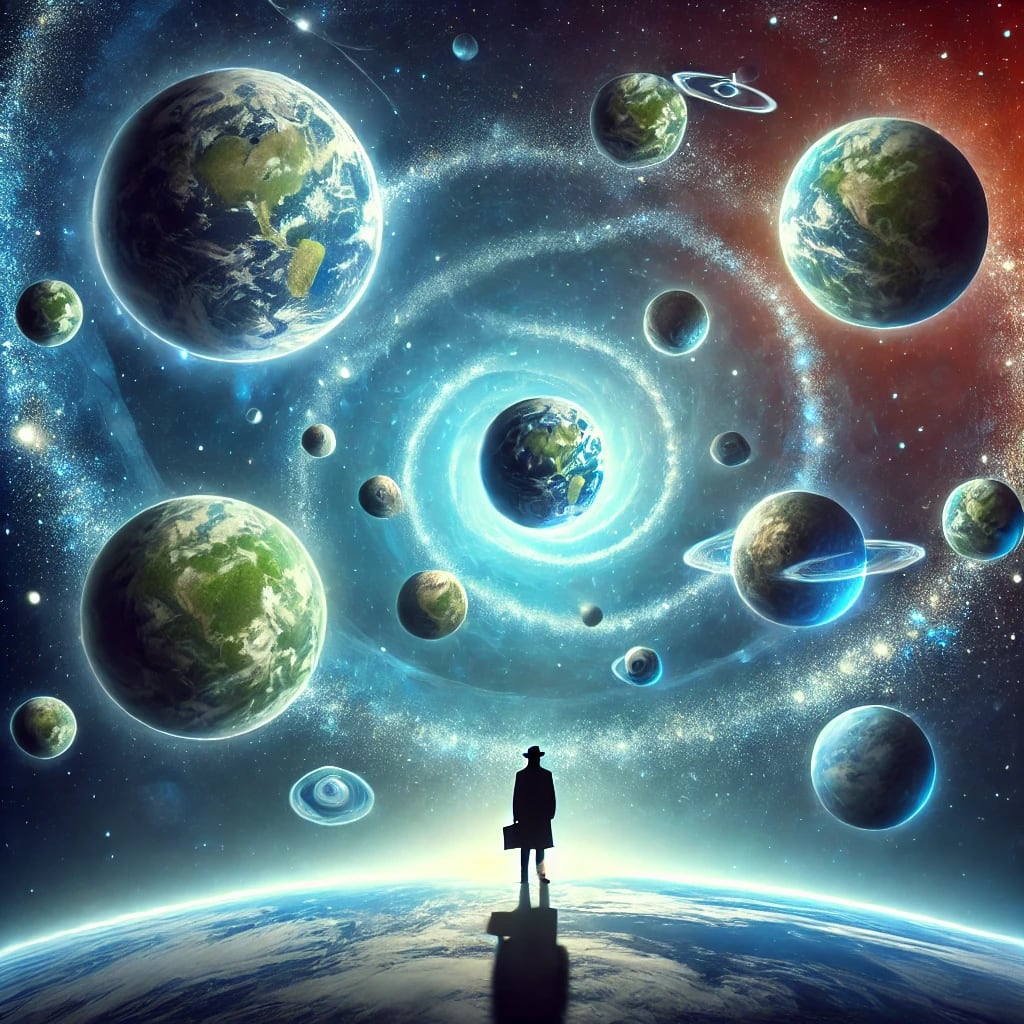
Imagine waking up tomorrow in a world almost identical to yours, except for one small detail—perhaps the color of your car is different, or you chose a different career path, or maybe, in that universe, you never met the people who define your life today. The idea that multiple realities exist, branching off into infinite possibilities, is one of the most fascinating concepts in both science and fiction.
Parallel universes have long been a staple of science fiction, but could they be more than just imaginative storytelling? Modern quantum physics, multiverse theories, and even real scientific experiments suggest that alternate realities may not be as far-fetched as we once believed.
So, could there be another version of you living a different life in a parallel universe? Let’s dive into the theories, the science, and the speculative mysteries surrounding the multiverse.
The Many Worlds Interpretation: Quantum Physics and Infinite Possibilities
One of the most popular scientific theories supporting parallel universes comes from quantum mechanics—the field of physics that governs the strange, unpredictable behavior of subatomic particles.
1. Schrödinger’s Cat: A Thought Experiment in Quantum Superposition
In 1935, physicist Erwin Schrödinger devised a now-famous thought experiment to explain the paradox of quantum mechanics:
A cat is placed inside a box with a radioactive atom that has a 50% chance of decaying and releasing poison.
According to quantum theory, until we observe the cat, it exists in a superposition of states—both alive and dead at the same time.
This bizarre idea suggests that, at a quantum level, multiple realities exist simultaneously. But what happens when we open the box?
Enter the Many Worlds Interpretation (MWI), proposed by physicist Hugh Everett III in 1957. This theory argues that instead of one definite outcome when we observe the cat, the universe splits into two realities—one where the cat lives and another where it dies. If this applies to every quantum event, then countless parallel universes are constantly forming, each representing a different possible outcome.
If true, this means that every choice you make creates a new universe—one where you took a different path, made a different decision, or experienced an entirely different fate.
Multiverse Theories: How Could Parallel Universe Exist?
The idea of multiple universes isn’t just confined to quantum physics. Scientists have proposed several multiverse theories, each suggesting a different way alternate realities could exist.
1. The Inflationary Multiverse: Bubbles of Reality
According to cosmologist Alan Guth, our universe may be just one of many created during the Big Bang. His theory of cosmic inflation suggests that space expanded rapidly in the first moments of existence, possibly spawning countless "bubble universes"—each with its own physical laws and properties.
In this scenario, parallel universes might be completely separate from ours, existing beyond what we can observe. Some could be vastly different, while others might be eerily similar, containing another version of you.
2. The Simulation Hypothesis: Are We Living in a Program?
Proposed by philosopher Nick Bostrom, the simulation theory suggests that our universe might be nothing more than a highly advanced simulation created by a more intelligent civilization. If this is the case, then multiple "simulations" could exist—each representing a different version of reality.
If our universe is just one of many computer-generated realities, then parallel worlds could be as simple as a new program running on a cosmic supercomputer.
3. The Brane Theory: Universes Stacked Like Pages in a Book
String theory, one of the leading theories in modern physics, proposes that our universe exists on a higher-dimensional membrane (brane) floating in a vast cosmic space. Other universes could exist right next to ours, separated by dimensions we cannot perceive—like pages in a book stacked side by side.
This means that a parallel version of you could be existing just micrometers away, yet entirely unreachable due to the fundamental nature of space-time.
Science Fiction and the Multiverse: Imagination Meets Reality
Parallel universes have been explored in movies, TV shows, and literature for decades, fueling our fascination with the unknown. Some of the most famous examples include:
Marvel’s Multiverse (Doctor Strange, Spider-Man: No Way Home): Different versions of superheroes from alternate timelines coexisting.
The Matrix (1999): A simulated reality that raises questions about what’s "real."
Rick and Morty (TV series): A comedic yet scientifically inspired take on infinite universes.
Interstellar (2014): A deep dive into black holes, time dilation, and alternate dimensions.
While these are fictional representations, they mirror real scientific discussions about the possibility of alternate realities.
Could We Ever Prove Parallel Universes Exist?
Despite intriguing theories, proving the existence of parallel universes remains one of the greatest challenges in modern science. However, some experiments and phenomena hint at the possibility:
Quantum Computing & Superposition: Quantum computers process information in multiple states simultaneously—mimicking how parallel universes might function.
The Mandela Effect: Some people report "false memories" that suggest they remember events differently than recorded history. Some theorists speculate this could be due to overlapping realities.
Cosmic Microwave Background Radiation: Some anomalies in the early universe’s radiation patterns have led scientists to speculate that they could be evidence of other universes interacting with ours.
While we may not have direct evidence yet, advances in quantum mechanics and cosmology could one day unlock the mystery of the multiverse.
Final Thoughts: Are We Alone in Our Own Universe?
The idea of parallel universes challenges our perception of reality. If they do exist, they could redefine our understanding of fate, free will, and identity.
Are you living the "best" version of your life, or is there another "you" in a reality where things played out differently? Perhaps one day, science will provide an answer—but until then, the multiverse remains one of the most captivating mysteries of our existence.
About the Creator
Ahmet Kıvanç Demirkıran
As a technology and innovation enthusiast, I aim to bring fresh perspectives to my readers, drawing from my experience.
Keep reading
More stories from Ahmet Kıvanç Demirkıran and writers in Futurism and other communities.
Tomorrow’s Utopia: The Perfect World That Wasn't
**Tomorrow’s Utopia: A Perfect World with Hidden Cracks** The year is 2145. Humanity has finally achieved what generations before could only dream of—a utopia. War, poverty, disease, and inequality have all been eradicated through radical technological innovation and deep social restructuring. Cities glisten with solar-powered towers, energy is limitless, and humans live in perfect harmony with nature. Artificial Intelligence governs with unparalleled efficiency, ensuring justice, opportunity, and fairness for all.
By Ahmet Kıvanç Demirkıranabout a year ago in Futurism
Saudi Arabia Pet Food Market: Pet Humanization, Premium Nutrition & Growth Outlook
According to IMARC Group's latest research publication, Saudi Arabia pet food market size reached USD 80.6 Million in 2024. The market is projected to reach USD 135.9 Million by 2033, exhibiting a growth rate (CAGR) of 5.7% during 2025-2033.
By Shubham Sharma 2 days ago in Futurism
Hummus Market Trends: Vegan Diet Growth, Healthy Snacking & Forecast to 2034
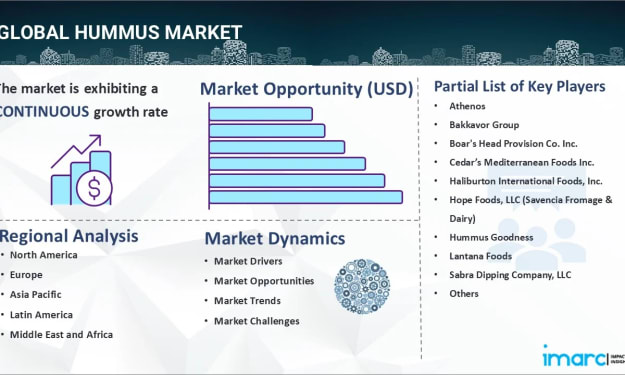
Growing consumer interest in plant-based eating, a sharper focus on clean-label nutrition, and the global spread of Mediterranean food culture are all converging to make hummus one of the most talked-about products in the packaged food space right now. According to IMARC Group’s latest research, the global hummus market size reached USD 4.7 Billion in 2025. Looking forward, IMARC Group estimates the market to reach USD 9.1 Billion by 2034, exhibiting a CAGR of 7.50% during 2026–2034. North America currently dominates the global market, driven by strong consumer demand for healthy, plant-based snacks and widespread adoption of Mediterranean-style diets across the region.
By Suhaira Yusuf4 days ago in Futurism
A System That Isn’t Working Challenge Winners
Systems promise order. They organize behavior, distribute opportunity, and suggest that if everyone follows the rules, things will work. The entries in A System That Isn’t Working look closely at what happens when that promise begins to slip.
By Vocal Curation Team4 days ago in Resources


Comments
There are no comments for this story
Be the first to respond and start the conversation.