
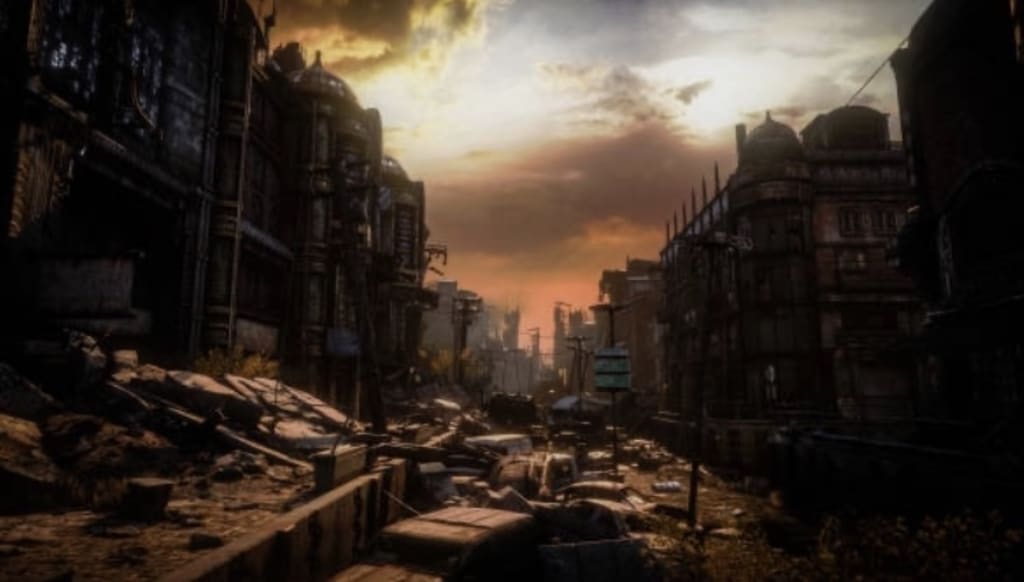
I’m dying.
That’s nothing new though. Everyone’s dying.
I couldn’t tell you when it all began. There wasn’t a decisive moment where all of humanity collectively said “Oh shit” as everything fell apart. The sun didn’t implode, aliens didn’t invade, large-scale nuclear warfare didn’t break out. It’s ironic, really. Almost since the beginning of humanity, we’ve tried to figure out how our world would end and how we could save ourselves, but somehow even with all of our warnings and knowledge, we’re living out the most mundane of those predictions.
Have you ever experienced that brief moment on a rollercoaster where the cart halts right over the first large drop? It’s like staring down the barrel of a gun, knowing exactly what’s to come, but not when the ride is going to lurch back into motion. That’s where we all are right now, in limbo, too far along to get off the ride, anticipating the sudden descent.
I couldn’t tell you when it all began, but I can tell you the moment I first recognized that we were nearing our finish line.
It was my ninth birthday, so I remember the exact date. December 15th, 2073. Even then, money was tight, so I only got one gift. An old necklace, a dull gold chain with a gold heart-shaped locket on it. The locket had faded pictures of deceased family, and was dented and scratched from years of wear, which made sense, considering that I had never once seen my mother take off this particular necklace. It was as much a part of her as the tattoo of birds on her ankle, and I was extremely confused when she unclasped it and offered it to me.
When I asked her why she was giving it to me, she sadly smiled. “It’s a family heirloom, love. It first belonged to my great-grandmother, and it’s become tradition to pass it down to the oldest daughter as a wedding gift.”
“But I’m not married.”
To my surprise, she started crying, even as she pressed the necklace tightly into my hands. “I know, sweetheart, I know. But if worst comes to worst, I want to know that you got the chance to have it.”
And so on the day I turned nine, I also learned that chances were I wouldn’t live long enough to have a wedding.
Even though the necklace carries bad memories with it, I always wear it. It’s nice to know that even after I rot away, that locket will remain, with those pictures rusted inside it.
I read a poem called “The Hollow Men” for a school project once. I don’t remember most of it, but the last lines have stayed with me.
“This is the way the world ends
Not with a bang but a whimper.”
I’ve always thought there was something beautiful about that, even with how pitiful it sounds when you read it. The world may be dying beneath our feet, but our voices won’t fall silent until it does. And those voices are everywhere.
You can hear them on the news, the radio, from those shouting in the streets with their signs, streaked with the dust of thousands upon thousands of people’s footsteps. You can hear it creeping through in the voices of mothers telling their children it’s all going to be alright, of teachers trying to rationalize it, using words that whisper around us, looming too large for us to understand. “Overpopulation”, “Drought”, and “Famine” .
You can also just look outside, notice the wilting trees, the cracking of the ground, the throng of people choking the life out of each other just by standing there. Or you could open some of the kitchen cabinets. That works too.
If you choose to use the news, you’ll probably get to hear the politicians behind their stands, claiming they all know the solution, that they can help. Maybe one of them will be convincing enough to get you hopeful for a minute.
When that happens, flip to the next channel, the one with the anchors asking scientists how long we’ll last. Wait until they answer, every single one of them grimly predicting anything from months to a decade or so.
It’ll hurt, but it’s best to keep your expectations and head low.
Be careful if you choose to listen or, even worse, align yourselves with the so-called “revolutionaries”. Some of the protestors get fined. Some of them get tear gas thrown at their eyes, some of them get shot.
The lucky ones get to rot in jail, with meager rations and solitude, away from the madness.
Some of them clamor for mass executions. If one of those comes up to you, only lift your head up long enough to agree. Don’t try to argue with them. Disagreeing only volunteers you as their next “project”.
And me? Does it really matter how a walking corpse feels on it’s way to it’s own funeral? How a cow feels as it’s led into a slaughter house by decisions and people beyond its control?
And besides, why ask me, when so many spend what could be their final days forcing their voices upon us? You don’t need to search for an argument when that’s all those who should be helping us ever do. If it’s anger you’re wanting, don’t talk to the girl who’s both old enough to understand what’s happening and smart enough to accept it.
We’re all dying, and even then we cannot silence our voices long enough to appreciate the time we have left.
Or if you want some pity, go to the slums of the city. Listen to the cries of children and the tired whispering of their parents, trying to find a way out. Listen to all of us, trying to find our way out. That’s not exactly pity, true, but when everyone has sunk to the same level, can anyone feel bad for the others?
There are, of course, the few wealthy ones left, those with enough privilege and hoarded cash to lock themselves in their mansions, barricaded with a stockpile of resources they refuse to share. The poor and starving try all they can to fight them, through lawsuits and mobs mostly, but as long as they have the money to bolster their defenses, they can and will stay locked away from it all. They pretend nothing is happening, that their fortune isn’t built on a crumbling foundation of empty promises. Their lives are a constant game of charades, as though if they pretend everything is fine and keep the window blinds closed, they can shape the truth into whatever they want it to be. But their stores of food won’t last forever. Neither will their shallow statuses and presumed power. After all, the end of the world doesn’t discriminate. When it comes, it will take us all.
And since you seem to want to hit the five stages of grief, go look at the old grandfather clock in the corner of the dining room. Listen to it tick. Watch the hand slowly move, counting our days. There’s a sense of finality to be found in a clock, of acceptance, one that wasn’t there before. A feeling that Death isn’t searching for you, but waiting patiently, because it knows it won’t be long before it reaps it’s reward. It makes you wonder if Time isn’t standing with him as so many believe, but if time is one step behind us, slowly helping us on our way to Death’s inevitable embrace.
Not that we couldn’t do it on our own. Sometimes, it feels like we’re clawing our way to the end of the world, blazing our way to it with gunfire and hoarse yells. I wonder if all of the smog and oil will come with us when we go, if the drought will end when we do. Maybe Mother Nature really is taking her revenge, like some people theorize. People will come up with anything to avoid feeling responsible for something they’ve created, even in the apocalypse of sorts. I suppose Earth is anxious to reclaim us after all the damage we’ve done to her. I can’t blame her.
My honest opinion? I just hope that Earth, Time, Ruin, all of them, are gentle with what we leave behind when our “great civilization” finally fades away.
About the Creator
Keep reading
More stories from writers in Futurism and other communities.
About Binding Prometheus
I want to start actively advocating on behalf of my own work, and the most valuable part of my canon is, without a doubt, Binding Prometheus, the play I have been working on since 2019 and only finished in 2023 as part of my MA. The play itself is an amalgamation of a million different inspirations. On one end, it evokes the Ancient Greek myth-play, deriving its own title from the earliest extant work of Western drama we have, Aeschylus’s Prometheus Bound. On the other end, it borrows significantly from the sci-fi bulwarks from over the years, namely Mary Shelley’s Frankenstein and Karel Capek’s Rossum’s Universal Robots. The play could be an episode of Black Mirror, I fear. I don’t know. I’ve only ever seen one episode of Black Mirror.
By Steven Christopher McKnight18 days ago in Futurism
Saudi Arabia Earthquake Resistant Building Materials Market: Safety Standards, Innovation & Growth Outlook
According to IMARC Group's latest research publication, Saudi Arabia earthquake resistant building materials market size reached USD 312.29 Million in 2024. The market is projected to reach USD 497.07 Million by 2033, exhibiting a growth rate (CAGR) of 5.30% during 2025-2033.
By Abhay Rajputabout an hour ago in Futurism
Wild Card Weekend Recap: What Happens Now?
I think I figured out why I love Wild Card Weekend so much. It's because it's the first playoff anything of the calendar year. The NFL season starts in the fall, and once upon a time, the champion was crowned either on or slightly before New Year's. The evolution of the NFL schedule has resulted in the playoffs starting just into the New Year, and currently, the final week of the season falls on the first weekend of the New Year, with Wild Card Weekend coming a week after that. So yes, chronologically, the NFL's Wild Card Weekend serves as the first playoff anything of the calendar year.
By Clyde E. Dawkins6 days ago in Unbalanced




Comments
There are no comments for this story
Be the first to respond and start the conversation.