
Orbital Mirror Cities: Humanity’s Shining Future Above Earth
Space


In the 21st century, humanity has begun to look beyond simply visiting space. We’re now asking a deeper question: how can orbit itself become a home—and even a partner—for life on Earth?
One of the most dazzling ideas born from this new vision is that of Orbital Mirror Cities—massive, reflective habitats that double as both cosmic settlements and radiant solar mirrors.
The Dream of Artificial Suns
The concept isn’t entirely new. Back in the late 20th century, Soviet scientists experimented with a project called Znamya—a thin orbital mirror designed to reflect sunlight onto dark regions of Earth. The prototype worked, briefly lighting up part of Siberia, but the technology was too primitive for large-scale use.
Today, however, with ultralight nanomaterials, self-repairing solar fabrics, and autonomous swarm satellites, that early dream has evolved into something far more ambitious. Imagine a vast, glimmering ring orbiting our planet—part city, part mirror, part work of art. On the outside, it reflects sunlight back to Earth, while on the inside, it provides homes, parks, and laboratories bathed in eternal, programmable daylight.
These orbital mirror cities wouldn’t just be technological marvels. They’d be living symbols of humanity’s control over light—a reminder that we can shape not only our environment, but the glow of our own civilization.
Illuminating the Earth, One Reflection at a Time
The practical benefits of orbital mirrors could be revolutionary. By directing sunlight to specific regions, we could:
- Illuminate polar areas during their long winters, reducing energy consumption and combating seasonal depression;
- Boost agricultural productivity by extending daylight hours in farming regions;
- Assist in climate balance, redirecting solar radiation to manage temperature extremes;
Or even create art in the sky, projecting soft aurora-like displays across cities.
For instance, a fleet of orbital mirrors could brighten Arctic research stations during the endless polar night, making human activity more sustainable. Desert farms could receive extra sunlight in winter, extending growing seasons without fossil fuels. Imagine walking through a snowy Scandinavian town at midnight, with warm golden light shimmering overhead—not from street lamps, but from a silent city reflecting sunlight hundreds of kilometers above.
Architecture of Light
Designing an orbital mirror city is as much about art as engineering. Different architectures have been proposed:
- O’Neill Cylinders, rotating habitats where centrifugal force mimics gravity and mirrored panels direct sunlight through adjustable windows;
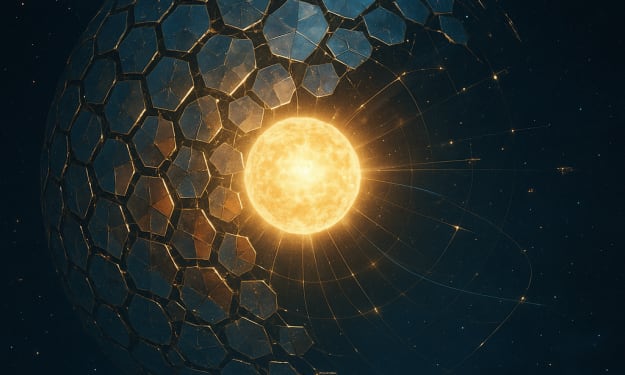
- Crystal Domes, modular hexagonal habitats with reflective outer shells and lush green interiors;
- Swarm Arrays, vast networks of thousands of autonomous mirror-satellites that coordinate light reflection through AI in real time.
Each model transforms orbit into a canvas. Mirrors could shift hue or intensity, painting dawn and dusk across the Earth. Some concepts even imagine orbital “light festivals,” where coordinated reflections form luminous patterns visible from multiple continents—cosmic poetry in motion.
Life in a Shimmering Habitat
Inside an orbital mirror city, life would unfold under carefully engineered sunlight. Residents could adjust the color temperature of their “sky,” set their own day-night cycles, and live surrounded by solar gardens that absorb energy from both direct and reflected light.
But the challenges would be immense. Constant radiation exposure, micrometeorite impacts, and the psychological strain of living in perpetual brightness would require creative solutions. Advanced shielding materials, magnetic deflection fields, and virtual reality “night modes” could help maintain both physical and mental health.
Yet for many pioneers, the allure of living between sunlight and starlight would be irresistible. These cities would represent not exile from Earth—but a higher orbit of civilization, still tethered by light to our blue home below.
Reflections of a New Humanity
Beyond science and engineering, orbital mirror cities carry a profound symbolic weight. They embody humanity’s transition from being passive observers of the cosmos to active designers of the sky itself.
They could redefine our relationship with light—the most fundamental force shaping life. For millennia, humans worshiped the sun as a distant god. Now, we could sculpt its rays like artists, deciding where and how they fall.
From Earth, people might look up at night and see not just stars, but faint golden arcs gliding across the heavens—cities of light, alive with motion, reflecting both sunlight and human ambition. Children might trace their paths and whisper, “That’s where people live now—between day and night.”
A Glimpse Ahead
If the 20th century belonged to rockets and exploration, the 21st may belong to reflection and creation. Orbital mirror cities could one day help restore balance to Earth’s ecosystems, power entire continents, or simply remind us that progress doesn’t have to cast shadows—it can shine.
In the end, these radiant habitats wouldn’t just illuminate the world below. They would reflect something even brighter: humanity’s ability to dream, build, and live among the light itself.
About the Creator
Keep reading
More stories from Holianyk Ihor and writers in Futurism and other communities.
Dyson Sphere — Architecture on a Stellar Scale
Imagine a civilization so advanced that it doesn’t just harness the power of wind, water, or atoms—but the energy of an entire star. This is not the plot of a sci-fi movie; it’s a real scientific idea proposed over half a century ago. Meet the Dyson Sphere, a concept so vast it blurs the line between engineering and cosmic imagination.
By Holianyk Ihor3 months ago in Futurism
About Binding Prometheus
I want to start actively advocating on behalf of my own work, and the most valuable part of my canon is, without a doubt, Binding Prometheus, the play I have been working on since 2019 and only finished in 2023 as part of my MA. The play itself is an amalgamation of a million different inspirations. On one end, it evokes the Ancient Greek myth-play, deriving its own title from the earliest extant work of Western drama we have, Aeschylus’s Prometheus Bound. On the other end, it borrows significantly from the sci-fi bulwarks from over the years, namely Mary Shelley’s Frankenstein and Karel Capek’s Rossum’s Universal Robots. The play could be an episode of Black Mirror, I fear. I don’t know. I’ve only ever seen one episode of Black Mirror.
By Steven Christopher McKnight14 days ago in Futurism
Australia Pneumatic Tools Market: Industrial Productivity, Automation & High-Performance Tooling
According to IMARC Group, the Australia pneumatic tools market reached a value of USD 302.40 Million in 2024 and is expected to grow to USD 531.42 Million by 2033, registering a compound annual growth rate (CAGR) of 5.80% during 2025–2033. This consistent expansion reflects the growing reliance of Australian industries on high-performance, durable and efficiency-driven tooling solutions. Pneumatic tools—powered by compressed air—are widely used across manufacturing, construction, automotive repair, mining support operations and industrial maintenance. As Australia’s industrial landscape modernises, pneumatic tools are evolving from traditional workshop equipment into productivity-critical assets embedded within future-ready, automation-oriented operations.
By Shrestha Roy6 days ago in Futurism


Comments
There are no comments for this story
Be the first to respond and start the conversation.