
Dyson Sphere — Architecture on a Stellar Scale
Space


Imagine a civilization so advanced that it doesn’t just harness the power of wind, water, or atoms—but the energy of an entire star. This is not the plot of a sci-fi movie; it’s a real scientific idea proposed over half a century ago. Meet the Dyson Sphere, a concept so vast it blurs the line between engineering and cosmic imagination.
The Birth of a Cosmic Idea
The concept was introduced in 1960 by British-American physicist and futurist Freeman Dyson in his paper “Search for Artificial Stellar Sources of Infrared Radiation.” Dyson wasn’t trying to design a superweapon or a utopian city. He was asking a simple, provocative question:
If intelligent life keeps advancing, how far could its energy consumption go?
Dyson reasoned that a truly advanced civilization—what Russian astronomer Nikolai Kardashev later called a Type II civilization—would eventually exhaust the resources of its home planet. The next logical step? Build a structure capable of collecting most, or even all, of the energy output of its parent star. In other words: a solar power plant the size of a solar system.
Not a Shell, but a Swarm
When people hear “Dyson Sphere,” they often picture a gigantic metal shell completely enclosing a star. In reality, such a rigid sphere would be impossible—it would collapse under its own gravity and be unstable at almost every point. Dyson himself never proposed that kind of monolithic design.
Instead, he envisioned a “Dyson Swarm”—a vast cloud of independent satellites, mirrors, and solar collectors orbiting the star in coordinated trajectories. Each satellite would gather sunlight and transmit energy back to inhabited planets or space habitats via lasers or microwaves.
Think of it as a cosmic network of solar panels, orbiting in perfect harmony, converting starlight into usable power.
Engineering on an Astronomical Scale
Constructing a Dyson Swarm would make every engineering project in human history look like child’s play. We would need billions of orbital platforms, all synchronized and communicating across astronomical distances.
Where would we get the materials? Earth certainly doesn’t have enough metal to build something like this. Scientists speculate we’d have to dismantle a planet—most likely Mercury, since it’s rich in metals and already close to the Sun. Its entire mass could be converted into solar collectors and transmission relays.
It’s a mind-bending idea: taking apart a world to build a machine that can power an entire civilization. Yet, in the long run, such astroengineering might be the only way for humanity to survive and thrive beyond its planetary cradle.
What Would It Look Like?
If someone built a Dyson Swarm around their star, we probably wouldn’t see it directly. But we could detect it through its heat signature. The star’s visible light would be partially blocked, while the captured energy would be re-emitted as infrared radiation—essentially, the glow of waste heat.
That’s exactly how astronomers are searching for alien megastructures. In 2015, the star KIC 8462852, also known as Tabby’s Star, drew global attention after its light dimmed in strange, irregular patterns. For a brief moment, scientists considered whether it might be a partial Dyson Swarm.
As it turned out, the dimming was likely caused by a vast cloud of dust. Still, the episode proved one thing: the idea of Dyson Spheres has become mainstream enough that serious scientists will at least consider it as a hypothesis.
Beyond Energy: A New Kind of Civilization
The Dyson Sphere isn’t just about gathering energy—it’s about transformation. A civilization that could build one would no longer be bound by planetary limits. It could use the harvested energy to power massive computers, create artificial worlds, or even simulate entire realities.
In fact, some futurists suggest that a Dyson Swarm could become a habitable environment in itself—a cluster of habitats orbiting in a golden halo around the star, each one home to billions of beings. Imagine billions of artificial worlds connected by streams of light and data—a living, breathing ecosystem of technology and biology intertwined.
Our First Steps Toward the Stars
We’re obviously not there yet. Humanity is still at what Kardashev called Type 0.7 on the energy scale—we use only a fraction of the power available on Earth, let alone the Sun. But every solar panel we install, every space probe we launch, is a baby step toward that future.
In the 21st century, private companies and national space agencies are experimenting with space-based solar power, placing collectors in orbit to beam energy back to Earth. While still small in scale, the principle is strikingly similar to Dyson’s vision.
A Symbol of Ambition
Ultimately, the Dyson Sphere isn’t just an engineering fantasy—it’s a symbol of human ambition. It asks us to imagine a civilization that doesn’t fight over scarce resources but instead thinks big enough to harness a star.
It’s a reminder that architecture isn’t limited to buildings or cities. On a cosmic scale, architecture could mean reshaping the very structure of a solar system—a network of mirrors and satellites glimmering like a vast crown around the Sun.
The Dyson Sphere remains a dream for now, but it’s a dream worth keeping.
Because every great leap in human history began with someone looking at the sky and wondering: What if we could build there?
About the Creator
Keep reading
More stories from Holianyk Ihor and writers in Futurism and other communities.
Oxygen Regeneration on the ISS — Lessons for Future Space Missions
One of the greatest challenges of long-term space travel isn’t just surviving the journey — it’s breathing through it. On the International Space Station (ISS), astronauts have spent more than two decades learning how to generate, recycle, and conserve oxygen far from Earth’s atmosphere. What they’ve discovered goes far beyond the station’s metallic walls. It’s a crucial testbed for technologies that will one day sustain explorers on the Moon, Mars, and beyond.
By Holianyk Ihor3 months ago in Futurism
About Binding Prometheus
I want to start actively advocating on behalf of my own work, and the most valuable part of my canon is, without a doubt, Binding Prometheus, the play I have been working on since 2019 and only finished in 2023 as part of my MA. The play itself is an amalgamation of a million different inspirations. On one end, it evokes the Ancient Greek myth-play, deriving its own title from the earliest extant work of Western drama we have, Aeschylus’s Prometheus Bound. On the other end, it borrows significantly from the sci-fi bulwarks from over the years, namely Mary Shelley’s Frankenstein and Karel Capek’s Rossum’s Universal Robots. The play could be an episode of Black Mirror, I fear. I don’t know. I’ve only ever seen one episode of Black Mirror.
By Steven Christopher McKnight13 days ago in Futurism
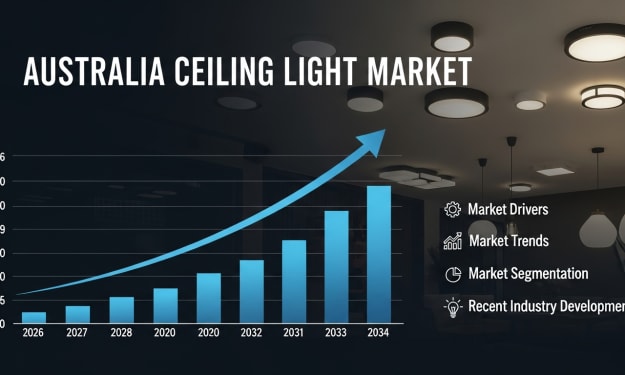
Australia Ceiling Light Market: Smart Illumination, Energy Efficiency & Future-Ready Living
In 2025, Australia ceiling light market was valued at USD 994.81 Million. Looking ahead, the market is projected to reach USD 1,461.66 Million by 2034, growing at a compound annual growth rate (CAGR) of 4.37% during 2026–2034.
By Kevin Coopera day ago in Futurism



Comments
There are no comments for this story
Be the first to respond and start the conversation.