
One Smartphone per Second, Lights Off, 24/7
Inside Xiaomi’s Dark Factory. Robots, dust-free halls and an AI brain push lightning-fast, lights-out manufacturing to the limit.
What Does “Dark Factory” Really Mean
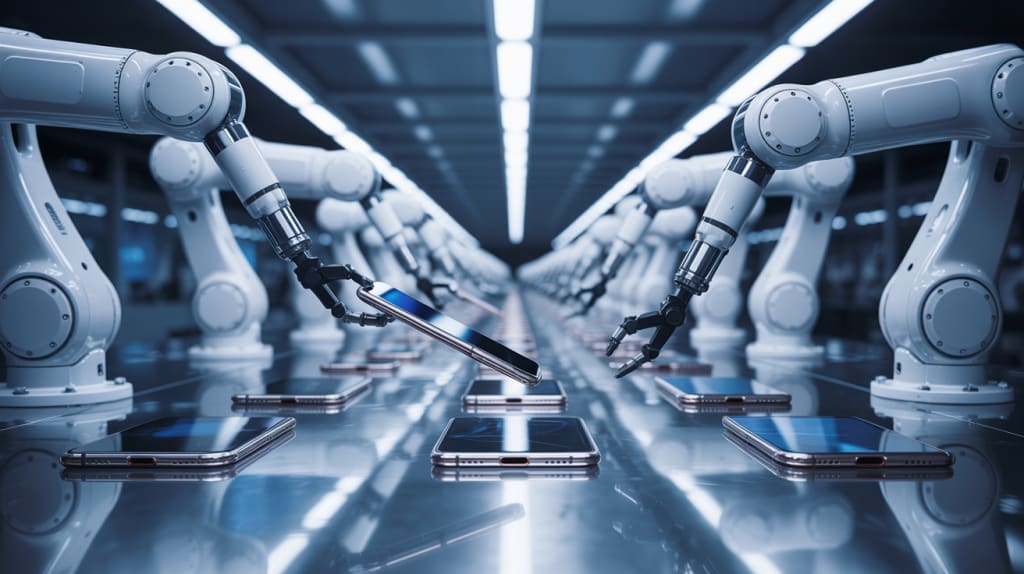
No people on the line. Ceiling lamps are mostly off. Robots handle the lifting, welding, and those tiny screw twists. Xiaomi’s plant in Changping, Beijing, fills 81,000 m²—about eleven soccer fields—and works day and night without coffee breaks.
Quick facts, boom-boom style:
- Always on—24 / 7
- Lights off except for safety beacons
- Nobody in the aisles unless something breaks
- One finished smartphone every single second
(Pause. One… two… another phone.)
Speed and Volume
That headline pace—one phone each second—adds up to roughly ten million flagship phones a year if the line keeps humming. No shifts, no lunch whistles, just tick-tick-tick.
The Brain of the Place
The control stack is the Hyper Intelligent Manufacturing Platform, or HyperIMP. Think of it as the factory’s brain. It watches sensors, tweaks settings, and even books repairs before a bearing squeals.
Inner-voice moment: “Does that mean the system fires off emails by itself?”
Answer from an engineer: “Yes. The software opens the ticket on its own.”
Money on the Table
Building this wonder took 2.4 billion yuan—about USD 330 million. Some online voices call that low for a plant this smart, but that’s the number in filings and news posts. Either Xiaomi bargained hard with suppliers, or local subsidies bridged the gap. Doesn’t matter—the gate is open and the line is live.
Clean Enough for Surgery
Dust kills micro-electronics. Xiaomi runs micron-level dust removal akin to an operating room. Picture robots in a giant air shower:
- Smooth airflow from the ceiling to the floor
- Vacuum ducts under the grates
- Any human who steps in must gown up head-to-toe
- People are still around (but fewer)
- The floor stays empty, yet humans hover nearby:
- A small repair team is on call
- Dashboard watchers in a glass room
Software Staff Tuning Code
A Reddit comment said bluntly:
“The people are just the repair crew.”
Old roles—hand solder, visual inspection, and shrink. New ones—robot tech, data analyst—grow. A World Economic Forum report once warned that automation could move up to 85 million jobs by 2025
Why Build Like This? Three Straight Reasons
- Speed and yield. Faster line, fewer defects.
- Cost over time. Running robots can beat human payroll once you count maintenance and amortization.
- Energy and waste. AI trims scrap and dials power down when loads are light.
Wider Robot Wave
China installed about 290,000 industrial robots in 2023—over half the world’s total
Cobots, swarm bots, even clumsy humanoids ride that same wave. Cheaper sensors plus smart chips push them everywhere.
Messy notepad:
Cobots = work with humans
Swarm = many little bots, simple brains
Humanoid = still awkward, hype high
The Green Angle
Robots don’t need bright lights or AC for comfort. By trimming those loads and cutting rework, Xiaomi says the plant wins on carbon footprint
Servers running HyperIMP draw power, too, but audits will have the last word.
Beyond Phones: Cars
IXiaomi’s EV plant in Beijing has been running since late 2023. By early 2024, it was already rolling an SU7 off the line every 76 seconds (around 40 cars an hour). Phase 1 can churn out up to 150,000 cars a year, and a Phase 2 expansion—under construction since late 2024—will double capacity in 2025.
Same recipe: heaps of robots, few humans, lights mostly off.
Simple Pros and Cons List
Upside:
- More products, faster
- Steadier quality
- Lower unit cost in the long run
- Safer—machines tackle risky jobs
Downside:
- Big cash up front
- Skill shift; staff need retraining
- Cybersecurity—robots can be hacked
- Less flexible if demand flips overnight
A Short Personal Wrap-up
I watch the line again—imaginary, on a monitor. Phone frames glide, robot arms move, no chatter, no coffee smell. It works. It’s eerie. It’s also just the next step on a road that started with the first conveyor belt.
And yes, every second, a new phone drops off. Another. And another.
All right, your turn: Is Xiaomi’s lights-out revolution thrilling or troubling? Drop your thoughts in the comments—I’m all ears
About the Creator
Francisco Navarro
A passionate reader with a deep love for science and technology. I am captivated by the intricate mechanisms of the natural world and the endless possibilities that technological advancements offer.
Keep reading
More stories from Francisco Navarro and writers in Futurism and other communities.
Robots with Blood and Tongue
In our time of vanishing boundaries between the pulse of life and the hum of circuits, a new breed of machines is stirring. Like evolution's ancient dance from sea to shore, researchers at Cornell University have birthed two remarkable creatures of their own: a serpentine wanderer and an artificial medusa. But these aren't your grandmother's robots—they draw life from an extraordinary elixir, a "mechanical blood" that serves as both their heartbeat and their muscle. Within these pages, we'll dive into how these synthetic beings integrate vitality into their very essence and peek into a future where they might even taste their world, much as we do with our tongues.
By Francisco Navarroabout a year ago in Futurism
Enterprise Agentic AI Market worth USD 171 Billion By 2034
The Global Enterprise Agentic AI Market is projected to reach approximately USD 171 Billion by 2034, increasing from USD 3.6 Billion in 2024, expanding at a remarkable CAGR of 47.2% during the forecast period from 2025 to 2034.
By Roberto Crum3 days ago in Futurism




Comments
There are no comments for this story
Be the first to respond and start the conversation.