
One rock at a time, revealing Mars's buried history
A fresh method for cleaning the rocks of Mars

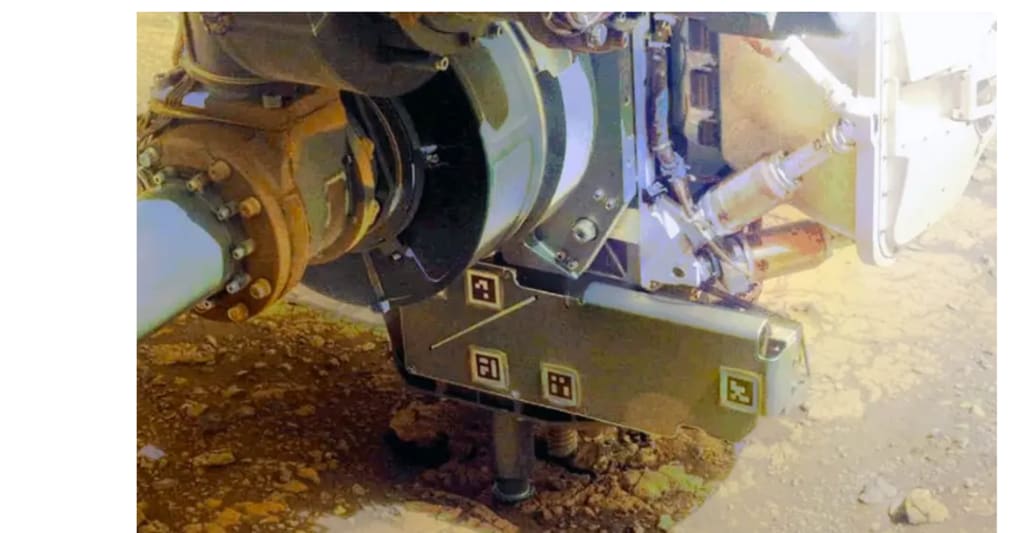
The surface of Mars is only the first step in the exploration process. For this reason, the Perseverance rover from NASA is engaged in more than merely gathering core samples. Additionally, it is sifting through Martian pebbles in search of mysteries hidden behind the dusty exterior.
Perseverance began working on "Kenmore," a recalcitrant rock, on June 3. After removing some debris and scraping away a portion of the surface, the rover examined the inside in greater detail.
The rover analysed the minerals and geological characteristics of the rock using its advanced toolkit. Beginning with a two-inch-wide abrasion patch, Kenmore is the thirty-first rock to be examined in this manner.
Reaching further into a challenging rock
The Perseverance mission’s deputy project scientist is Caltech professor Ken Farley, an isotope geochemist specialising in noble gases. Kenmore was described as "a weird, uncooperative rock" by him.
"On the surface, it appeared to be in good condition—the kind of rock that we could abrasively polish and possibly collect a sample from, if the science was sound," Professor Farley remarked.
However, it vibrated everywhere during abrasion, and little pieces broke off. Thankfully, we were able to descend just far enough to begin an analysis. Scientists are particularly interested in overcoming the dust-covered and worn outermost layers of Martian rocks.
By exposing the unaffected interior, grinding helps reveal the composition of the rock. Additionally, it leaves behind a level area that is ideal for up-close examination with the rover's sensors.
A fresh method for cleaning the rocks of Mars
Rock surfaces were cleaned by spinning grinders with brushes on earlier Mars missions, such as Spirit and Opportunity. To remove dust, NASA's Curiosity rover employed wire bristles. However, Perseverance is adopting a more streamlined and effective strategy.
Perseverance employs the gaseous Dust Removal Tool, or gDRT, in place of brushes. After grinding, it releases a burst of nitrogen gas to remove any remaining particles.
Kyle Kaplan, a robotic engineer at NASA's Jet Propulsion Laboratory in Southern California, explained, "We use Perseverance's gDRT to fire a 12 pounds per square inch (about 83 kilopascals) puff of nitrogen at the tailings and dust that cover a freshly abraded rock."
Each abrasion requires five puffs: four to clean the abrasion and one to exhaust the tanks. Furthermore, gDRT still has a ways to go. We have puffed 169 times since we landed at Jezero Crater more than four years ago. Approximately 800 puffs are left in the tank.
Because it doesn't come into contact with the rock, the gDRT is particularly helpful because it eliminates the possibility of introducing impurities from Earth into the mixture.
A closer examination using advanced technology
Perseverance uses a suite of sophisticated sensors to get to work after the dust is swept away. The rover's robotic arm is used to capture close-up photos with a camera known as WATSON.
The SuperCam then starts directing hundreds of small laser pulses at the abraded area from its mast. A spectrometer analyses the small particles that are ejected by each laser beam.
Cathy Quantin-Nataf, a team member from the University of Lyon in France, stated, "SuperCam made observations in the abrasion patch and of the powdered tailings next to the patch."
We learnt from the tailings that this rock contains clay minerals, which are comparatively typical of clay minerals found on ancient Mars. These minerals contain water as hydroxide molecules coupled with iron and magnesium. We were able to determine the rock's chemical composition from the abrasion spectra, which revealed increases in iron and magnesium.
Not every rock on Mars is made equally.
Kenmore was also examined by the SHERLOC and PIXL instruments. They added something fresh and supported SuperCam's findings. Feldspar, a mineral distinguished by its luminous appearance on the Moon, was found by the instruments. More significantly, a manganese hydroxide mineral was detected by PIXL.
This type of substance has never been discovered during the mission before. The rover is now leaving Perseverance to investigate further regions along the border of Jezero Crater after completing its work on Kenmore.
"Working on Mars rover missions teaches you early on that not all rocks on Mars are made equal," Farley said. "Future missions won't have to deal with strange, uncooperative rocks thanks to the data we currently collect from rocks like Kenmore."
Rather, they will have a far better understanding of whether it is feasible to drive over it, sample it, extract the hydrogen and oxygen inside for fuel, or determine whether it would be viable for use as habitat construction material.
Record-breaking on the Red Planet
A new personal record was set by Perseverance on June 19, mission day 1,540. One autonomous drive took it 1,348 feet (411 meters) in length. Compared to its previous record set in April 2023, that is around 210 feet more.
The rover frequently uses a mechanism called AutoNav to drive autonomously while the science team chooses the overall course. As a result, it can travel between regions of interest more quickly and without waiting for every order from Earth.
According to Camden Miller, a rover driver for Perseverance at JPL, "Perseverance drove 4½ football fields and could have gone even farther, but that was where the science team wanted us to stop." "And our stop target location was perfect."
We gain more knowledge on how to maximise our rover's performance every day we operate on Mars. Furthermore, what we discover today won't need to be learnt by future Mars expeditions.
About the Creator
Keep reading
More stories from Francis Dami and writers in Futurism and other communities.
The 'cosmic web,' the universe's secret roads, is seen for the first time by astronomers.
Space isn't empty. Even the greatest telescopes have trouble seeing the minuscule strands of matter that are woven throughout it. This enormous network is known to astronomers as the cosmic web. It is the unseen framework that holds galaxies in place and directs their expansion.
By Francis Dami9 months ago in Futurism
Europe Gene Therapy Market Within Cell & Gene Therapy: Fast‑Growing Niche in a USD 7.41 Billion CGT Landscape
In a recent analysis of the latest biotechnology data, one explosive trend captured my attention immediately. The Europe gene therapy market is rapidly evolving into the most critical segment of the broader Cell & Gene Therapy (CGT) sector. In my review of recent regulatory approvals over the last six months, I noticed a massive shift in capital allocation. Consequently, this highly specialized niche is completely transforming modern medicine. Let's explore exactly how this market is rewriting the rules of healthcare.
By Joey Mooreabout 16 hours ago in Futurism
Tactical Communication Market to Hit Nearly USD 39.1 billion by 2034
Tactical Communication Market Overview The Global Tactical Communication Market is projected to reach approximately USD 39.1 Billion by 2034, increasing from USD 21.4 Billion in 2024, reflecting a CAGR of 6.2% during the forecast period from 2025 to 2034. Market expansion is largely driven by rising investments in advanced military communication infrastructure and the growing need for secure, real time data exchange during defense operations. Tactical communication systems support battlefield coordination, intelligence sharing, and command and control functions across modern military environments.
By Roberto Crum3 days ago in Futurism


Comments
There are no comments for this story
Be the first to respond and start the conversation.