
One Half Terror
The Ray Bradbury Theater "The Murderer" (Season 4, Episode 2)

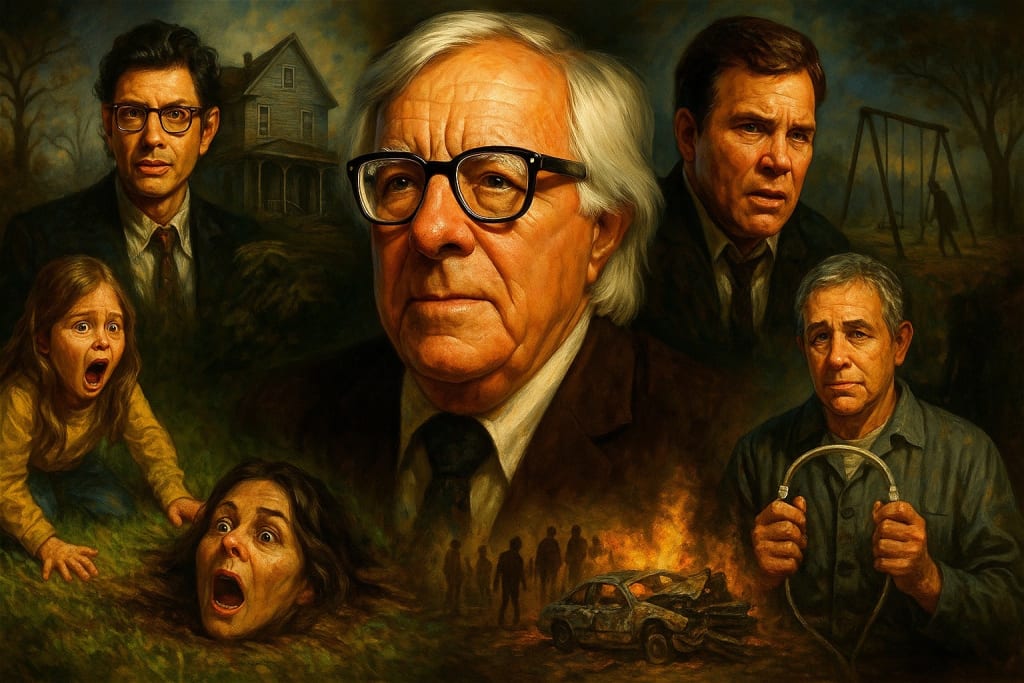
“We're prisoners of our own progress, manacled by squawking machines.”
— "The Murderer," Ray Bradbury Theater (1990)
The Ray Bradbury Theater is one of television’s all-time greats—a deeply lyrical and darkly poetic half-hour journey into the heart of an ever-swirling mysterious world, wherein we’re gifted with Ray’s singular visions of the present and, most especially, the future—marked by aberration, but still clinging, like a drop of dandelion wine, to the lip of our humanity. Waiting to be sipped by lips we dream of kissing—or to fall, unclaimed, into the looming void below.
The first seven episodes are a tour of genre dreamscapes, ranging from the fantastical tale of a man who replaces himself with a robotic double (“Marionettes, Inc.,” Season 1, Episode 1) to a sharp, dark gem starring Jeff Goldblum (“The Town Where No One Got Off,” Episode 4). Goldblum, fresh off hatching as Brundlefly in Cronenberg’s The Fly, plays a slick big-city drifter who disembarks in a dusty small town, only to find the predator lurking in the polite, poisoned bosom of flyover America.
William Shatner delivers a memorable turn in “The Playground” (Episode 2), confronting the phantoms of childhood bullying with a performance that walks the tightrope between repression and madness. Episode 3, “The Crowd,” depicts fatal car wrecks viewed by an ever-growing congregation of zombie-like onlookers—eerily prescient, like something from Ballard, where the car crash becomes the erotic and existential climax of modern life.
Drew Barrymore appears in “The Screaming Woman” (Episode 5) as a little girl with a battered issue of Tales from the Crypt in her back pocket—proof enough this first season was all horror, and all heart.
Future Calling
But the future was calling. In “The Toynbee Convector” (Season 4, Episode 2), James Whitmore plays Stiles, an aging time traveler celebrated for his visionary role in saving humanity from ecological and spiritual collapse—only for it to be revealed as a hoax. The paradox threatens to unravel the comfort of the lie. But Bradbury doesn’t fear the lie—instead, he suggests we may need it. Sometimes, the truth is too fragile to live by.
Then there’s “The Murderer” (Season 4, Episode 2), where we stare into the glass darkly—a vision of the future even Stephen King might have envied when he described television as “the glass teat” in Danse Macabre. The episode plays today like a ghostly premonition. Bruce Weitz stars as Albert Brock, a man in an institutional cell, visited by psychiatrist Dr. Arnold Fellows (Cedric Smith). Brock calmly explains that from a young age, he was given telephones. Then cordless phones. Sony Walkmans. Lapel phones. Computers. The endless voice of the machine.
Brock becomes a soft-spoken Luddite, raging against the techno-babble tide by sabotaging the very tools of his torment. He pours chocolate milkshakes into circuit boards. He contemplates murdering his wife for her robotic complicity. It’s ridiculous. And yet—eerily familiar.
The world of noise, intrusion, synthetic voices, and constant connection that drove him mad? That’s our world now. Everyone’s always on their phone. That was science fiction in 1990. Now, it's just Tuesday.
Bradbury’s predictive powers were as sharp as Asimov’s, but painted with poetic ink. He was the Poet Laureate of Tomorrow, and in his vision, man would rise—must rise—against the soulless voices of his own creation. To reclaim the fine wine of his inner life. To journey once more beyond the veil, knowing that paradise, if it comes at all, comes at a price.
After all: “Mars is Heaven.”
But tomorrow breeds murderers.
Phantoms in the Machine
Shatner’s episode confronts the psychological aftermath of childhood abuse, with his character casting off the weight of past torment by sacrificing another—a dark transaction for spiritual freedom.
Goldblum’s city slicker meanders through a town steeped in menace, its silence heavy with unseen monsters. The sign might as well read: “Nobody Gets Off Here.”
Barrymore’s character carries a comic book like a talisman, but it’s the screams from beneath the soil that haunt her—a buried woman, a buried truth. Her mother, perhaps, in metaphor, beneath suburban pretense, beneath the manicured lawn. Horror is not out there. It is underfoot. And memory has a way of clawing back through the dirt.
Madeline Usher returns. Morella reincarnates. The past never dies in Bradbury—it gestates.
Ray opened every episode riding a creaky elevator to his studio. His office was a magician’s toy shop: cluttered, personal, filled with talismans of memory. “I’ll never starve in here,” he said. He didn’t. The toys always spoke.
And the journey?
As Ray said—it was always one-half exhilaration.
And one-half terror.
Excelsior.
"The Murderer" (1990) - Best Episode of 'Ray Bradbury Theater'
Follow me on Twitter/X: BakerB81252
My book: Cult Films and Midnight Movies "From High Art to Low Trash" Volume 1
Ebook
About the Creator
Tom Baker
Author of Haunted Indianapolis, Indiana Ghost Folklore, Midwest Maniacs, Midwest UFOs and Beyond, Scary Urban Legends, 50 Famous Fables and Folk Tales, and Notorious Crimes of the Upper Midwest.: http://tombakerbooks.weebly.com
Block Cuts 40% of Workforce, Citing AI — CEO Jack Dorsey Says Most Companies Will Follow
What Happened Block, the financial technology company founded by Jack Dorsey, announced it is laying off roughly 40% of its workforce, cutting more than 4,000 employees and reducing total headcount to just under 6,000.
By Behind the Tech2 days ago in Futurism
Boundless
A geographical map could take you there. To the places I've been, to the sights I've seen, to the landscapes I've climbed. But no compass could point you in the direction of my memories. To the experiences I've lived, to the happiness I've felt, to the wonder I've held so close to my heart.
By Alyssa Musso7 days ago in Writers



Comments
There are no comments for this story
Be the first to respond and start the conversation.