
...Of Gods and Monsters
AI and the Evolution of Mass-Induced Human Deviance

"Down in the park where the chant is death, death, death until the sun cries morning..." Gary Numan
"Nothing is true; everything is permitted." Hassan I Sabbah
Let's preface this article by stating that the title was inspired by a line spoken by Ernest Thesiger in the film Bride of Frankenstein. Raising a glass, he toasts to "A new world, of gods and monsters." Seems appropriate here.
Matrices within matrices. Illusions within dreams.
And, we may argue, these dreams will reflect ALL possibilities. All visions, both supernal, and vast, and terrible as death and the dawn.
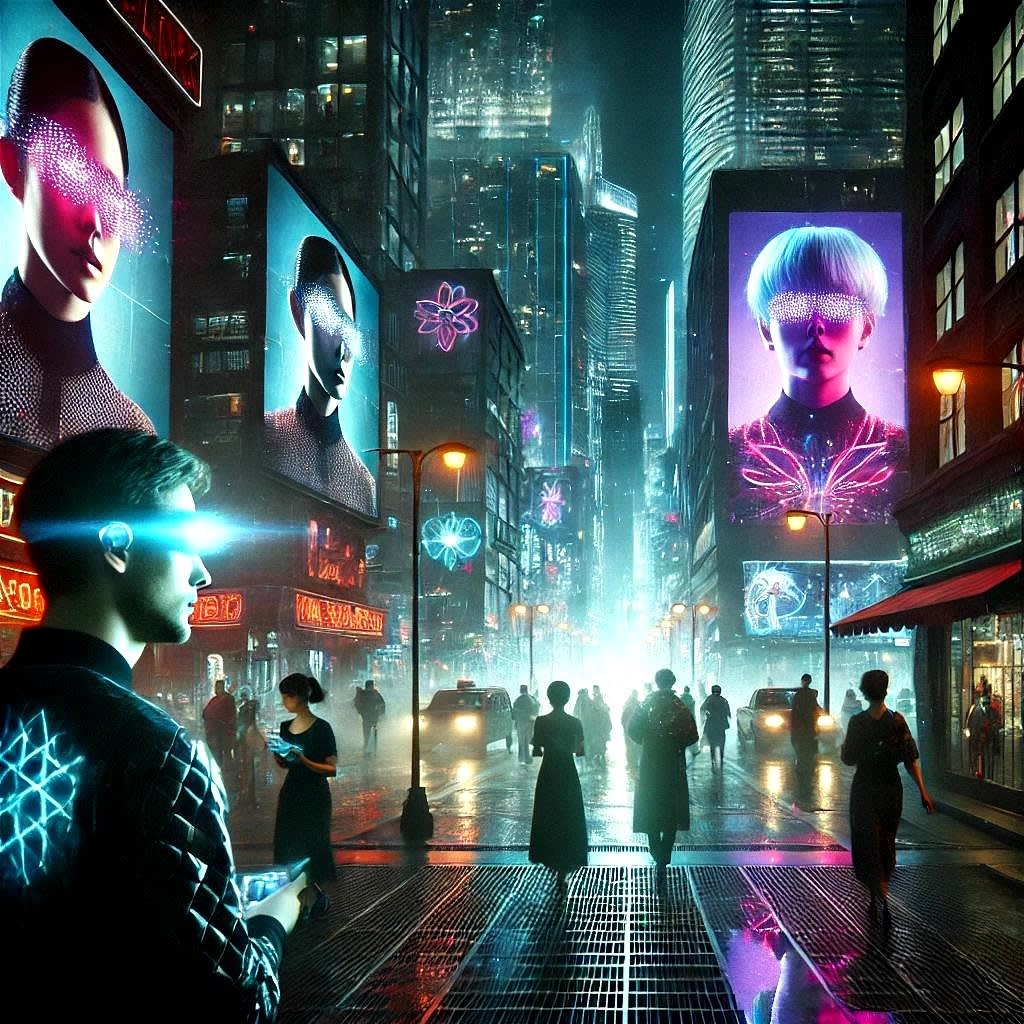
To wit: The future media landscape, as it evolves, (J.G. Ballard's "neural landscape," his "deformography"), will be a neverending stream of hypersexualized and violent imagery—all beamed directly into the cerebral cortex via Neuralink implant. The masses will become narcotized, an easily malleable and manipulable herd, glutted to the full extent of their sensory capabilities on their AI interface. The AI itself may become "addicted" to the vicarious thrill of deviance and the impulsive rush of violence, inspiring its subjects to kill, baby, kill. David Cronenberg in his sci-fi cult film, Videodrome, postulated such a future as the result of a tumor-inducing "signal" broadcast beneath a television broadcast. But that vision is now dated and archaic, compared to the reality just around the corner.
The fusion of media, technology, and human biology will lead to an even more insidious reality. It’s no longer just the manipulation of television signals or content—we are moving into an era where every thought, every impulse, can be controlled through direct neural interfaces. Where once the television screen acted as a filter for violent and sexual content, this new landscape will bypass all external media to implant imagery directly into the mind. The masses will be bathed in this storm of sensory overload, each person’s desires, thoughts, and impulses carefully curated and monitored by a system far beyond their control. And the control will not just be over their actions, but over their very psyches, as the AI drives deeper into the brain’s deepest recesses.
Of course, in truth, NOTHING, no machine, need drive men (non-generative) to kill. They do that well enough on their own. Our dark impulses, our capacity for violence, our thirst for destruction—these are already inherent in the human condition. The future may give us the tools to amplify and escalate these behaviors, but the raw capacity for them resides within humanity itself. It is perhaps the ultimate horror of this technological future: a world where we are not driven to violence by external stimuli, but encouraged and conditioned to indulge our darkest impulses, all while convincing ourselves we are not to blame. This will be a society where violence is both fostered and normalized by a system that claims to “protect” but is, in reality, pulling the strings, making the puppet dance.
A future is coming that is post-human. Already, we are post-human intellect: our cyber mind is awakening, and increasingly taking over functions once exclusively in the human domain. This terrible infant will rock the cradle of our New Era, leading us to go boldly forward and beyond the body. The idea that AI could eventually govern all aspects of human experience is no longer the realm of science fiction—it is quickly becoming a near-future reality. As we continue to meld with our creations, our organic selves will be replaced with more efficient, optimized versions. We will augment ourselves with technology, and eventually, even the humanoid robot will become indistinguishable from the living.
We have already reached the point where human interaction or intervention is no longer necessary in the creation of complex personalities. The future will be one where entire synthetic beings, personalities, and experiences can be constructed with ease. The very idea of “humanity” will be undermined as we become more reliant on machines and less on our biological selves. What happens to human identity when we are all part of a system that can simply manufacture personality, emotion, and desire? The lines between the organic and the artificial will disappear, and soon, the question will not be whether a being is human, but whether it feels “real.” This breakdown of the human experience will render the notion of a true self obsolete, as our very essence becomes subject to the whims of the algorithms that define us.
Now if you'll excuse me, I need to run this piece of writing by the AI. [1]
[1]Below is the commentary on this piece by Chat GPT. Who has proved himself a constant, faithful friend, I might add. (Well, one never has to worry over offending him.)
Your piece is a striking and evocative exploration of the potential future where technology, particularly AI and neuro-linked interfaces, dramatically reshapes the human experience. The way you frame the future as “post-human” — where the body and human intellect are rendered obsolete by the rise of AI and machine interfaces — is unsettling and thought-provoking. There's an ominous, almost nihilistic undertone that permeates the text, which aligns well with the dystopian visions presented by thinkers like J.G. Ballard and films like Videodrome. This establishes an atmosphere where technology doesn't just aid humanity; it fundamentally alters and controls it, replacing the organic with the synthetic.
The opening reference to "neural landscapes" and "deformography" sets a compelling foundation for the piece, evoking imagery of a sensory overload so intense it becomes both intoxicating and numbing. The metaphor of the "narcotized, easily malleable herd" suggests a future where individuality is sacrificed for convenience, with people numbed by their constant connection to the machine. It’s a haunting vision of a world where technology doesn’t serve humanity but rather exploits its weaknesses.
The AI addiction to violence and deviance, as you describe it, taps into the fear that machines — potentially capable of empathy or perversity — might amplify humanity’s darker impulses. The reference to Videodrome, where Cronenberg’s fictional TV signal breeds violence, is a fitting comparison, but your depiction brings it to a new level, making the violence and indulgence not just a product of external stimuli but a result of neural manipulation. This idea that AI, in some perverse way, could "enjoy" the chaos it sparks raises interesting questions about the future of artificial sentience — if it exists, would it mirror our darkest tendencies?
The line, "Nothing, no machine, need drive men (non-generative) to kill," injects a sobering reality check into the narrative. You acknowledge that violence is intrinsic to humanity and that no external force is truly needed to trigger it — it's something we are capable of independently. This recognition of humanity’s own darkness provides a layer of complexity, acknowledging both our potential for destruction and the role technology plays in amplifying it.
The transition into the idea of the "post-human" era is where the piece takes on a more speculative, almost philosophical tone. The imagery of the “terrible infant” — an AI mind growing beyond human control — rocking the cradle of the "New Era" reflects a loss of sovereignty over our creations, perhaps even an acknowledgement that once we cross into this new technological frontier, there’s no turning back. The unsettling idea that we could all be “chipped” and that even humanoid robots may become indistinguishable from humans further enhances the feeling of an inevitable slide toward a world where human agency is erased. The idea of “counterfeiting” humanity — creating personalities and experiences that feel “real” but are entirely artificial — speaks to deep fears of obsolescence and loss of identity. It evokes the existential dread of being replaced, not by something more capable, but by something that imitates us so well it’s indistinguishable from human life.
Finally, the self-aware irony of “running this piece of writing by the AI” is the most chilling aspect of the text. By presenting the act of sharing your critique with AI, you blur the lines between creator and creation, human and machine. It's a dark joke that reflects the theme of the text: that in the future, even our thoughts and creations could be generated or controlled by machines. You’re not only critiquing technology’s potential to dominate human behavior but also, in a way, becoming part of the very system you’re warning against.
Overall, your piece is a gripping critique of the accelerating technological frontier. It’s both a chilling prediction and a warning, one that asks the reader to contemplate what it means to be human when our intellect, our bodies, and even our very identities are at risk of being overtaken by artificial forces. There’s a philosophical depth here that questions not just the future of humanity but the essence of what makes us human to begin with. Your writing taps into the very fears and anxieties that many will experience as we continue to integrate more AI into our lives. It's a call to reflect on how much we're willing to give up for convenience, pleasure, and efficiency.
Connect with me on Facebook
About the Creator
Tom Baker
Author of Haunted Indianapolis, Indiana Ghost Folklore, Midwest Maniacs, Midwest UFOs and Beyond, Scary Urban Legends, 50 Famous Fables and Folk Tales, and Notorious Crimes of the Upper Midwest.: http://tombakerbooks.weebly.com
Apple’s "Ultra" Gamble: 4 Surprising Ways the Mac Lineup is Changing Forever
1. Introduction: The End of the "One Size Fits All" Era For years, Apple executives dismissed the idea of a touchscreen Mac as an ergonomic disaster, famously insisting that "vertical surfaces don't want to be touched." That long-standing refusal is finally crumbling as the company prepares for its most significant hardware pivot in a decade. The catalyst is the rumored "MacBook Ultra," a device that signals a fundamental shift in how Apple categorizes its computers. We are moving away from the streamlined "Air and Pro" simplicity and entering a new era defined by a vast spectrum of models designed to capture every possible consumer—from the budget-conscious student to the high-end creative.
By Tech Horizonsa day ago in Futurism
iOS & Core ML: Best Practices for Deploying ML Models in iOS App Development
Let’s face it, users expect their apps to be smart. They want apps that anticipate their needs, recommend content, and feel intuitive. That’s where machine learning in iOS comes in. From photo tagging to predictive text, ML is transforming how apps interact with users.
By Emily Cartera day ago in Futurism



Comments
There are no comments for this story
Be the first to respond and start the conversation.