
Mobile Application Market Size and Forecast 2025–2033: The Digital Economy in Your Pocket
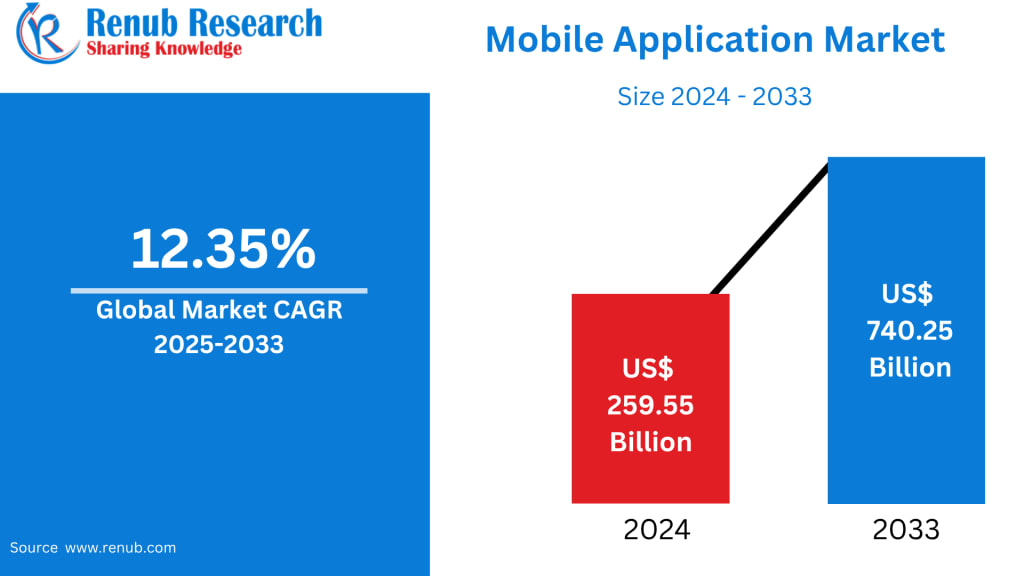
Mobile Application Market is expected to reach US$ 740.25 billion by 2033 from US$ 259.55 billion in 2024, growing at a CAGR of 12.35% during 2025–2033, driven by smartphone penetration, 5G rollout, AI integration, mobile commerce expansion, and rising demand for digital experiences.

Mobile Application Market Overview
A mobile application, commonly known as a mobile app, is a software program designed specifically for smartphones, tablets, and other portable devices. These apps deliver a wide range of functionalities—from communication and entertainment to productivity, navigation, healthcare, education, and financial services. Most mobile apps are distributed through platform-based marketplaces such as Google Play Store and Apple App Store, although alternative stores and enterprise distribution channels also exist.
Mobile apps can be native (built for a specific operating system), web-based, or hybrid, combining features of both. Their popularity lies in their accessibility, ease of use, and ability to provide personalized, on-the-go experiences. Behind the scenes, modern mobile app development integrates user-friendly UI/UX design, secure backend infrastructure, cloud connectivity, AI capabilities, and advanced analytics, ensuring seamless performance and data security.
The mobile application industry has evolved into one of the most powerful pillars of the global digital economy. With billions of users interacting with apps daily, mobile platforms now shape how people work, shop, learn, communicate, and entertain themselves. According to Renub Research, the Mobile Application Market was valued at US$ 259.55 billion in 2024 and is projected to reach US$ 740.25 billion by 2033, reflecting the industry’s immense growth potential over the next decade.
Key Growth Drivers of the Mobile Application Market
Rising Smartphone Penetration Worldwide
The single most important growth catalyst for the mobile application industry is the rapid increase in smartphone adoption. Smartphones are becoming more affordable, powerful, and accessible, especially in emerging economies across Asia, Africa, and Latin America. This expanding user base directly translates into higher app downloads and usage.
According to the International Telecommunication Union (ITU), the world had 5.4 billion internet users in 2023, representing nearly 67% of the global population. For most of these users, smartphones are the primary gateway to the internet. Studies show that millennials open mobile apps up to 50 times per day, highlighting how deeply embedded apps are in everyday life. As smartphone usage continues to grow, so does the demand for innovative mobile applications.
Explosion of In-App Purchases and Subscription Models
The monetization landscape of mobile apps has shifted dramatically. While free downloads remain the norm, in-app purchases and subscription-based models now generate a significant share of total revenue. Users increasingly pay for premium features, ad-free experiences, exclusive content, cloud storage, and advanced functionalities.
Gaming apps, fitness platforms, streaming services, productivity tools, and education apps are leading this trend. Improved digital payment infrastructure, secure wallets, and seamless checkout experiences have made it easier for users to spend within apps. The freemium model—free access with optional paid upgrades—has proven particularly successful in boosting user engagement and lifetime value.
AI and Machine Learning Integration
Artificial Intelligence (AI) and Machine Learning (ML) are transforming mobile apps from static tools into intelligent digital assistants. AI-powered personalization engines recommend content, predict user behavior, automate workflows, and improve customer engagement. Voice assistants, chatbots, image recognition, predictive analytics, and real-time translation are now common app features.
In sectors such as healthcare, finance, retail, and education, AI-driven apps are enhancing efficiency and delivering personalized experiences at scale. As AI becomes more affordable and accessible to developers, its integration into mobile apps will further accelerate market growth.
5G Technology and Enhanced Mobile Experiences
The global rollout of 5G networks is unlocking new possibilities for mobile applications. Faster speeds, lower latency, and higher bandwidth enable high-performance apps such as cloud gaming, AR/VR experiences, live streaming, and real-time collaboration tools.
With 5G, mobile apps can deliver near-instant responses and richer multimedia experiences, pushing innovation in gaming, remote work, healthcare monitoring, and immersive entertainment. As 5G coverage expands globally, the demand for data-intensive apps is expected to surge.
Expansion of Mobile Commerce and Digital Services
Mobile apps are now at the center of the global e-commerce ecosystem. Consumers increasingly prefer shopping through apps due to convenience, personalization, and exclusive offers. From retail and food delivery to banking and travel, apps are redefining how services are delivered.
Mobile payment systems, buy-now-pay-later services, and integrated loyalty programs further strengthen the mobile commerce ecosystem. Businesses across industries are investing heavily in mobile-first strategies to capture this growing digital consumer base.
Challenges Facing the Mobile Application Market
Intense Competition and Market Saturation
With millions of apps available across app stores, competition is fierce. Discoverability remains a major challenge for developers, especially smaller companies and startups. Even high-quality apps can struggle to gain visibility without strong branding, effective marketing, and continuous innovation.
User expectations are also rising. Apps must deliver flawless performance, frequent updates, and unique value to retain users. Failure to meet these standards often results in quick uninstalls and low engagement rates.
Data Privacy and Security Concerns
Mobile apps collect vast amounts of sensitive data, including personal information, location details, financial records, and behavioral insights. As cyber threats grow, ensuring data security has become a top priority for developers and companies.
Strict regulations such as GDPR, CCPA, and other national data protection laws require apps to maintain transparency, encryption, and secure data storage practices. Compliance increases development costs and complexity but is essential for building user trust and long-term sustainability.
Regional Insights: Mobile Application Market by Country
United States Mobile Application Market
The United States remains one of the largest and most advanced mobile app markets in the world. High smartphone penetration, strong digital infrastructure, and a culture of innovation drive continuous growth. The U.S. is a global leader in AI, AR, mobile commerce, and app-based advertising.
In March 2024, Snap Inc. introduced sponsored AR filters, enabling brands to engage users even after photo capture—an innovation that expands interactive advertising opportunities. With over 5 billion Snaps created daily, the U.S. market continues to push the boundaries of mobile engagement and monetization.
Germany Mobile Application Market
Germany is a major hub for mobile innovation in Europe, supported by a tech-savvy population and strong data security standards. Android dominates the market, while iOS continues to grow steadily. Popular app categories include finance, e-commerce, gaming, and social media.
The rise of super apps that integrate multiple services into one platform is a key trend. Despite strict regulations, German consumers value secure and high-quality digital experiences, driving sustained growth in the mobile application ecosystem.
India Mobile Application Market
India is one of the fastest-growing mobile application markets globally, fueled by affordable smartphones, low-cost data, and a young, digitally native population. Mobile apps dominate sectors such as fintech, e-commerce, gaming, education, and social media.
Government initiatives like Digital India and UPI-based digital payments have accelerated app adoption. The growth of regional language apps and AI-powered personalization has further expanded accessibility, making India a global hotspot for mobile app development and innovation.
Saudi Arabia Mobile Application Market
Saudi Arabia’s mobile app market is expanding rapidly due to strong internet infrastructure and government-led digital transformation under Vision 2030. Mobile apps are widely used in e-commerce, fintech, healthcare, transport, and public services.
E-governance platforms and on-demand services have increased app usage across demographics. With a young population and high smartphone penetration, Saudi Arabia is emerging as a key mobile innovation hub in the Middle East.
Recent Developments in the Mobile Application Market
November 2024: Ninja MTB Performance launched the Ninja MTB Studio Fitness and Skills App, offering an integrated platform for mountain biking training and fitness.
September 2023: Google introduced new AI-powered features on YouTube, including Dream Screen, enabling creators to use AI-generated video backgrounds in Shorts.
December 2022: Apple launched Freeform, a collaborative canvas app for iPad, Mac, and iPhone, enhancing creative collaboration across devices.
These developments highlight how innovation continues to redefine the mobile application landscape.
Mobile Application Market Segmentation
By Type
Google Store
Apple Store
Other Types
By Application
Gaming
Music and Entertainment
Health and Fitness
Retail and E-commerce
Learning and Education
Travel and Hospitality
Other Applications
By Country (25 Viewpoints)
North America: United States, Canada
Europe: France, Germany, Italy, Spain, United Kingdom, Belgium, Netherlands, Turkey
Asia Pacific: China, Japan, India, Australia, South Korea, Thailand, Malaysia, Indonesia, New Zealand
Latin America: Brazil, Mexico, Argentina
Middle East & Africa: South Africa, United Arab Emirates, Saudi Arabia
Key Players in the Mobile Application Market
Uber Technologies, Inc.
Apple Inc.
Tencent Holdings Limited
Google LLC
Facebook (Meta Platforms), Inc.
Microsoft Corporation
Adobe Inc.
Spotify Technology S.A.
Snap Inc.
Lyft, Inc.
Each company has been analyzed across five viewpoints: company overview, key persons, recent strategies, SWOT analysis, and sales performance, reflecting the competitive and innovative nature of the industry.
Final Thoughts
The mobile application market is no longer just a technology sector—it is the backbone of the global digital economy. From entertainment and commerce to healthcare and education, mobile apps are transforming how people interact with the world. With Renub Research forecasting the market to reach US$ 740.25 billion by 2033, the industry is set for sustained and dynamic growth.
As 5G, AI, cloud computing, and digital payments continue to mature, mobile apps will become smarter, faster, and more deeply embedded in everyday life. Companies that focus on user experience, security, personalization, and innovation will be the biggest winners in this mobile-first future.
About the Creator
Janine Root
Janine Root is a skilled content writer with a passion for creating engaging, informative, and SEO-optimized content. She excels in crafting compelling narratives that resonate with audiences and drive results.
Keep reading
More stories from Janine Root and writers in Futurism and other communities.
Digital Printing Market Size and Forecast 2025–2033: A Global Shift Toward Speed, Customization, and Sustainability
Global Digital Printing Market Outlook 2025–2033 The Global Digital Printing Market is undergoing a major transformation as businesses, brands, and consumers increasingly demand faster, more flexible, and cost-efficient printing solutions. Valued at US$ 33.5 billion in 2024, the market is projected to reach US$ 57.08 billion by 2033, expanding at a CAGR of 6.1% during the forecast period 2025–2033.
By Janine Root 3 days ago in Futurism
About Binding Prometheus
I want to start actively advocating on behalf of my own work, and the most valuable part of my canon is, without a doubt, Binding Prometheus, the play I have been working on since 2019 and only finished in 2023 as part of my MA. The play itself is an amalgamation of a million different inspirations. On one end, it evokes the Ancient Greek myth-play, deriving its own title from the earliest extant work of Western drama we have, Aeschylus’s Prometheus Bound. On the other end, it borrows significantly from the sci-fi bulwarks from over the years, namely Mary Shelley’s Frankenstein and Karel Capek’s Rossum’s Universal Robots. The play could be an episode of Black Mirror, I fear. I don’t know. I’ve only ever seen one episode of Black Mirror.
By Steven Christopher McKnight24 days ago in Futurism
How AI is switching from a skilled tortious to a creative playful in case of video making in 2026
I see that the digital landscape has always been a place. In 2026 the digital landscape faces more stakes than before. People no longer just live in a world. People now live in a world where attention's the most valuable currency. For years the barrier to entry for high‑quality video production was high. The barrier required cameras, complex editing software and hundreds of hours of labor.
By Muhammad Hanzla6 days ago in Futurism
Thoughts on Vocal and the way the world is
"Death cannot stop true love, only delay it." – Wesley in The Princess Bride. I decided to come back to Vocal on a very cold and dark night at the end of December. I had been, and still am, convalescing from a horrible staph infection that had gone misdiagnosed for months. This, paired with the increasing challenges of being healthy, making the best choices for my co-parented child, being a wife, and being a director at a new job, was a lot to manage.
By Jazzy 6 days ago in Confessions




Comments
There are no comments for this story
Be the first to respond and start the conversation.