
Mind-Blowing Discoveries That Changed the Course of History
Unveiling the Greatest Discoveries That Shaped Human History
Introduction
Throughout history, humanity has stumbled upon groundbreaking discoveries that completely altered the way we live, think, and interact with the world. From ancient inventions to modern scientific breakthroughs, these revelations have shaped civilizations, sparked revolutions, and unlocked mysteries of the universe.
In this article, we’ll explore some of the most astonishing discoveries that rewrote history—stories of chance encounters, relentless curiosity, and genius innovations that transformed our world forever.
1. Fire: The Spark of Civilization
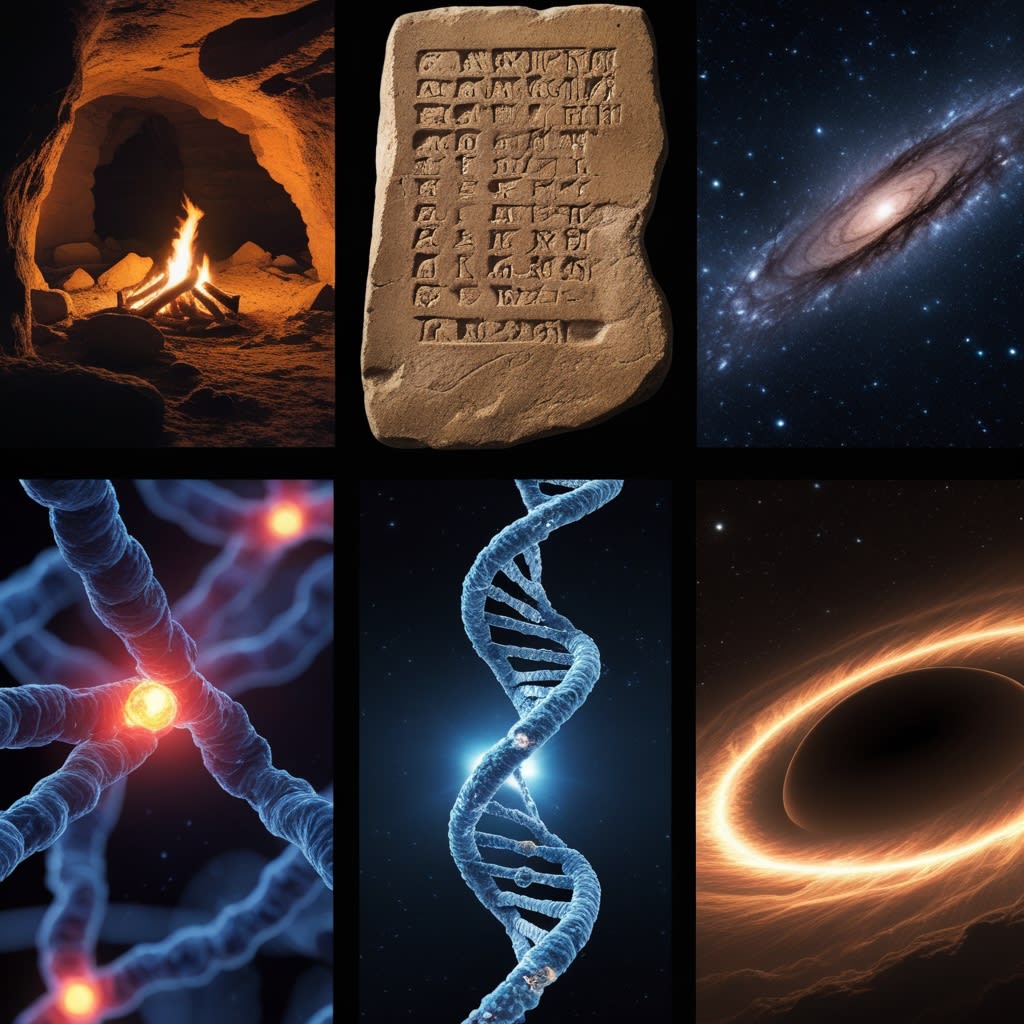
Long before recorded history, early humans discovered fire—a turning point that set us apart from other species. Fire provided warmth, protection, and a way to cook food, which led to better nutrition and brain development.
How it changed history:
Enabled survival in harsh climates.
Led to cooking, improving diet and health.
Became the foundation for later technologies like metalworking.
Bonus Insight: The Discovery of Controlled Fire
Archaeological evidence suggests that early humans may have started using fire over 1.5 million years ago. Sites like Wonderwerk Cave in South Africa contain ash and burnt bones, hinting at the early mastery of fire. This ability not only revolutionized food consumption but also led to more advanced hunting techniques, as fire could be used to drive animals into traps.
2. The Rosetta Stone: Decoding Ancient Secrets
In 1799, a French soldier in Egypt stumbled upon a slab of black basalt covered in inscriptions—the Rosetta Stone. It contained the same text in three scripts: Greek, Demotic, and hieroglyphics.
Why it mattered:
Allowed scholars like Jean-François Champollion to finally decipher Egyptian hieroglyphs.
Unlocked the secrets of ancient Egypt, revealing its history, religion, and culture.
Bonus Insight: Hidden Texts and Ongoing Discoveries
Even today, researchers continue to uncover hidden layers of Egyptian history using AI-powered scans and multispectral imaging. Many ancient texts remain undeciphered, waiting for the next "Rosetta Stone" moment.
3. Penicillin: The Accidental Miracle
In 1928, Alexander Fleming returned to his messy lab after a vacation and noticed something strange—a mold called Penicillium had killed bacteria in a petri dish. This accidental discovery led to the first antibiotic.
Impact on humanity:
Revolutionized medicine by treating deadly infections.
Saved millions of lives during World War II and beyond.
Marked the dawn of modern antibiotics.
Bonus Insight: Antibiotic Resistance – A New Challenge
While penicillin was a game-changer, modern medicine faces antibiotic resistance, where bacteria evolve to resist treatments. Scientists are now exploring alternatives like bacteriophages—viruses that attack bacteria—as a potential solution.
4. The Structure of DNA: The Blueprint of Life
In 1953, James Watson and Francis Crick unveiled the double-helix structure of DNA, thanks in part to Rosalind Franklin’s X-ray images.
Why it was revolutionary:
Explained how genetic information is stored and passed on.
Paved the way for genetic engineering, CRISPR, and medical breakthroughs.
Transformed biology, forensics, and biotechnology.
Bonus Insight: CRISPR and the Future of DNA Editing
Recent advancements in CRISPR gene-editing technology are making it possible to cure genetic diseases like sickle cell anemia and even prevent inherited disorders before birth. Could this be the next great leap in human evolution?
5. Gravity: Newton’s Apple & Einstein’s Relativity
Isaac Newton’s realization about gravity (thanks to a falling apple, as legend goes) and later Einstein’s Theory of General Relativity reshaped our understanding of the universe.
How it changed science:
Newton’s laws explained planetary motion.
Einstein’s work predicted black holes and the bending of spacetime.
Enabled space travel and GPS technology.
Bonus Insight: The First Image of a Black Hole
In 2019, scientists captured the first-ever image of a black hole using the Event Horizon Telescope. This confirmed Einstein’s predictions from over a century ago and opened new doors in astrophysics.
6. The New World: Columbus’s Accidental Discovery
In 1492, Christopher Columbus set sail for Asia but instead landed in the Americas—an event that connected two hemispheres and changed global trade, culture, and history forever.
Consequences:
Led to the Columbian Exchange (transfer of plants, animals, and diseases).
Redefined world maps and sparked European colonization.
Forever altered the course of human migration and economies.
Bonus Insight: The Vikings Got There First
Historians now believe that Leif Erikson and the Vikings reached North America 500 years before Columbus, settling briefly in what is now Canada. However, their discovery did not lead to large-scale colonization.
7. The Printing Press: Spreading Knowledge Like Wildfire
In 1440, Johannes Gutenberg invented the printing press, making books affordable and accessible.
Impact:
Fueled the Renaissance, Reformation, and Scientific Revolution.
Democratized knowledge, leading to mass education.
Allowed ideas (like democracy and human rights) to spread rapidly.
Bonus Insight: The Digital Printing Revolution
The internet has become the modern equivalent of the printing press. Platforms like Wikipedia, e-books, and online journals continue to make information more accessible than ever before.
8. The Internet: The Digital Revolution
What began as a military project (ARPANET) in the 1960s evolved into the internet—a discovery that reshaped communication, business, and society.
How it changed everything:
Connected the world instantly.
Revolutionized commerce (e-commerce, social media).
Became essential for education, work, and entertainment.
Bonus Insight: The Next Evolution – Quantum Internet?
Scientists are developing a quantum internet, which could offer unhackable communications using quantum entanglement. This could revolutionize cybersecurity and data privacy.
Conclusion: What’s Next?
These discoveries prove that curiosity and persistence can unveil world-changing truths. Who knows what future breakthroughs await—quantum computing, immortality, alien life?
One thing is certain: the next great discovery is just around the corner, waiting for a curious mind to uncover it.
About the Creator
Smart Home Technology: What Life Looks Like When Your Home Can Actually Think
It is seven in the morning and the kitchen already knows. The blinds have lifted just enough to let in soft light without waking anyone who is still sleeping. The kettle began heating two minutes ago.
By CurlsAndCommas6 days ago in Futurism
Silicone Coating Market: Sustainable Coating Materials, Low-VOC Formulations & Growth Outlook
According to IMARC Group's latest research publication, global silicone coating market size reached USD 6.9 Billion in 2024. Looking forward, IMARC Group expects the market to reach USD 10.1 Billion by 2033, exhibiting a growth rate (CAGR) of 3.99% during 2025-2033.
By sujeet. imarcgroupabout 15 hours ago in Futurism



Comments
There are no comments for this story
Be the first to respond and start the conversation.