
Mexico 3D Printing Powder Market Size and Forecast 2025–2033
How Mexico Is Becoming Latin America’s Fastest-Growing Hub for Advanced Additive Manufacturing


The Mexico 3D Printing Powder Market is on a transformative growth path—one that reflects the nation’s shift toward advanced manufacturing, industrial modernization, and technological independence. According to Renub Research, the Mexico 3D Printing Powder Market is expected to reach US$ 140.43 million by 2033, rising sharply from US$ 39.58 million in 2024, with an impressive CAGR of 15.11% during 2025–2033.
This surge isn’t happening in isolation. It’s driven by the growing demand for strong, lightweight components in the automotive and aerospace sectors, increased medical customization, and government-backed incentives aimed at building a resilient manufacturing ecosystem. Together, these factors are pushing Mexico into a leadership position in Latin America’s evolving additive manufacturing landscape.
Mexico 3D Printing Powder Industry Overview
Mexico’s 3D printing powder market is maturing on the back of rising adoption across key industries—automotive, aerospace, healthcare, and advanced manufacturing.
In the automotive sector, 3D printing offers unparalleled freedom for lightweighting, enabling the creation of complex geometries that reduce vehicle weight, improve performance, and lower production costs. The aerospace industry, with its stringent safety standards and demand for precision, is increasingly relying on powder-bed fusion and specialty metal powders to produce critical components.
The healthcare sector is equally vital to this growth. Surgeons and hospitals are turning toward custom implants, prosthetics, and biocompatible materials that offer better patient matching and faster recovery. Each application relies heavily on high-quality powders, particularly titanium, stainless steel, ceramics, and medical-grade polymers.
Government policy is another significant growth accelerator. The January 13, 2025 announcement of “Plan México” marked a major milestone, signaling federal commitment to expanding advanced manufacturing capabilities. Through tax incentives, R&D funding, and innovation-friendly regulations, the government is making additive manufacturing more accessible for both local companies and multinational manufacturers operating within the country.
With a wider availability of metal alloys, thermoplastic polymers, composites, and ceramic powders, Mexican manufacturers now have the material diversity required for specialized, high-performance applications. As adoption deepens, Mexico is positioning itself as an essential contributor to global additive manufacturing supply chains.
Key Factors Driving Mexico’s 3D Printing Powder Market Growth
1. Rising Industrial Adoption & Technological Advancements
Industries across Mexico are quickly integrating 3D printing into their operations. Automotive giants, aerospace suppliers, medical device manufacturers, and industrial engineering firms now view 3D printing as a strategic necessity rather than an experimental technology.
Technological advancements are making this transition easier. Today’s 3D printers can handle:
Metal alloys (titanium, aluminum, steel, nickel)
Engineering-grade thermoplastics
Composites with enhanced mechanical properties
Ceramic and glass powders for specialized applications
These innovations improve:
Part durability
Accuracy and surface finish
Production speed
Material compatibility
As demand for superior material performance grows, so does the need for high-quality 3D printing powders, fueling market expansion.
2. Strong Government Support & Strategic Investments
Government-backed incentives are playing a central role in making additive manufacturing more affordable and scalable. Mexico offers:
Tax exemptions for companies adopting advanced manufacturing
R&D grants for universities, startups, and industrial labs
Subsidies encouraging domestic powder production
Support for innovation clusters such as technology parks and AM hubs
These policies reduce financial barriers, especially for small and mid-sized manufacturers, and stimulate local innovation.
Government initiatives are also aligning with global trends—supporting Industry 4.0, automation, and digital transformation. This environment fosters public-private collaboration, empowering Mexico to compete internationally in the 3D printing materials sector.
Challenges in the Mexico 3D Printing Powder Market
1. High Raw Material and Production Costs
Despite rapid growth, Mexico’s 3D printing powder market faces notable hurdles. High production costs remain the most significant challenge, especially for metal powders, which require:
Specialized manufacturing environments
High-temperature smelting
Strict particle size uniformity
Advanced milling and atomization processes
Mexico also imports a large percentage of raw materials, exposing local manufacturers to:
Currency fluctuations
Customs expenses
Transportation costs
These factors increase the price of 3D printing powders, making adoption difficult for small and medium enterprises. Solutions lie in strengthening local production capabilities and optimizing supply chains to stabilize costs.
2. Technical Barriers in Quality Control & Material Performance
3D printing powders require extreme precision. Any inconsistency in particle size, moisture, flowability, or chemical composition can compromise the printed product’s quality.
For industries like aerospace, defense, and medical devices, powder inconsistency is unacceptable.
Mexico faces challenges including:
Limited availability of advanced testing facilities
Need for standardized quality certification protocols
Shortage of highly skilled AM specialists
Environmental sensitivity of certain powders to humidity or storage conditions
Expanding Mexico’s testing and certification capacity is essential to strengthening reliability and international competitiveness.
Mexico 3D Printing Powder Market Overview by Regions
Mexico’s 3D printing powder market is expanding across major industrial corridors, with regional specialization shaping the market landscape.
Northern Mexico: Industrial Powerhouse for Metal Powders
Northern states such as Nuevo León, Coahuila, and Chihuahua contribute the largest share of Mexico’s 3D printing powder demand. This region is home to major automotive clusters and aerospace facilities, making it a natural hub for advanced materials.
Key attributes include:
High demand for metal alloys (aluminum, titanium, steel)
Established SLS and powder-bed fusion ecosystems
Cross-border synergy with U.S. manufacturing supply chains
New partnerships like Sintratec–Sun Digital, which expand access to industrial-grade SLS powders
Manufacturers here are exploring eco-friendly, biodegradable powder alternatives, reflecting growing environmental stewardship.
Northern Mexico’s industrial infrastructure and investor-friendly environment make it the strongest contender for national leadership in additive manufacturing materials.
Central Mexico: Innovation Hub & Home to Latin America’s First AM Consortium
Central Mexico—encompassing Querétaro, Guanajuato, and Jalisco—is evolving into a premier innovation cluster for 3D printing.
Querétaro hosts Latin America’s first Additive Manufacturing Consortium, providing:
Research collaboration
Training programs
Specialized powder development
Industrial testbeds for AM technologies
Companies such as 3D Factory MX have expanded their operations in Guadalajara and Monterrey, increasing local availability of SLS and industrial-grade materials.
Central Mexico’s strength lies in:
A dense network of universities
A booming automotive and aerospace manufacturing base
Strong public-private partnerships
Demand for high-grade polymer and metal powders is rising sharply, positioning this region as a key nexus for R&D and high-tech material development.
Southern Mexico: Emerging Market for Biocompatible & Medical Powders
Southern states—including Yucatán, Chiapas, and Oaxaca—are seeing steady adoption, particularly in the medical, dental, and small-scale manufacturing sectors.
Key drivers include:
University-led initiatives exploring prosthetics and educational prototypes
Growing demand for custom dental implants
Interest in biocompatible polymers and metals
Increasing availability of Fab Labs and technical training programs
Despite comparatively limited infrastructure, Southern Mexico is increasing its contribution through grassroots innovation and emerging healthcare applications.
Market Segmentation
By Powder Type
Plastic Powder
Metal Powder
Ceramic Powder
Glass Powder
Other Types
By End User
Industry
Automotive
Aerospace and Defense
Medical
Architecture
By Region
Northern Mexico
Central Mexico
Southern Mexico
Others
Key Companies Covered
Arkema
BASF SE
Evonik Industries AG
ExOne
GENERAL ELECTRIC
Höganäs AB
Sandvik AB
Metalysis
Includes: Overviews, Key Personnel, Recent Developments, SWOT Analysis, Revenue Analysis, Company Profiling.
Final Thoughts
Mexico’s 3D printing powder market is entering a pivotal era. With strong government backing, expanding industrial adoption, and rising technological sophistication, the country is becoming a regional powerhouse for additive manufacturing materials.
Challenges remain—particularly high production costs and the need for advanced quality control—but ongoing investments and collaborations signal a promising trajectory.
The next decade will be transformative. As Mexico strengthens its domestic manufacturing ecosystem, enhances local powder production, and embraces digital transformation, it will solidify its place on the global additive manufacturing map—driven by innovation, strategic partnerships, and a commitment to industrial modernization.
About the Creator
Janine Root
Janine Root is a skilled content writer with a passion for creating engaging, informative, and SEO-optimized content. She excels in crafting compelling narratives that resonate with audiences and drive results.
Keep reading
More stories from Janine Root and writers in Futurism and other communities.
Global Sensor Market Size and Forecast 2025–2033
The Global Sensor Market is on a transformational growth path, projected to surge from US$ 241.26 billion in 2024 to US$ 539.33 billion by 2033, according to Renub Research. This represents a strong CAGR of 9.35% from 2025 to 2033, driven by the accelerating adoption of smart devices, IoT ecosystems, automation technologies, and sensor-based industrial systems worldwide.
By Janine Root 2 months ago in Futurism
About Binding Prometheus
I want to start actively advocating on behalf of my own work, and the most valuable part of my canon is, without a doubt, Binding Prometheus, the play I have been working on since 2019 and only finished in 2023 as part of my MA. The play itself is an amalgamation of a million different inspirations. On one end, it evokes the Ancient Greek myth-play, deriving its own title from the earliest extant work of Western drama we have, Aeschylus’s Prometheus Bound. On the other end, it borrows significantly from the sci-fi bulwarks from over the years, namely Mary Shelley’s Frankenstein and Karel Capek’s Rossum’s Universal Robots. The play could be an episode of Black Mirror, I fear. I don’t know. I’ve only ever seen one episode of Black Mirror.
By Steven Christopher McKnight18 days ago in Futurism
Health Insurance Market: Preventive Care Focus, Value-Based Models & Industry Trends
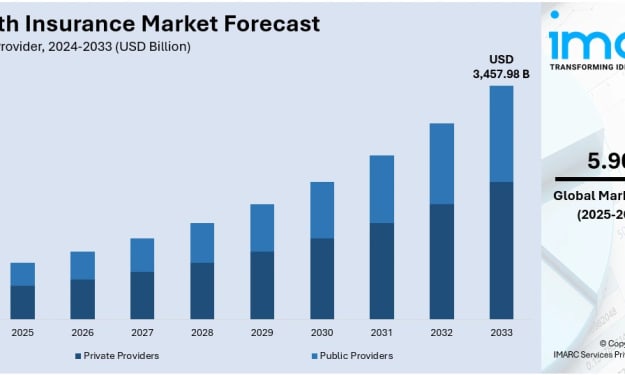
According to IMARC Group's latest research publication, global health insurance market size reached USD 1,949.84 Billion in 2024. Looking forward, IMARC Group expects the market to reach USD 3,457.98 Billion by 2033, exhibiting a growth rate (CAGR) of 5.90% during 2025-2033.
By Andrew Sullivan6 days ago in Futurism



Comments
There are no comments for this story
Be the first to respond and start the conversation.