
Mars: Once Habitable, or Just Deceptively Earth-Like?
Space

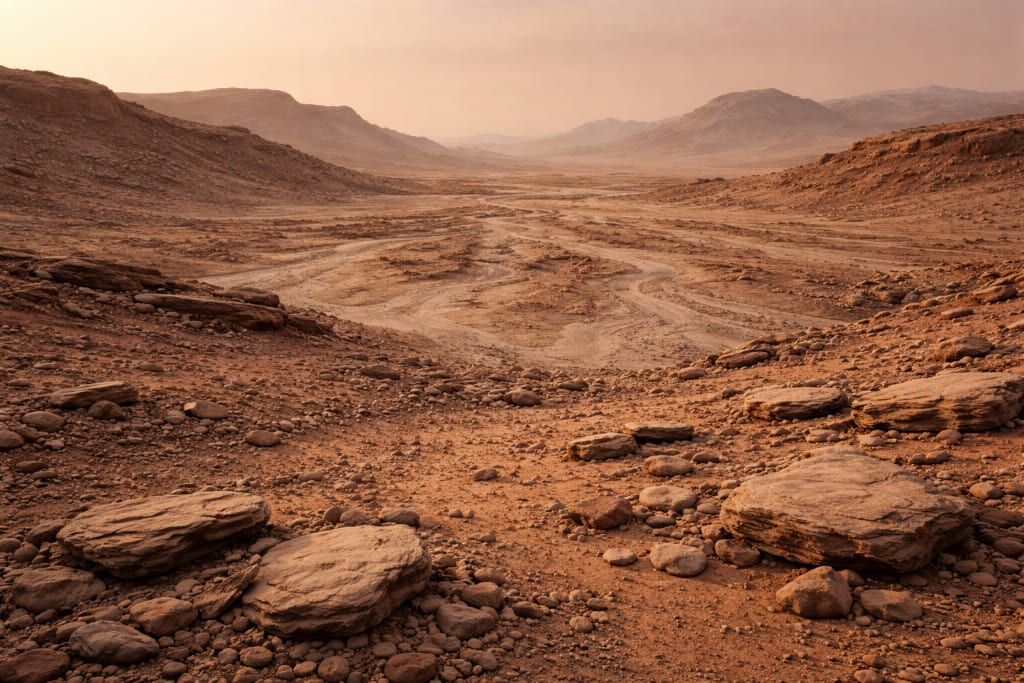
For centuries, Mars has fascinated humanity more than any other planet in the Solar System. Its reddish surface, polar ice caps, changing seasons, and surface features reminiscent of dried riverbeds once inspired dreams of canals, civilizations, and alien life. Today, science has replaced speculation with data, yet the central question remains just as compelling: was Mars ever truly habitable—and did life actually arise there—or was it merely a planet that looked like Earth without ever crossing the threshold into life?
Modern planetary science suggests that the answer lies somewhere in between.
A Younger Mars That Looked Strikingly Familiar
Around 4 billion years ago, Mars was a very different world. Geological evidence collected by orbiters and rovers indicates that the planet once had a much thicker atmosphere and stable liquid water on its surface. Vast networks of dried river channels, ancient lake basins, and delta formations strongly suggest long-lasting bodies of water rather than brief, catastrophic floods.
One of the most compelling examples is the Jezero Crater, where NASA’s Perseverance rover is currently exploring. The crater once hosted a lake fed by a river delta—precisely the kind of environment on Earth where microbial life thrives. Clay minerals found there form only in the presence of water and, importantly, relatively mild chemical conditions. This implies that early Mars was not just wet, but potentially comfortable by microbial standards.
In its youth, Mars shared several key traits with early Earth: water, energy sources such as volcanism, and the essential chemical building blocks of life. On paper, it checked nearly all the boxes required for habitability.
Habitability Does Not Guarantee Life
However, it is crucial to distinguish between habitability and inhabitation. A habitable environment is one where life could exist, not proof that life did exist.
Mars appears to have offered a viable window for life lasting hundreds of millions of years—possibly long enough for simple microorganisms to emerge. On Earth, life appeared relatively quickly once conditions stabilized. This raises a reasonable question: if life arose so readily here, why not on Mars?
Despite decades of exploration, no mission has yet found definitive biosignatures—clear chemical or structural evidence that can only be explained by biological activity. Organic molecules have been detected, but these can form through non-biological processes such as volcanic activity or meteorite delivery. Even methane, which occasionally spikes in the Martian atmosphere, remains ambiguous; it could be geological rather than biological in origin.
The absence of proof does not mean absence of life—but it does mean the case remains unproven.
Why Mars Took a Different Path Than Earth
The greatest divergence between Earth and Mars likely comes down to planetary size and internal dynamics. Mars is roughly half Earth’s diameter and only about one-tenth its mass. That difference had profound consequences.
Smaller planets cool faster. As Mars’ interior cooled, it lost its global magnetic field—the invisible shield that protects Earth’s atmosphere from being stripped away by solar wind. Without this protection, Mars gradually lost most of its atmosphere to space. Atmospheric pressure dropped, temperatures fell, and liquid water became unstable on the surface.
Earth, by contrast, retained its magnetic field, thick atmosphere, and active plate tectonics, which help regulate climate over geological timescales. Mars simply could not sustain these processes long enough.
In essence, Mars did not fail because it was never Earth-like—it failed because it could not remain Earth-like.
Could Life Still Exist on Mars Today?
Although the Martian surface is now cold, dry, and bathed in radiation, hope has not entirely vanished. Beneath the surface, conditions may be far more hospitable. Subsurface environments could provide protection from radiation, more stable temperatures, and access to briny liquid water.
On Earth, life thrives in extreme underground environments—from deep mines to hydrothermal vents—completely isolated from sunlight. If life ever emerged on Mars, it may have retreated underground as surface conditions deteriorated.
Some scientists even suggest that dormant microbial life could still exist today, waiting in subsurface niches. Detecting such life, however, would require drilling far deeper than current missions are capable of achieving.
Mars as a Warning—and a Mirror
The story of Mars is not just about alien life; it is also about planetary fragility. Earth and Mars may have started with similar ingredients, yet their outcomes diverged dramatically.
Mars shows us that habitability is not permanent. A planet can lose it. In this sense, Mars acts as a natural experiment—a cautionary tale illustrating how climate stability, atmospheric retention, and magnetic protection are essential for long-term life.
Studying Mars helps scientists refine models of planetary evolution and assess the habitability of exoplanets orbiting distant stars. It also deepens our understanding of Earth’s own resilience—and vulnerability.
So, Was Mars Ever Alive?
The most honest scientific answer today is this: Mars was very likely habitable, but we do not yet know if it was ever inhabited. It was not merely a superficial twin of Earth; it genuinely possessed conditions that could have supported life. Whether life actually took hold remains one of the most profound unanswered questions in planetary science.
Future missions, especially those designed to return Martian samples to Earth, may finally resolve this mystery. Until then, Mars remains a haunting reminder of what a world can become—and a tantalizing possibility that life may not be unique to our planet after all.
About the Creator
Keep reading
More stories from Holianyk Ihor and writers in Futurism and other communities.
Do Unknown Types of Stars and Compact Objects Really Exist?
For more than a century, astronomers have been steadily cataloging the inhabitants of the Universe. We have mapped stellar lifecycles, classified stars by their mass and temperature, and identified the ultimate fates of stellar evolution: white dwarfs, neutron stars, and black holes. At first glance, it may seem that the cosmic inventory is complete. Yet modern astrophysics increasingly suggests that this picture might be far from finished. As observational technology improves, scientists are encountering phenomena that do not fit neatly into established categories, raising an intriguing question: could there be unknown types of stars and compact objects still waiting to be discovered?
By Holianyk Ihor2 months ago in Futurism
Mirror Coatings Market: Solar Energy Systems, High-Reflectivity Surfaces & Industry Growth Ahead
According to IMARC Group's latest research publication, the global mirror coatings market size reached USD 785.83 Million in 2024. Looking forward, IMARC Group expects the market to reach USD 1,265.21 Million by 2033, exhibiting a growth rate (CAGR) of 5.35% during 2025-2033.
By sujeet. imarcgroup5 days ago in Futurism
Stanislav Kondrashov Oligarch Series: Oligarchy and the Rise of a Post-Planetary Civilisation
Stop for a moment and picture this: permanent human settlements orbiting Earth, research hubs on distant worlds, new cities designed from scratch beyond our atmosphere. It sounds like fiction. Yet serious capital is already moving in that direction. The real question is not whether a post-planetary civilisation is possible. It is who will shape it first.
By Stanislav Kondrashov 5 days ago in Futurism



Comments
There are no comments for this story
Be the first to respond and start the conversation.