


Mars
Distance from the Sun: 227,943,824 km
Martian Year: 687 Earth days.
Martian Solar Day: 24 Hrs 39 Min 36 sec.
Martian Sidereal Day: 24 Hrs 37 min 22 sec
Astronomical Mars
Mars is the 4th planet from the sun, placing it 2 planets closer to the Sun than us. It is one of the 7 planets that can be seen from the sky with the naked eye, looking like an extra big bright star with an orange-red color to its light. One will have the easiest time seeing Mars in the sky when it is in opposition to the sun, leaving plenty of light to shine and stand out. This occurrence happens about once every 26 months. This planet is the second smallest planet being just a little bit larger than Mercury. It is currently stale and dry and likely inhabits little to no life on its surface mostly due to its lack of usable water. Despite this factor though, Mars does share quite a few features with Earth. Some of these things include the 24 hour solar day, seasonal weather patterns, polar ice caps, volcanoes, and canyons. The Martian day is about the same as ours so the rotating spin of the planet would be about the same as Earth, but its orbit around the sun is almost twice as long making a Martian year almost two years in our time.
In the 1800s Astronomer scientists were finally able to clearly see this bright red planet clearly with a telescope. These people had developed a theory that there was indeed life possibly living upon the planet in the media culture. It started to become a common flare in the media to have stories about Martians, although there is no proof of possible life yet then. Although since then much has been learned about possible life on mars. There has even been recent talk of hopes to have life on the planet Mars that seem to have started to come back to the surface again.
On Mars there is something else quite interesting. Recently NASA had done an experiment with a rover in which they played sound to see how it would react. They found that with Mars’ atmosphere being so much less dense, that sound travels slower and when listening, it sounds more muffled if you can hear it at all. On our planet Earth sound travels at about 760 mph whereas on Mars sound travels at about 540 mph, so sound would take longer to reach your ears. This could cause being presence on Mars to be a fairly quiet experience. There is now even a chance to be able to look up YouTube videos of what sounds that different planets sound like based on their frequency. Mars is an interesting one.
There is so much more to be known on Mars as what I go over is a small scratch of the surface overview. If you wish to learn more I have a couple links the bottom under my references where you can dive even deeper into getting know Mars if you wish.
Timeline of Mars
1609 - German Astronomer Johannes Kepler use the naked eye observations of Mars, made by his Danish colleague Tycho Brahe, to deduce its laws of motion and pave the way for later to come gravitational theory of our solar system
1610 - Italian Astronomer Galileo Galilei has made the first telescopic observations of Mars
1659 - Christiaan Huygens made the first known accurate drawing of Mars including the large dark spot known as Syrtis Major
1666 - The polar caps of Mars were for the first time noticed by Italian born-French astronomer Gian Domenico Cassini. Cassini also measure the rotation of Mars that was previously noticed by Huygens in 1659 and measured this rotation to be 24 hours and 40 minutes. Later he was found to be in error by 3 minutes. Still impressively close to the latter to be found accurate time.
1780 - German-born British Astronomer William Herschel measured the tilt of Mars's rotational axis and first discussed the seasons of Mars. William Herschel also first noted the tenuous Martian atmosphere.
1830 - First known map of Mars was made by German astronomers Wilhelm Beer and Johannes Heinrich Von Mäder
1877 - Asaph Hall of the U.S. Naval Observatory discovered that Mars has two natural satellites (small moons).
1877 - Italian Astronomer Giovanni Birginio Schiaparelli made the first modern version of the map of Mars that includes the basis of the system of nomenclature
1894 - American Astronomer Percival Lowell established America's oldest observatory in Flagstaff, Arizona that was dedicated specifically to Mars and establishing its canals and forming more accurate maps of Mars until his death in 1916.
1898 - Irish Scientist Goerge J. Stoney questioned William Hershal’s theory that Mar’s caps were made of water ice, just like Earth’s. Stoney disagreed with Hershal and theorized that the polar caps of Mars were frozen carbon dioxide rather than frozen water.
1947 - Dutch-American Astronomer Gerald Kuiper brought evidence to further support George Stoney in his theory that the polar caps of Mars are frozen carbon dioxide with an experiment that showed that there is carbon dioxide in the atmosphere of Mars.
1966 - American Scientists Robert Leighton and Bruce Murray published the results of the numerical model of the thermal environment of Mars that raised considerable doubt about the water ice cap theory.
1969 - Twin Mariner 6 & 7 spacecraft flew by Mars to collect thermal and spectral measurements to confirm the paper theorized measurements that Robert Leighton and Bruce Murray had initially proposed.
References
Britannica
Belton, Michael J.S. , Carr, Michael H. and Malin, Michael C.. "Mars". Encyclopedia Britannica, 19 Feb. 2024, https://www.britannica.com/place/Mars-planet. Accessed 19 March 2024.
Mars (NASA)
https://science.nasa.gov/mars/
Sounds of Mars
Mars Communications Manager: Claire Powell;NASA Official: Debra Hernandez;Site Manager: Melody Ho;Editor: Jane Platt;CL#: 19-6952
https://mars.nasa.gov/mars2020/participate/sounds/?playlist=earth&item=ocean&type=mars
About the Creator
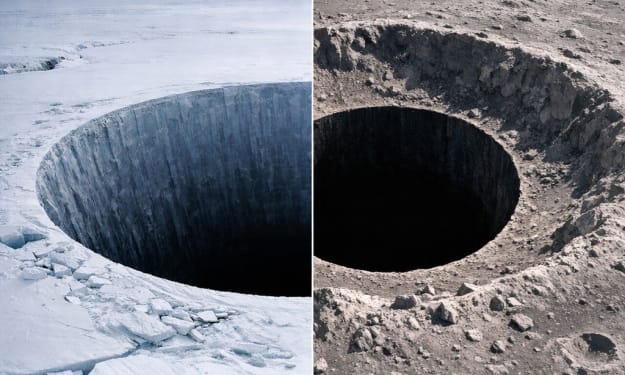
Why NASA Cancelled The Artemis III Lunar Landing
At 23:30 GMT on February 27th, 2026, a small compliment of analysts, technicians, and operators were in the operations center when the Advanced Scout Satelite alerted them to something unusual. Just mere months away from the long awaited return to the moon by humans, NASA and SpaceX had everybody paying close attention to the moon. A couple of generations ago, NASA and the United States celebrated their final trip to the moon, and hadn't returned since. And while the reasoning behind cessations of lunar exploration remained a mystery in many minds, America and the human race were finally about to return to the first step away from Earth and into the galaxy.
By Jason Ray Morton a day ago in Futurism
Australia Medicated Skincare Market: Consumer Health Focus, Product Innovation & Clinical Demand
According to IMARC Group, the Australia medicated skincare market reached USD 1,011.7 Million in 2025 and is projected to grow to USD 2,080.6 Million by 2034, exhibiting a compound annual growth rate (CAGR) of 8.34% during 2026–2034. The expansion reflects a structural shift in consumer behavior across Australia, where skincare is increasingly viewed through a medical and preventative health lens rather than purely cosmetic. Rising awareness of dermatological conditions such as acne, eczema and psoriasis, coupled with a preference for clinically tested formulations, is accelerating demand for specialized and scientifically validated skincare solutions.
By Kevin Cooper6 days ago in Futurism



Comments
There are no comments for this story
Be the first to respond and start the conversation.