
Managed Services Market Size and Forecast 2025–2033
How Rising IT Complexity, Cloud Expansion, and Cybersecurity Demands Are Powering a US$ 572.15 Billion Industry by 2033

Global Managed Services Market Overview
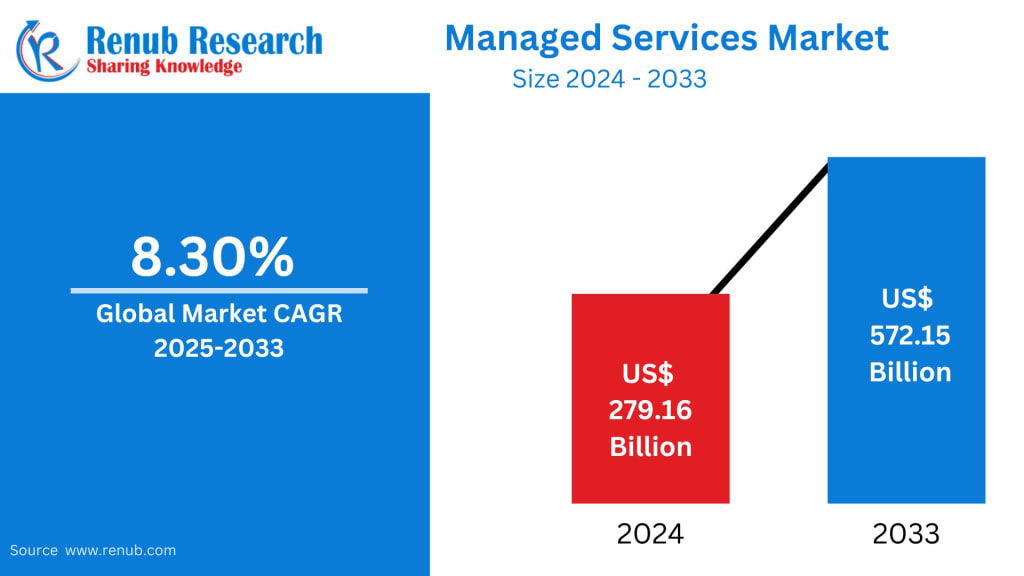
The global Managed Services Market is on an accelerated growth path, expected to reach US$ 572.15 billion by 2033, rising from US$ 279.16 billion in 2024. According to Renub Research, the industry will expand at a robust CAGR of 8.30% from 2025 to 2033, driven by the surging demand for scalability, cost efficiency, and cutting-edge IT support across industries.
In an era where digital transformation dictates competitiveness, organizations are increasingly outsourcing IT operations to specialized Managed Service Providers (MSPs). These providers offer streamlined expertise across network management, cybersecurity, cloud infrastructure, communications, and data center operations—allowing businesses to focus on core functions while relying on expert partners for IT excellence.
The growing sophistication of enterprise technology—ranging from hybrid cloud setups to AI-powered workflows—has created scenarios where internal IT teams often lack the bandwidth or expertise to manage systems effectively. MSPs have emerged as essential partners to fill this gap, offering predictable pricing structures, 24/7 monitoring, advanced security, and compliance management.
Industry adoption spans sectors like finance, healthcare, retail, manufacturing, and government. Technologies such as AI, automation, and IoT are further broadening market potential, making managed services not merely an operational add-on but a strategic lever for business continuity, resilience, and future-ready transformation.
Technology Adoption and Market Trends
A defining trend shaping the managed services landscape is the complexity of cloud transitions. Recent research indicates that 48% of IT decision-makers in the US and UK require 1–2 months for a single multi-cloud migration, highlighting the operational challenges companies face. This has fueled a wave of specialized cloud-focused managed services—spanning migration, optimization, governance, and hybrid infrastructure management.
Moreover, MSPs are integrating advanced technologies into their service offerings. Blockchain, AI, machine learning, IoT, and AR/VR have become central to next-generation solutions aimed at predictive analytics, intelligent automation, and real-time insights. The shift toward outcome-based service delivery, emphasizing measurable KPIs, uptime guarantees, and performance metrics, is reshaping client expectations.
The rising financial impact of system downtime adds urgency: 25% of enterprises report downtime costs between US$ 301,000 and US$ 400,000 per hour, making proactive monitoring and rapid remediation mission-critical.
With businesses demanding stronger governance, tighter compliance controls, and near-zero downtime, MSPs are becoming indispensable partners for enterprise resilience.
Growth Drivers for the Managed Services Market
1. Rising Cybersecurity Threats
Cybersecurity remains the strongest growth catalyst. MSPs now function as frontline defenders against evolving cyber-attacks—providing threat detection, vulnerability assessments, incident response, and compliance management.
The numbers underscore the urgency:
2,365 cyberattacks occurred in 2023, impacting 343 million individuals.
Data breaches surged by 72% compared to 2021, setting a record high.
The average cost of a data breach reached US$ 4.45 million.
35% of malware was distributed via email—still the biggest vector.
94% of organizations reported email-related security incidents.
Business email compromise led to US$ 2.7 billion in losses in 2022.
Cybersecurity jobs are expected to grow 32% from 2022 to 2032.
For industries such as healthcare, BFSI, retail, and telecommunications—where compliance and data protection are non-negotiable—MSPs have become a vital extension of enterprise security operations.
2. Widespread Adoption of Cloud Computing
Cloud computing has been a monumental driver of managed services demand. As organizations migrate workloads to cloud platforms, complexities related to governance, performance optimization, and cost control become inevitable. MSPs offer end-to-end cloud management services—from architecture design to security, analytics, optimization, and ongoing maintenance.
A strong example of this momentum is the 2024 collaboration between Rackspace Technology and Young Hollywood, where the former deployed a multi-phase Google Cloud architecture. Using Google Cloud Video Intelligence API and optimized metadata structures, the new setup enabled content processing 10 times faster—boosting scalability and revenue potential.
Such partnerships illustrate how cloud-focused managed services help organizations unlock efficiency, drive innovation, and reduce infrastructure overheads.
3. Increasing IT Infrastructure Complexity
The expanding use of hybrid clouds, edge computing, software-defined networks, and distributed workforces is creating intricate IT environments. MSPs deliver the expertise and automation tools needed to manage such complexity at scale.
A notable example is Cognizant’s 2023 launch of a multi-hybrid cloud and edge management platform, designed to simplify cloud-native transitions and improve cost efficiency. By integrating accelerators and industry-focused frameworks, the solution helps enterprises adopt modern infrastructure while avoiding operational pitfalls.
With technologies evolving faster than traditional IT teams can adapt, MSPs are stepping in to bridge the expertise gap, supporting businesses in modernization initiatives without disrupting ongoing operations.
Challenges Facing the Managed Services Market
Cybersecurity Vulnerabilities
While cybersecurity drives demand, it also poses challenges. MSPs themselves have become prime targets due to their access to client systems. A single breach can compromise dozens of organizations, making security diligence essential. MSPs must implement rigorous access controls, multifactor authentication, continuous monitoring, and rapid incident response frameworks.
Failure to do so risks client trust, regulatory violations, and long-term reputation damage.
Regulatory and Compliance Complexities
MSPs operate in a landscape governed by stringent laws such as:
GDPR (Europe)
CCPA (California, USA)
HIPAA (Healthcare, USA)
Navigating these global and regional frameworks requires constant audits, transparent data-handling practices, and compliant storage/processing protocols. Regulatory non-compliance can result in fines, lawsuits, and contract cancellations.
This adds operational challenges but also expands demand for MSPs capable of managing governance and compliance for clients.
Regional Market Insights
United States
The US represents one of the most mature markets for managed services. Growth is supported by:
expansion of remote/hybrid workplaces
rising use of AI-driven monitoring
increasing cloud adoption
heightened cybersecurity requirements
large-scale IoT deployments
Companies such as IBM, Cisco, and AT&T dominate the landscape, focusing on automation, security, multi-cloud solutions, and industry-specific offerings.
United Kingdom
The UK market is fueled by the surge in digital transformation and the need for cost-effective IT solutions. London leads as the fintech and enterprise hub, while Birmingham, Manchester, and Scotland showcase strong demand from growing tech clusters.
Major players include BT, Deloitte, Microsoft, Google, OryxAlign, Babble, and BCN Group, offering managed cloud, cyber, communications, and IT infrastructure solutions across industries.
India
India is one of the fastest-growing markets, driven by:
cloud-native adoption
cybersecurity modernization
expansion of Global Capability Centers (GCCs)
rising demand from BFSI, healthcare, manufacturing, and IT
Maharashtra, Karnataka, and Telangana—home to Mumbai, Pune, Bengaluru, and Hyderabad—account for the bulk of demand due to their robust tech ecosystems and enterprise clusters.
United Arab Emirates
The UAE market is expanding rapidly due to digital transformation initiatives, smart city projects, and heightened cybersecurity needs. Dubai leads the market with 40% share, followed by Abu Dhabi at 30%. Microsoft, Huawei, and DXC Technology are among the leading players innovating cloud, security, and automation-based managed solutions.
Market Segmentation
By Type (6 Segments)
Managed Data Center
Managed Security
Managed Communications
Managed Network
Managed Infrastructure
Managed Mobility
By Size of Enterprise (2 Segments)
Small & Medium-Sized Enterprises (SMEs)
Large Enterprises
By End-User Industry (8 Segments)
BFSI
IT & Telecommunication
Healthcare
Entertainment & Media
Retail
Manufacturing
Government
Others
By Deployment Mode (2 Segments)
On-Premise
Cloud
Regional Coverage
North America (US, Canada)
Europe (France, Germany, Italy, Spain, UK, Belgium, Netherlands, Turkey)
Asia-Pacific (China, Japan, India, Australia, South Korea, Thailand, Malaysia, Indonesia, New Zealand)
Latin America (Brazil, Mexico, Argentina)
Middle East & Africa (South Africa, Saudi Arabia, UAE)
Key Players in the Managed Services Landscape
Fujitsu Ltd
Cisco Systems Inc.
IBM Corporation
AT&T Inc.
Microsoft Corporation
Verizon Communications Inc.
Dell Technologies Inc.
Nokia Solutions and Networks
Rackspace Inc.
Tata Consultancy Services Limited
These companies continue to expand portfolios through AI integration, zero-trust security, edge computing, automation, and cloud-native technologies.
Final Thoughts
The Managed Services Market is entering a transformative phase where operational optimization, cybersecurity resilience, and cloud modernization are no longer optional—they are essential for survival. As enterprises worldwide pursue digital-first strategies, MSPs will remain crucial partners enabling scalability, security, and agility.
With the market set to surpass US$ 572 billion by 2033, MSPs that innovate with AI, automation, and security-first infrastructure will shape the next decade of digital transformation.
About the Creator
Janine Root
Janine Root is a skilled content writer with a passion for creating engaging, informative, and SEO-optimized content. She excels in crafting compelling narratives that resonate with audiences and drive results.
Keep reading
More stories from Janine Root and writers in Futurism and other communities.
Global Watch Market Trends & Summary
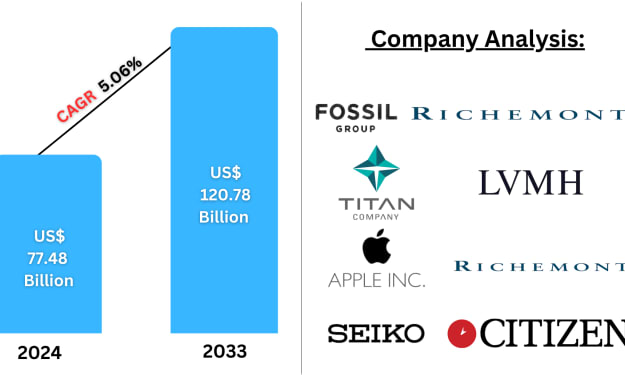
The global watch market is undergoing a dynamic transformation, driven by a blend of timeless craftsmanship and cutting-edge technology. According to Renub Research, the Global Watch Market was valued at US$ 77.48 billion in 2024 and is projected to reach US$ 120.78 billion by 2033, expanding at a CAGR of 5.06% from 2025 to 2033. This growth is attributed to rising luxury spending, increasing adoption of smartwatches, strong e-commerce penetration, and growing consumer interest in both functional and fashionable timepieces.
By Janine Root 2 months ago in Futurism
About Binding Prometheus
I want to start actively advocating on behalf of my own work, and the most valuable part of my canon is, without a doubt, Binding Prometheus, the play I have been working on since 2019 and only finished in 2023 as part of my MA. The play itself is an amalgamation of a million different inspirations. On one end, it evokes the Ancient Greek myth-play, deriving its own title from the earliest extant work of Western drama we have, Aeschylus’s Prometheus Bound. On the other end, it borrows significantly from the sci-fi bulwarks from over the years, namely Mary Shelley’s Frankenstein and Karel Capek’s Rossum’s Universal Robots. The play could be an episode of Black Mirror, I fear. I don’t know. I’ve only ever seen one episode of Black Mirror.
By Steven Christopher McKnight11 days ago in Futurism
Saudi Arabia Retail Market: Data-Driven Merchandising, Supply Chain Agility & Urban Retail Boom Under Vision 2030
According to IMARC Group's latest research publication, Saudi Arabia retail market size was valued at USD 293.6 Billion in 2025. The market is projected to reach USD 411.7 Billion by 2034, exhibiting a growth rate (CAGR) of 3.83% during 2026-2034.
By Jeffrey Wilsonabout 13 hours ago in Futurism
Where's the Glory?
In breaking news, rehabilitated Republican Senator Johnnie Johnson (Pronouns: HE, HIM, HIS) called a press conference from the Men’s room of the New Orleans Louis Armstrong International Airport, Concourse B, across from the Ignatius Reilly’s Lucky Dog stand. The Senator had just returned from a sexual reorientation rehabilitation program in Memphis, TN after being publically disgraced at a Buckee’s Truckstop restroom soliciting sex from an undercover cop three months ago. He is a founding member of the Reformed Christians for Christ, a conservative, pro-family and ex-gay advocacy group. In the spirit of being reborn, Senator Johnson invited reporters to marvel at his plans for a major remodeling of airport bathrooms.
By Cathy Schieffelin5 days ago in Humor


Comments
There are no comments for this story
Be the first to respond and start the conversation.