
Global Watch Market Trends & Summary
Evolving Timepieces: How Luxury, Fashion, and Smart Technology Are Driving the Global Watch Boom (2025–2033)

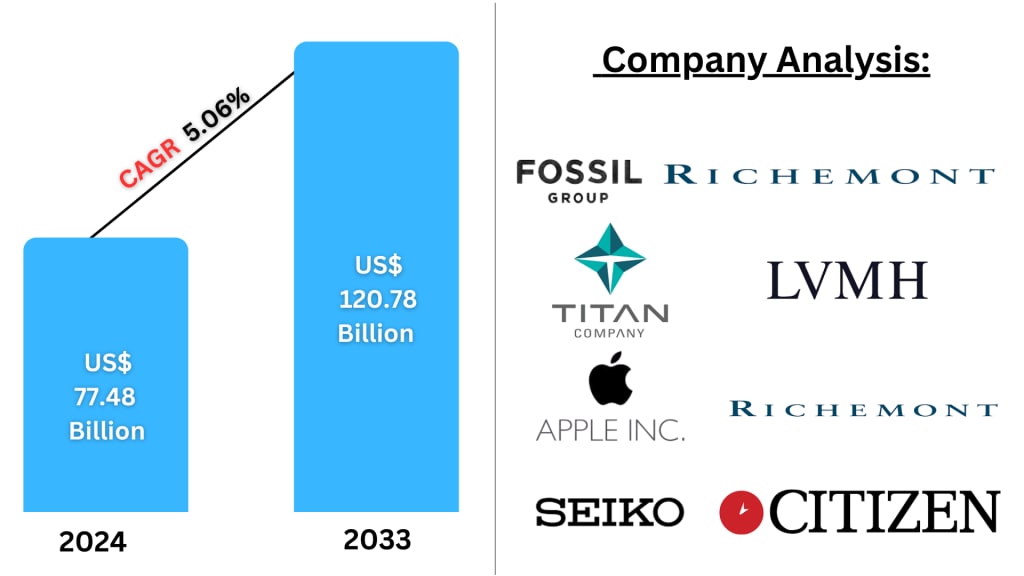
The global watch market is undergoing a dynamic transformation, driven by a blend of timeless craftsmanship and cutting-edge technology. According to Renub Research, the Global Watch Market was valued at US$ 77.48 billion in 2024 and is projected to reach US$ 120.78 billion by 2033, expanding at a CAGR of 5.06% from 2025 to 2033. This growth is attributed to rising luxury spending, increasing adoption of smartwatches, strong e-commerce penetration, and growing consumer interest in both functional and fashionable timepieces.
Watches today go far beyond timekeeping. They represent identity, status, fitness aspirations, and even lifestyle philosophies. From Swiss luxury masterpieces to minimalist fashion watches and sensor-loaded smartwatches, every segment is contributing to the industry’s strong upward momentum.
Global Watch Market Outlook: A Blend of Heritage and Innovation
A watch is one of the few accessories that has seamlessly evolved with societal shifts. Traditionally a mechanical marvel worn on the wrist or kept in the pocket, the watch has transformed into a multifunctional device. Mechanical timepieces remain a hallmark of craftsmanship, admired by collectors and luxury aficionados. Meanwhile, modern electronic and smartwatches—equipped with health sensors, communication capabilities, and connectivity features—have expanded the industry’s horizons.
Luxury watches from Rolex, Patek Philippe, Omega, and Audemars Piguet continue to dominate the status-symbol category. Meanwhile, global tech leaders like Apple, Samsung, Huawei, and Garmin have reshaped consumer expectations by positioning smartwatches as personal digital assistants. As consumers increasingly seek style, utility, and connectivity, watches continue to hold their ground as essential lifestyle accessories—balancing tradition with innovation.
Key Growth Drivers in the Global Watch Market
1. Surging Demand for Smartwatches
Smartwatches are the fastest-growing segment in the watch industry. Consumers now want fitness tracking, sleep monitoring, GPS navigation, ECG measurement, and smartphone integration—all accessible on their wrist.
Health consciousness, particularly after the pandemic, has accelerated smartwatch adoption. Innovation remains robust: enhanced biometric sensors, fall detection, voice assistants, and even AI-enhanced features are pushing demand further.
According to IDC, global wearable device shipments are set to grow by 6.1% in 2024, reaching 538 million units—a clear indicator of the smartwatch industry's momentum.
2. Rising Affluence and Luxury Consumption
As income levels rise across Asia, the Middle East, and Eastern Europe, luxury watches are witnessing strong demand. High-end brands are benefiting from increased interest in collectible and limited-edition pieces.
Luxury timepieces are viewed not only as accessories but also as investments—sometimes appreciating in value. Retail expansion in premium malls is also supporting this growth. For example:
In September 2023, major luxury brands such as Gucci, Cartier, and Louis Vuitton signed leases at the Jio World Plaza in Mumbai—demonstrating rising luxury demand in India and the commitment of top brands to expand globally.
3. E-commerce and the Digital Shopping Boom
The rise of online shopping has democratized access to watches. Consumers today browse global collections, read reviews, compare prices, and get doorstep delivery.
E-commerce is especially crucial for smartwatches and fashion watches, where tech-savvy buyers prefer online purchases. Global brands are also expanding their digital retail strategies. For instance:
In April 2023, a French luxury brand debuted its watches online through South Korea’s leading platform SSG.COM, marking a significant step in its digital transformation.
Online channels have not only expanded market reach but also helped combat geographical limitations, driving significant sales growth across both developed and emerging markets.
Challenges in the Global Watch Market
1. Counterfeiting and Brand Integrity Risks
Fake watches remain a major concern, especially in the luxury segment. Counterfeits dilute brand value, erode consumer trust, and cause revenue losses for legitimate brands. While companies have adopted tracking technologies such as RFID, blockchain authentication, and secure serial numbers, counterfeiters continue to exploit online marketplaces. Constant vigilance and consumer education remain essential.
2. Volatile Raw Material Prices
Watches require materials such as stainless steel, leather, sapphire glass, rubber, and precious metals—whose prices fluctuate due to political tensions, inflation, and supply chain disruptions. Production delays and rising manufacturing costs can impact pricing strategies and profit margins. Global economic volatility continues to pose a challenge for both luxury and non-luxury watchmakers.
Segment Analysis of the Global Watch Market
Global Electronic Watches Market
Electronic watches—including smartwatches, fitness trackers, hybrid watches, and digital watches—are experiencing rapid global uptake. These watches offer:
health monitoring
connectivity with smartphones
sleek designs
multifunctional capabilities
Demand continues to grow among tech-savvy consumers and fitness enthusiasts. Improved battery life, stronger processors, and AI-powered features are expected to accelerate future growth.
Global Quartz Watches Market
Quartz watches remain the most widely sold category due to their accuracy and affordability. Powered by quartz crystals, these watches require minimal maintenance and are ideal for all age groups. Technological advancements like improved shock resistance and durability make quartz watches a preferred choice among mass consumers.
Global Men’s Watch Market
Men’s watches dominate overall sales. Increased disposable income, rising interest in fashion and accessories, and strong demand for smartwatches contribute to this segment’s growth. High demand for bespoke, limited-edition, and luxury mechanical timepieces further bolsters this market.
Global Luxury Watch Market
Driven by craftsmanship, exclusivity, and prestige, luxury watches represent the most profitable segment. Swiss brands lead the market with sophisticated designs and “heritage value.” Rising demand from Asia-Pacific and the Middle East continues to fuel premium sales. Collectors and investors are especially drawn to rare models, boosting the secondary watch market as well.
Global Convenience Store Watch Market
This segment caters to consumers seeking basic, affordable watches. Convenience stores offer accessibility and low-cost options, ideal for casual buyers. These watches primarily serve functional needs rather than style or luxury preferences.
Regional Market Highlights
United States
The U.S. remains a dominant market for luxury, fashion, and smartwatches. The rise of wearable technology is driving substantial growth. E-commerce platforms have significantly boosted visibility and sales. In September 2024, Panerai launched new US Navy SEAL-inspired watches, strengthening military-themed collections and appealing to enthusiasts.
France
France remains a global fashion and luxury hub. With historic brands like Cartier, Chanel, and Hermès, the country’s high-end watch industry reflects a blend of craftsmanship and innovation. French consumers are embracing smartwatches, although luxury mechanical watches remain culturally significant. In November 2024, Hegid launched the Specimen FE-01 Caliber, showcasing France’s push toward domestic innovation in watchmaking.
India
India’s growing middle class and rising disposable income have transformed its watch market. Both fashion and luxury watches are gaining momentum, alongside health-driven smartwatch demand. Gifting culture further drives sales. In April 2024, Cerruti 1881—represented by Titan Company—launched premium chronograph and automatic watches, signaling increasing appetite for mid-premium offerings.
Saudi Arabia
Saudi Arabia’s affluent population fuels strong demand for luxury watches. Swiss timepieces dominate, but demand for smartwatches is also rising. Expanding retail networks and growing online options contribute to sector expansion. Notably, Sotheby’s will host its first Saudi Arabian auction in February 2025, featuring rare collectible watches—highlighting the region’s growing collector culture.
Watch Market Segmentation Overview
By Type
Quartz Watches
Electronic Watches
Mechanical Watches
By Gender
Men
Women
Unisex
By Price Range
Luxury
Non-Luxury
By Distribution Channel
Hypermarkets/Supermarkets
Convenience Stores
Online Retail
Countries Covered (25 Markets)
United States, Canada, France, Germany, Italy, Spain, UK, Belgium, Netherlands, Turkey, China, Japan, India, Australia, South Korea, Thailand, Malaysia, Indonesia, New Zealand, Brazil, Mexico, Argentina, South Africa, Saudi Arabia, UAE
Key Companies Profiled
Fossil Group Inc., Titan Company Limited, LVMH Group, Apple Inc., Richemont SA, The Swatch Group Ltd., Citizen Watch Co. Ltd., Seiko Group Corporation
Final Thoughts
The global watch market is thriving due to its ability to innovate while preserving heritage. Luxury brands uphold craftsmanship and exclusivity, smartwatches push the boundaries of technology, and fashion watches continue to appeal to style-driven consumers. With the market forecast to reach US$ 120.78 billion by 2033, the future of the watch industry looks exceptionally bright.
As e-commerce expands, smart technology evolves, and luxury demand rises across emerging economies, the watch industry is well-positioned for long-term growth. From iconic Swiss timepieces to next-generation wearables, the global watch market remains an exciting and resilient sector—proving that time, indeed, never goes out of style.
About the Creator
Janine Root
Janine Root is a skilled content writer with a passion for creating engaging, informative, and SEO-optimized content. She excels in crafting compelling narratives that resonate with audiences and drive results.
Keep reading
More stories from Janine Root and writers in Futurism and other communities.
A2P Messaging Market Outlook: Global Adoption Surges as Enterprises Shift to Secure, Real-Time Communications
The global A2P (Application-to-Person) messaging market is on a strong upward trajectory as businesses worldwide accelerate their digital communication strategies. According to Renub Research, the industry was valued at US$ 72.18 billion in 2024 and is projected to reach US$ 104.52 billion by 2033, growing at a CAGR of 4.20% during 2025–2033.
By Janine Root 2 months ago in Futurism
About Binding Prometheus
I want to start actively advocating on behalf of my own work, and the most valuable part of my canon is, without a doubt, Binding Prometheus, the play I have been working on since 2019 and only finished in 2023 as part of my MA. The play itself is an amalgamation of a million different inspirations. On one end, it evokes the Ancient Greek myth-play, deriving its own title from the earliest extant work of Western drama we have, Aeschylus’s Prometheus Bound. On the other end, it borrows significantly from the sci-fi bulwarks from over the years, namely Mary Shelley’s Frankenstein and Karel Capek’s Rossum’s Universal Robots. The play could be an episode of Black Mirror, I fear. I don’t know. I’ve only ever seen one episode of Black Mirror.
By Steven Christopher McKnight12 days ago in Futurism
Railroad Market: Freight Demand Growth, Logistics Integration & Market Opportunities
According to IMARC Group's latest research publication, global railroad market size reached USD 332.2 Billion in 2024. Looking forward, IMARC Group expects the market to reach USD 460.8 Billion by 2033, exhibiting a growth rate (CAGR) of 3.52% during 2025-2033.
By Andrew Sullivan4 days ago in Futurism


Comments
There are no comments for this story
Be the first to respond and start the conversation.