
M5 MacBook Pro vs Snapdragon X2 Elite: The ARM Laptop Chip Showdown of 2025
M5 MacBook Pro vs Snapdragon X2 Elite Performance Comparison 2025: Benchmarks, Specs, and Real-World Results.

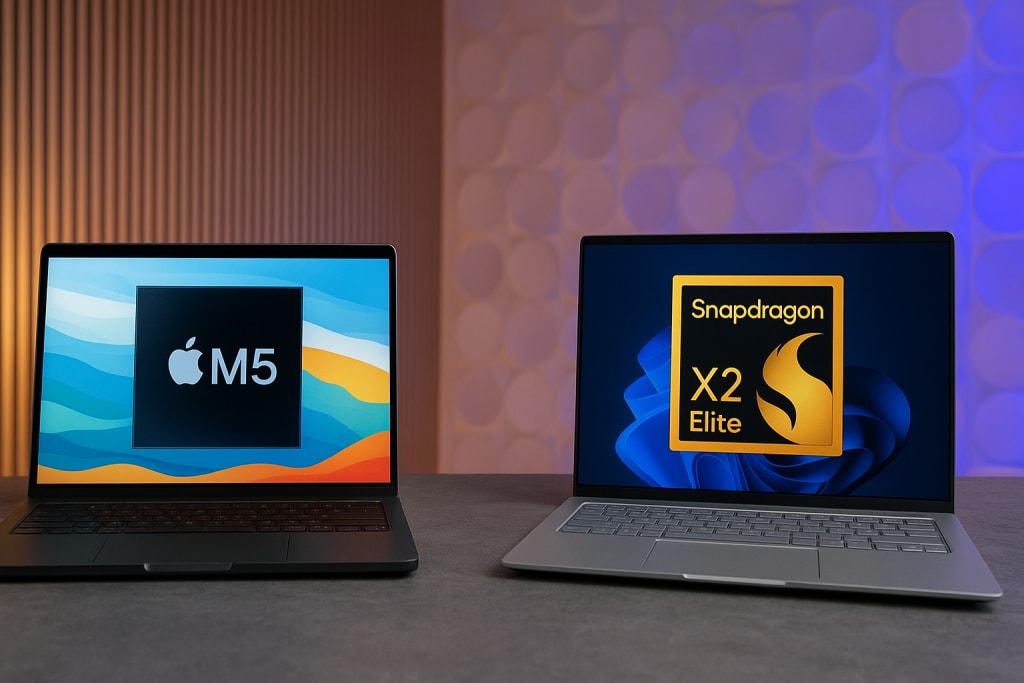
When we talk about laptop performance in 2025, one of the most compelling rivalries isn’t between Intel and AMD any more — it’s between two ARM-based contenders: the newly-announced Apple M5 (inside the latest MacBook Pro) and the upcoming Snapdragon X2 Elite (and its Extreme variant) from Qualcomm. Both chips herald the next generation of ARM laptop computing. But which one takes the crown? Let’s dive into the numbers, the tech, and what it means for you — the user.
Setting the stage: Why this matters
The laptop market is evolving fast. Gone are the days when premium laptops meant bulky, hot-running Intel/AMD silicon. Today, ARM architectures are increasingly viable for high-performance computing: lower power, better integration, and fewer compromises. The M5 and Snapdragon X2 Elite both ride a 3 nm class process, signalling the next leap in mobile/ultraportable performance.
For Apple, the M5 continues the narrative of vertical integration — hardware + software tuned for a singular ecosystem. For Qualcomm, the Snapdragon X2 Elite offers the promise of high-end ARM performance in Windows laptops from multiple OEMs, potentially shoring up competition. This is an important pivot in the “ARM laptop chips 2025” conversation.
Core specs & architecture overview
Apple M5
According to official and leaked data, the M5 uses a 10-core CPU configuration (likely 4 high-performance cores + 6 efficiency cores) built on a 3 nm (or equivalent) node. ([Wikipedia][1])
GPU side: Apple claims up to ~30% faster graphics versus its previous generation M4, with enhancements in ray-tracing and AI-accelerator capability. ([Wikipedia][1])
Key benchmark leak: in single-core testing the MacBook Pro M5 variant clocked ~4,263 in Geekbench-style tests. ([Tom's Hardware][2])
Snapdragon X2 Elite (Extreme)
Built for Windows laptops in early 2026, the Snapdragon X2 Elite line (including the high-end “Extreme” variant) packs up to 18 CPU cores according to leaks and benchmarking sources. ([Windows Central][3])
Memory bandwidth and core count significantly higher: e.g., one spec list shows 228 GB/s vs 153 GB/s for M5 in one comparison. ([NanoReview.net][4])
Early results show strong multi-core and graphics performance, setting a new bar for ARM in laptops. ([WIRED][5])
Performance face-off: Single-core, multi-core & graphics
Single-core performance
In single-threaded workloads — the kind of tasks that emphasise responsiveness (web browsing, document editing, launching apps) — the M5 holds a slight edge. Leaked benchmark entries show it reaching around 4,263 vs ~4,080 for the Snapdragon X2 Elite Extreme. ([Tom's Hardware][2])
That’s an impressive feat: Apple continues to hit very high single-core ceilings, thanks in part to its strong performance cores and efficient thermal envelope inside the MacBook chassis.
Multi-core performance
Here is where the Snapdragon X2 Elite pulls ahead. With up to 18 cores, early benchmarks show it reaching multi-core scores of ~23,000+ (Geekbench-style) compared to the M5’s ~17,800 in comparable tests. ([TechRadar][6])
In real-world terms this means heavy workloads — GPU rendering, large-scale compiling, multitasking across dozens of threads — may favour the Snapdragon architecture.
Graphics & GPU performance
Graphics benchmarks (e.g., 3DMark Steel Nomad Light) show a tight contest. One source reports the Snapdragon X2 Elite Extreme achieving ~42.5 fps vs ~40.5 fps for the M5. ([Geeky Gadgets][7])
While the margin is small (~5 %), it signals that Qualcomm’s integrated GPU (Adreno X2-90/whatever the naming) is catching up or perhaps even surpassing Apple’s offering in certain GPU-bound tasks. That said, the ecosystem (drivers, optimised apps) still matter hugely.
Efficiency, thermals & real-world considerations
Benchmarks alone don’t tell the full story. In laptops, sustained performance, cooling, power draw, and battery life are often the differentiators.
For the M5 MacBook Pro, reviewers report class-leading single-core scores, but some note battery life falling short of the headline figures (~18 hours vs a claimed 24) under heavy use. ([TechRadar][8])
The Snapdragon X2 Elite, by virtue of its higher core count and likely higher power envelope, will demand robust cooling and may be more dependent on laptop OEM design to deliver sustained performance without thermal throttling.
The MacBook Pro benefits from Apple’s tight hardware/software integration — from the OS (macOS) to the cooling solution and power management. Windows laptops powered by Snapdragon chips will face heterogeneous ecosystems and variable hardware implementation.
Thus, while the Snapdragon may have the peak multi-core numbers, real-world sustained performance, usability, battery life and ecosystem play in favour of Apple’s M5 in many scenarios.
User-centric implications: What does this mean for you?
If you prioritise responsiveness and general productivity
If your workload is mostly office apps, web browsing, light photo editing, streaming and everyday tasks — you’ll likely be delighted with the M5 MacBook Pro. Its single-core strength ensures snappy responses, excellent integration, and a mature platform. The “M5 MacBook Pro vs Snapdragon X2 Elite” battle here tilts in favour of the M5 for this class of use-case.
If you are into heavy multitasking, large projects, or thread-rich workflows
If you compile large code-bases, render 3D scenes, run virtual machines, or heavily multitask across dozens of threads — the Snapdragon X2 Elite’s higher multi-core count gives it a meaningful edge in this domain. In those raw benchmark-type tasks, the extra cores matter.
If you care about GPU/creative workloads
The GPU gap is narrowing. The Snapdragon shows a slight lead in one benchmark, but the real differentiator may be in software optimisation and ecosystem. Apple already has a mature set of creative apps (Final Cut Pro, Logic, etc.) tuned to its hardware. Windows + Snapdragon hardware is still emerging. So for creatives, you’ll want to look at the entire system (app support, thermal cooling, display, I/O) not just the chip.
When battery life, ecosystem & support matter
Here, Apple takes advantage of years of integration. The M5 MacBook Pro offers a mature, polished experience. With a Snapdragon-based machine, you’ll need to check the OEM implementation, cooling solution, battery size, OS experience, and app compatibility. The chipset alone doesn’t guarantee the same level of user experience.
Market & future implications
The rivalry between Apple’s M5 and Qualcomm’s Snapdragon X2 Elite line reflects a larger shift in the ARM laptop space. For years Apple has defined what ARM could do in laptops. But now, companies like Qualcomm are bringing serious competition to the table.
Qualcomm’s push means Windows OEMs might finally deliver ARM-laptop alternatives that can match or challenge Apple not just in light-use scenarios but heavier workloads too.
For Apple, this competition pressures further innovation — we already hear about upcoming M5 Pro and M5 Max versions, which could widen the gap again or shift the battleground. ([TechRadar][8])
For consumers: more choice is good. More performance, more form-factors, potentially lower prices as competition heats up.
Verdict: Who wins?
The short version: there’s no absolute winner — the “better chip” depends heavily on your usage model.
For everyday workflows, light-to-moderate workloads, and the best user experience today: the M5 MacBook Pro remains the reliable pick.
For heavy multitasking, thread-intensive workloads, or if you’re building a high-end Windows ARM laptop and can wait for the Snapdragon X2 Elite ecosystem to mature — the Snapdragon brings serious promise.
In other words: if you need maximum multi-core firepower now, keep an eye on the Snapdragon X2 Elite and its laptop partners. If you want a polished experience today with excellent performance and battery life: the M5 MacBook Pro is hard to beat.
Final thoughts
The headline “M5 MacBook Pro vs Snapdragon X2 Elite” may sound like a simple comparison — but in reality, it’s the beginning of a broader shift. ARM laptop chips in 2025 are no longer niche; they’re now contenders. And when chips like the M5 and Snapdragon X2 Elite go head-to-head, the winners aren’t just the brands — it’s us, the users, who benefit.
The next few months will be fascinating: more benchmarks, more devices, more real-world reviews. Whether you’re an Apple loyalist or a Windows-ARM early-adopter, this era marks the start of a new chapter for portable computing.
For now — choose the machine that matches your workflow, ecosystem preference, and budget. Because whichever chip you pick, you’re buying into a very powerful future.
About the Creator
NextGen Mobile Tech
- I review the latest smartphones, mobile accessories, and tech essentials to help you make smart buying decisions. Explore my curated kits for phones and gear here: [Kit.co link].
Keep reading
More stories from NextGen Mobile Tech and writers in Futurism and other communities.
iPhone and Mac: How Apple’s Perfect Pair Transforms the Way You Work, Connect, and Create
In today’s digital world, convenience is everything. From managing work to staying in touch with family, the average person juggles multiple devices every day. For millions of Americans, that ecosystem is powered by Apple — and the magic truly happens when the iPhone and Mac work together.
By NextGen Mobile Tech3 months ago in Futurism
About Binding Prometheus
I want to start actively advocating on behalf of my own work, and the most valuable part of my canon is, without a doubt, Binding Prometheus, the play I have been working on since 2019 and only finished in 2023 as part of my MA. The play itself is an amalgamation of a million different inspirations. On one end, it evokes the Ancient Greek myth-play, deriving its own title from the earliest extant work of Western drama we have, Aeschylus’s Prometheus Bound. On the other end, it borrows significantly from the sci-fi bulwarks from over the years, namely Mary Shelley’s Frankenstein and Karel Capek’s Rossum’s Universal Robots. The play could be an episode of Black Mirror, I fear. I don’t know. I’ve only ever seen one episode of Black Mirror.
By Steven Christopher McKnight19 days ago in Futurism
Saudi Arabia Furniture Fittings Market: Residential Expansion, Design Innovation & Market Growth
According to IMARC Group's latest research publication, Saudi Arabia furniture fittings market size reached USD 122.10 Million in 2024. The market is projected to reach USD 294.08 Million by 2033, exhibiting a growth rate of 10.26% during 2025-2033.
By Abhay Rajputa day ago in Futurism



Comments
There are no comments for this story
Be the first to respond and start the conversation.