
Life on a Planet of Eternal Night — How Is It Possible?
Space

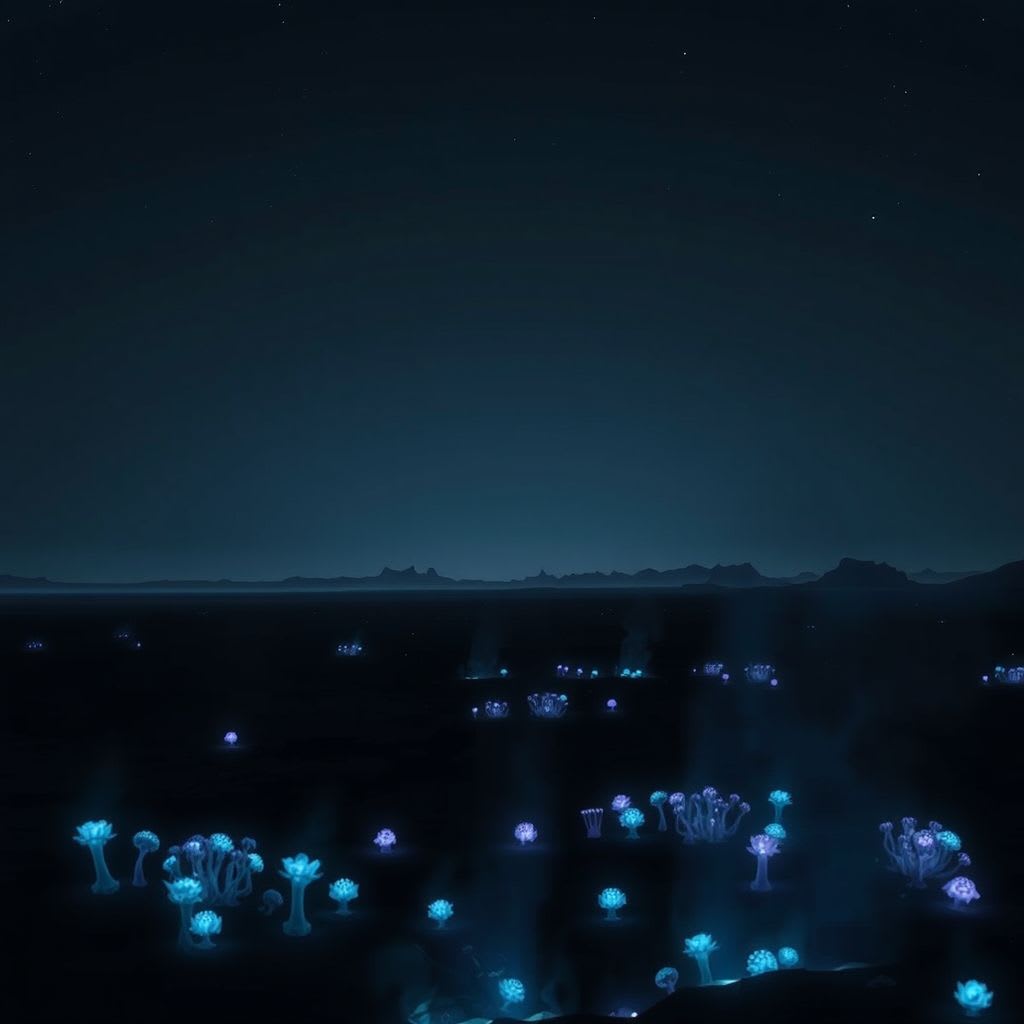
When we imagine life on other planets, we often picture vibrant landscapes bathed in sunlight — maybe two suns blazing in alien skies — or frozen wastelands shrouded in endless darkness. But what if there’s a world where night never ends, where the sun never rises? Could life exist there? The idea of a planet locked in eternal night might sound like science fiction, but it’s actually a real possibility within the realm of astronomy. Such worlds do exist, and scientists are seriously exploring whether life could thrive in their unending darkness.
Worlds Where the Sun Never Rises
Planets with permanent night are usually tidally locked to their stars. This means one side of the planet always faces the star, basking in constant daylight, while the other side remains in perpetual darkness — a cosmic “day side” and “night side,” never switching places. Think of it like our Moon, which always shows the same face to Earth.
Many tidally locked planets orbit red dwarf stars — the smallest and most common stars in our galaxy. These stars are much cooler and dimmer than our Sun, so their habitable zones, where liquid water might exist, are very close to the star. This proximity often leads to tidal locking. For example, the famous TRAPPIST-1 system hosts several such planets, some potentially in the habitable zone, with one hemisphere forever dark.
Darkness Isn’t a Death Sentence
At first glance, eternal darkness might seem like a death sentence for life. Without sunlight, how could organisms survive? But life depends on energy — not necessarily from light alone. On these dark sides, life could exist if other energy sources are available:
- Geothermal activity. Volcanic activity, geysers, and hot springs could create warm pockets or “oases” beneath the surface, where temperatures are suitable for life. Just as life thrives near Earth’s deep-sea hydrothermal vents, alien life could draw energy from a planet’s internal heat.
- Chemical energy. Some Earth bacteria don’t rely on sunlight but obtain energy through chemosynthesis — extracting energy from chemical reactions involving minerals and gases. Similar processes might power life in the dark regions of other worlds.
- Bioluminescence. On Earth, many deep-sea creatures produce their own light through bioluminescence. Alien organisms could have evolved to emit light themselves, allowing them to navigate and communicate in the eternal night.
Adapting to the Eternal Night
Life on a planet cloaked in darkness would likely be very different from what we know. Eyes, if they exist at all, might be highly sensitive to the faintest light or perhaps disappear entirely. Instead, creatures might rely on other senses — sound, vibrations, chemical signals, or even magnetic fields — to find food, avoid danger, and communicate.
Intelligent lifeforms, if they arise, might develop entirely unique technologies and cultures shaped by the absence of a visible sun. For example, a civilization never seeing the star might have no concept of “day” or “night,” and astronomy could be radically different or delayed in development.
Where Should We Look?
Red dwarf stars are the most abundant stars in the Milky Way, making tidally locked planets around them some of the most common potential habitats. Many rocky planets orbit these stars within the “habitable zone,” where liquid water could exist on the surface.
The “terminator zone” — the narrow band between the permanent day and night sides — might be the sweet spot. Here, temperatures could be moderate enough to sustain life, as the star’s light gently grazes this twilight strip, creating stable environments without extreme heat or cold.
Why It Matters
The idea of life existing in eternal night is more than just a cool sci-fi concept. It’s a plausible scenario that astrobiologists and astronomers are actively studying. After all, life on Earth has proven incredibly adaptable, thriving in the most extreme and unexpected environments — from the crushing pressure of deep ocean trenches to the frozen deserts of Antarctica.
If life can persist in complete darkness near underwater volcanic vents here, why couldn’t it survive on an alien world where sunlight never reaches? The cosmos may be home to countless dark worlds, some hiding ecosystems we can barely imagine.
Final Thoughts
Perhaps, somewhere out there, in the cold shadow of a distant star, life quietly flickers — strange, alien, and thriving in eternal night. Maybe an intelligent civilization is pondering the mysteries of the cosmos under a starless sky, sending signals into the void while we look up, dreaming of the dawn.
In the vast darkness of space, the potential for life is not limited by light — it is limited only by imagination and the unyielding will of life itself.
About the Creator
Keep reading
More stories from Holianyk Ihor and writers in Futurism and other communities.
Can We Build a Planet by Hand? Exploring the Future of Astroengineering
When we gaze at the stars, it feels almost unimaginable that one day humans might not only explore distant worlds but actually create entire planets from scratch. It sounds like pure science fiction—something out of a futuristic novel—but many ideas that once seemed impossible have gradually crept into the realm of scientific reality. Creating a planet by hand represents the ultimate frontier of astroengineering, the science of transforming and constructing celestial bodies. But is it really possible? Let’s dive into what this would mean and whether humanity might one day achieve it.
By Holianyk Ihor8 months ago in Futurism
About Binding Prometheus
I want to start actively advocating on behalf of my own work, and the most valuable part of my canon is, without a doubt, Binding Prometheus, the play I have been working on since 2019 and only finished in 2023 as part of my MA. The play itself is an amalgamation of a million different inspirations. On one end, it evokes the Ancient Greek myth-play, deriving its own title from the earliest extant work of Western drama we have, Aeschylus’s Prometheus Bound. On the other end, it borrows significantly from the sci-fi bulwarks from over the years, namely Mary Shelley’s Frankenstein and Karel Capek’s Rossum’s Universal Robots. The play could be an episode of Black Mirror, I fear. I don’t know. I’ve only ever seen one episode of Black Mirror.
By Steven Christopher McKnight18 days ago in Futurism
United States Kitchen Appliance Market Size and Forecast 2025–2033
The United States kitchen appliance market is entering a defining decade shaped by innovation, sustainability, and evolving consumer lifestyles. According to Renub Research, the market is projected to reach US$ 115.15 billion by 2033, rising from US$ 74.35 billion in 2024, at a compound annual growth rate (CAGR) of 4.98% during 2025–2033.
By Marthan Sir3 days ago in Futurism




Comments
There are no comments for this story
Be the first to respond and start the conversation.