


The new era of space exploration is upon us, with plans to colonize Mars and the moon by NASA, the European Space Agency (ESA) and private entrepreneurs collaborating to envision and build a moon village to permanently inhabit the moon and then Mars. Once we have successfully started a village on the moon, the sky’s the limit. We can go anywhere, any planet, any moon of any planet . But first, we have to start small, and grow. Just get a foothold on the moons surface, with a steady reliable transportation system to resupply their colonists with food and supplies from Earth until they can grow and manufacture their own on site.
the location of the village has already been picked out, the Shackleton Crater on the South Pole of the moon. It is continually bathed in sunlight, with deep shadows because of the deep crater walls, so there is a permanent source of ice and water available to access for drinking and irrigation of plant life, and manufacturing of rocket fuel, H2O, hydrogen and oxygen. Where there is water, there is life.
The European Space Agency (ESA) has already developed an inflateable housing unit. The innovative structural design of the modules is a hybrid rigid-soft system, made of two key elements: a rigid composite perimeter frame and an inflatable structural shell that integrates a multi-layer assembly with an environmental protection system. Unlike other inflatable designs that center structural and mechanical systems, this solution allows for more flexible interior arrangements to optimize environmental conditions, air distribution and recycling, visibility, workstation flexibility, and movement between spaces. It will be shipped to the village site pre-assembled, but deflated for shipping. Once it is in place, it will be inflated to its final size, and can be configured in various positions to fit into any building plan as needed. The development of the Moon Village would happen in phases: the initial phase would allow crews to live, work, and continue building the settlement. Gradually, additional infrastructure and equipment would arrive to support excavation, manufacturing, and construction. It is envisioned that robotic workers using 3d printing technology will be utilized to construct the second phase of building. The initial shipped habitation units can serve functions such as food production and science operations. Eventually, the Moon Village would grow into a thriving community: a hub for science, exploration, even tourism.The village would be the base for asteroid mining, with abundant minerals worth trillions of dollars being captured in space and taken to the moon for processing and then transported to Earth for manufacturing. Tourism is obvious, with millions of people eager to visit the moon village and space. Hotels would pop up all over the village to accommodate the traffic. Space elevators which are being developed now will be improved and then built, so that the impact of heavy rockets and the enormous amount of fuel needed for lift off out of Earth’s gravity will be cut, and the time taken to travel to the moon will be slashed. The moon village will flourish.
And there will be more than one village eventually, there will be several. China and Russia will get in on the action, as will India, and other players will emerge and develop there own villages and mining operations, not just countries but private entrepreneurs. It will be the dawn of a new age that will grow in leaps and bounds to all the other planets and moons in our solar system, and maybe one day to other galaxies. This is our future. One day we will have independent countries organized on planets, with governments, and Earth might not be the center of the civilization. Life imitating art (science fiction art).
About the Creator
Guy lynn
born and raised in Southern Rhodesia, a British colony in Southern CentralAfrica.I lived in South Africa during the 1970’s, on the south coast,Natal .Emigrated to the U.S.A. In 1980, specifically The San Francisco Bay Area, California.
Peer-to-Peer (P2P) Lending Market: Consumer Loan Expansion, Online Borrowing Trends & Growth Outlook
According to IMARC Group's latest research publication, the global peer-to-peer (P2P) lending market reached USD 279.4 Billion in 2025. Looking forward, IMARC Group expects the market to reach USD 1,714.1 Billion by 2034, exhibiting a growth rate (CAGR) of 20.46% during 2026-2034.
By sujeet. imarcgroup7 days ago in Futurism
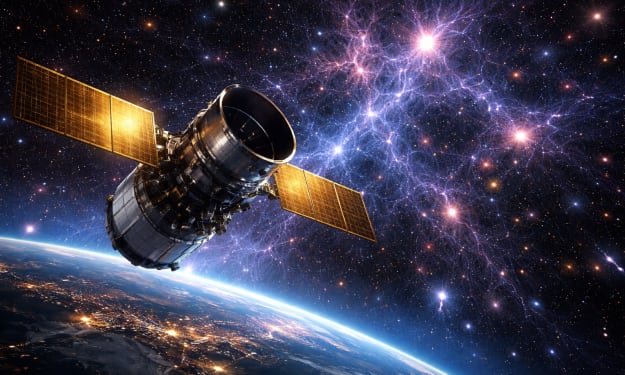
Euclid and the Precision Era of Dark Cosmology
In 2023, the European Space Agency launched Euclid with a sharply defined objective: to map the geometry of the Universe and determine, with unprecedented precision, how dark matter and dark energy shape cosmic evolution. Rather than focusing on individual spectacular objects, Euclid operates as a large-scale cartographer. Its mission is statistical and structural. It surveys billions of galaxies across a third of the sky to reconstruct a three-dimensional map of the cosmic web stretching over 10 billion years of cosmic history.
By Holianyk Ihor7 days ago in Futurism



Comments
There are no comments for this story
Be the first to respond and start the conversation.