
Euclid and the Precision Era of Dark Cosmology
Space

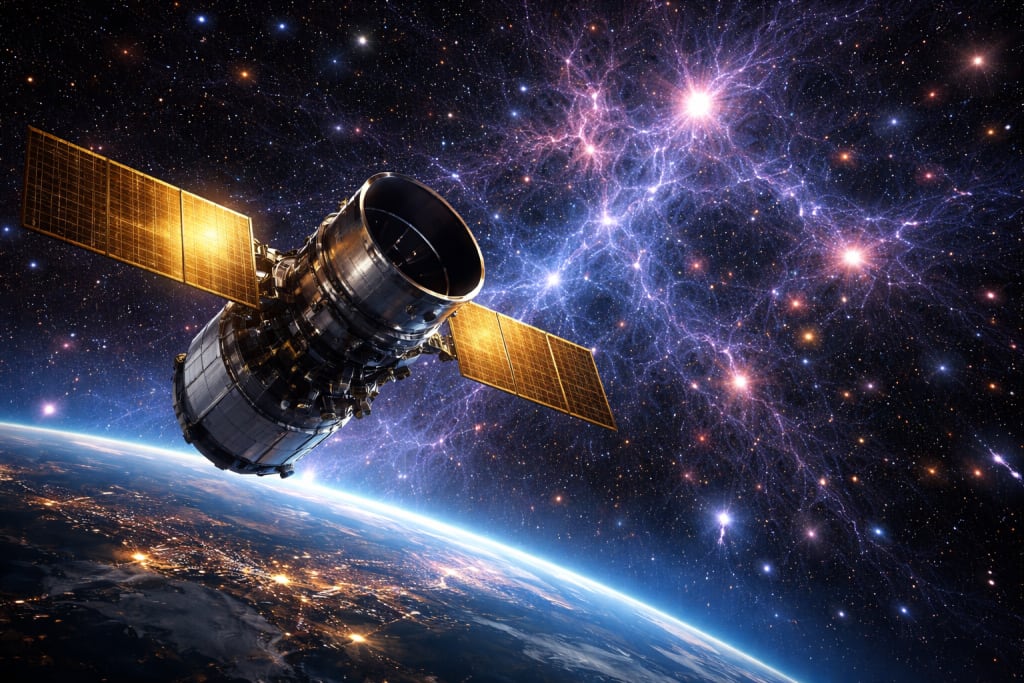
In 2023, the European Space Agency launched Euclid with a sharply defined objective: to map the geometry of the Universe and determine, with unprecedented precision, how dark matter and dark energy shape cosmic evolution. Rather than focusing on individual spectacular objects, Euclid operates as a large-scale cartographer. Its mission is statistical and structural. It surveys billions of galaxies across a third of the sky to reconstruct a three-dimensional map of the cosmic web stretching over 10 billion years of cosmic history.
The central question is straightforward but profound: Why is the Universe accelerating, and how exactly does invisible matter sculpt its structure?
Mapping the Invisible
Roughly 95% of the Universe is composed of dark components. About 27% is dark matter—non-luminous mass that exerts gravity but does not emit or absorb light. Approximately 68% is dark energy—the unknown driver behind the accelerating expansion of the cosmos.
Euclid does not detect dark matter particles directly. Instead, it measures their gravitational influence. One of its primary tools is weak gravitational lensing. When light from distant galaxies travels toward Earth, it passes through regions filled with dark matter. The gravity of that invisible mass subtly distorts the shapes of background galaxies. The distortions are extremely small—comparable to observing a slight warping in a reflection on uneven glass—but across billions of galaxies, the signal becomes statistically powerful.
Early Euclid observations have produced high-resolution measurements of cosmic shear—the pattern of weak lensing distortions across vast sky areas. These measurements significantly tighten constraints on parameters such as σ₈, which describes the amplitude of matter clustering, and Ωₘ, the total matter density fraction. The results so far are consistent with the ΛCDM (Lambda Cold Dark Matter) model, but the uncertainties are shrinking rapidly.
This precision matters. If gravity behaves differently on cosmological scales than predicted by general relativity, or if dark matter interacts in unexpected ways, deviations should emerge in how cosmic structure grows over time. Euclid’s early data already reduce the parameter space for alternative gravity models.
Listening to the Echo of the Early Universe
Euclid also studies baryon acoustic oscillations (BAO)—fossil patterns imprinted in the distribution of galaxies. In the early Universe, pressure waves propagated through hot plasma before recombination. When the Universe cooled and photons decoupled from matter, these waves left a characteristic scale embedded in the large-scale structure.
By measuring the apparent size of this standard ruler at different redshifts, Euclid determines how the expansion rate of the Universe has evolved. If dark energy changes over time, this evolution would deviate from the predictions of a simple cosmological constant.
The key parameter here is the equation-of-state value, w. In standard cosmology, w = −1. If w differs from −1—or varies with cosmic time—it would indicate physics beyond a simple vacuum energy interpretation.
Preliminary Euclid data confirm continued accelerated expansion and constrain w more tightly than before. So far, there is no statistically significant evidence that dark energy evolves. However, Euclid’s mission spans several years, and its full survey will multiply current data volumes. Small deviations, if present, may only become visible after comprehensive data accumulation and cross-correlation analyses.
The Hubble Tension Context
Modern cosmology faces a persistent discrepancy known as the “Hubble tension.” Measurements of the expansion rate based on the cosmic microwave background differ from those derived from local distance indicators such as Type Ia supernovae.
While Euclid does not directly measure the Hubble constant using local methods, its mapping of large-scale structure refines the cosmological parameters that influence inferred expansion rates. Early analyses do not eliminate the tension, but they narrow theoretical possibilities. Any proposed explanation—early dark energy, modified gravity, or systematic bias—must now remain consistent with Euclid’s structure-growth constraints.
Advanced Instrumentation and Data Processing
Euclid operates with two primary instruments:
- VIS (Visible Instrument), which measures galaxy shapes with extreme stability and precision.
- NISP (Near-Infrared Spectrometer and Photometer), which determines galaxy redshifts and distances.
The mission generates petabytes of data. Controlling systematic errors is critical. Even minute distortions in the point spread function (PSF) or detector effects could mimic cosmological signals. Calibration pipelines rely heavily on Bayesian statistical frameworks and machine learning algorithms to distinguish physical signal from instrumental noise.
This level of methodological rigor marks a transition from exploratory cosmology to precision cosmology. The goal is not merely detection but parameter constraint at percent-level accuracy.
Synergy with Other Observatories
Euclid’s findings gain additional strength through comparison with other missions:
- James Webb Space Telescope provides deep infrared observations of individual galaxies, informing models of galaxy evolution within dark matter halos.
- Hubble Space Telescope offers high-resolution imaging useful for calibration and morphological analysis.
- Planck supplies early-Universe constraints from the cosmic microwave background.
Together, these datasets allow cosmologists to test whether the growth of structure from recombination to the present day follows theoretical expectations.
Why It Matters
If Euclid continues to confirm ΛCDM with tighter constraints, it strengthens the case that dark energy behaves like a cosmological constant. That would imply the acceleration of the Universe is driven by vacuum energy—a concept rooted in quantum field theory but still not fully understood at a fundamental level.
However, if subtle inconsistencies emerge—such as scale-dependent growth anomalies or measurable deviations in w—they could signal new physics. This might include evolving scalar fields (quintessence), interactions between dark sectors, or modifications to gravity at gigaparsec scales.
In either scenario, Euclid’s contribution is transformative. It is converting cosmology from a discipline dominated by parameter degeneracies into one defined by high-precision constraints. The mission does not yet overturn existing theory, but it systematically limits where new physics can hide.
The broader implication is methodological. We are entering an era where invisible components of the Universe are mapped indirectly yet convincingly—through gravitational distortions, clustering statistics, and geometric measurements. Dark matter and dark energy remain unseen, but their fingerprints are now quantified with increasing clarity.
Euclid is not simply observing galaxies. It is measuring the structure of spacetime itself—and in doing so, narrowing the uncertainty around the fundamental forces that govern cosmic evolution.
About the Creator
Keep reading
More stories from Holianyk Ihor and writers in Futurism and other communities.
Launch and Scientific Impact of NASA’s Nancy Grace Roman Space Telescope (2026)
In 2026, NASA is preparing to launch one of the most ambitious space observatories of the decade: the Nancy Grace Roman Space Telescope. Designed to survey the universe at an unprecedented scale in near-infrared light, Roman is expected to reshape modern astrophysics by combining high resolution with an extraordinarily wide field of view. If the Hubble Space Telescope revealed the fine details of the cosmos, Roman will provide the panoramic context.
By Holianyk Ihorabout 7 hours ago in Futurism
Let’s Be Real: Can AI Ever Truly Feel the Spark of Creativity?
Honestly, I’ve spent the last few days playing around with AI. It’s everywhere—from our Spotify lists to our smart homes. It’s almost impossible to go a single day without interacting with some form of an algorithm. And while everyone is panicking about ChatGPT taking over the world and replacing every job on the planet, I started thinking about something deeper. I started wondering: Can a bunch of cold, calculated code and mathematical algorithms ever really understand the messy, beautiful, and sometimes chaotic "soul" that humans put into their work?
By Umar Waleed6 days ago in Futurism
LED Light Face Mask Market 2026: Investment Potential & Emerging Consumer Trends
According to IMARC Group's latest research publication, The global LED light face mask market size reached USD 357.6 Million in 2025. Looking forward, IMARC Group expects the market to reach USD 882.5 Million by 2034, exhibiting a growth rate (CAGR) of 10.60% during 2026-2034.
By sujeet. imarcgroupa day ago in Futurism
Echoes
I stepped carefully around the corner, the familiar sights and sounds hitting me like a brick to the face. My eyes watered. I could practically see us, all of us, back then, clustered around the outdoor tables in front of the pizza shop, the bar, the coffee shop. I could smell the various stalls from the events we’d been to on this street. I could taste the churros and nachos.
By Phoenixica243 days ago in Fiction


Comments
There are no comments for this story
Be the first to respond and start the conversation.