Latest Stories
Most recently published stories in Futurism.
Thoughts on the Book 'Brief Answers to the Big Questions' (Ch. 2)
Yes, I agree that the universe had a beginning, but I am not entirely sure what that beginning looks like. I am looking forward to future scientific discoveries that can shed a light on how exactly this universe came to be and why we are here. One specific statement I would like to expand upon is, “We don’t expect the universe to end in a brick wall, although there’s no logical reason why it couldn’t." This statement stood out to me because it is completely true; there is absolutely no reason why the universe could not end right now at this exact moment. That is to an extent crazy to think about because if the universe ends right now there are a lot of things I would never have gotten the chance to do or see; I wouldn’t have traveled or gone to college or seen my niece grow up. I do not want to die before I achieve all these things, but there is no reason why the entire universe couldn’t just stop at this very second. I don’t really know where I was going with this, but it is crazy to think my life and the life of everything I love could end instantly.
By Selena Vazquez7 years ago in Futurism
Easy Ways to Save Money and the Environment
In order to avoid spending money unnecessarily, you should reduce the amount of television you watch. Reducing the amount of television you watch saves you money, because you use less electricity at home, and you are also less exposed to advertisements that show items that you feel like buying, but that you do not really need. As a result, you would lower your stress, as you would not be as worried about money later on.
By Paisley Hansen7 years ago in Futurism
Review of David Walton's 'Three Laws Lethal'
David Walton's newest novel, Three Laws Lethal—title inspired by Isaac Asimov's three laws of robotics—begins with what certainly is an ethical quandary that typifies our increasingly AI-driven age, in this case, driven literally. A mother with her children are passengers in an AI-driven automobile. She can turn around and tell them to stop arguing, without risking an accident. She marvels at being in the driver's seat with her hands off the wheel. And then... a big tree falls in front of them. To plow into the tree would risk the death of both mother and children. The AI computes the deadly odds, and acts upon it, instantly swerving the car to the right to avoid the tree. Unfortunately, there's a biker in that lane, and he's killed by the swerving car.
By Paul Levinson7 years ago in Futurism
Nanobots and the Future of Technology
You might have heard the term nanobots in movies and remember them as microrobots. Nanobots in real life are nanoparticles sized machines. Nanoparticles are in between 1 to 100 nanometers. The study of building nanobots is called Nanorobotics. It is now mainly in the development phase and can have great potential to unlock new possibilities in the world of technology.
By Kevin Gardner7 years ago in Futurism
Thoughts on the Book 'Brief Answers to the Big Questions' (Ch. 1)
I believe faith plays a role in this chapter because he is answering the question about whether there is a God or not; evidence is highly important because the author is using scientific evidence to answer the chapter’s question. Imagination is involved because the author asks us to imagine certain situations in order to better understand his answer to the question. Group consensus plays a role because the laws of nature are accepted because of group consensus. Authority is also involved because Hawking is the authority since he is the author of the book; as well as how people see God as an authority figure. Sense perception can also be considered as a way of knowing for this situation because to understand the universe and the laws that govern it we use our different senses. Reason plays a role as well because the author is using logical arguments and scientific laws to answer the question. I don’t necessarily agree or disagree with the conclusion he came upon, which is that there is no God. This is because the science Hawking was explaining made sense to me and I agree with the scientific part of it. For example, I believe in evolution even though I was taught that God created all living things. I change my religious beliefs based on new evidence and new proof that we find because I hold science very highly. Thus even though I agree with the science of our universe, I still believe that there is a celestial being out there that is beyond scientific explanation. I believe in this entity not because there is an abundant amount of evidence it does but because I really want it to. I want it to exist because if it does exist then there is high chance heaven and hell exists as well.
By Selena Vazquez7 years ago in Futurism
Classic Movie Review: 'Star Trek V: The Final Frontier'
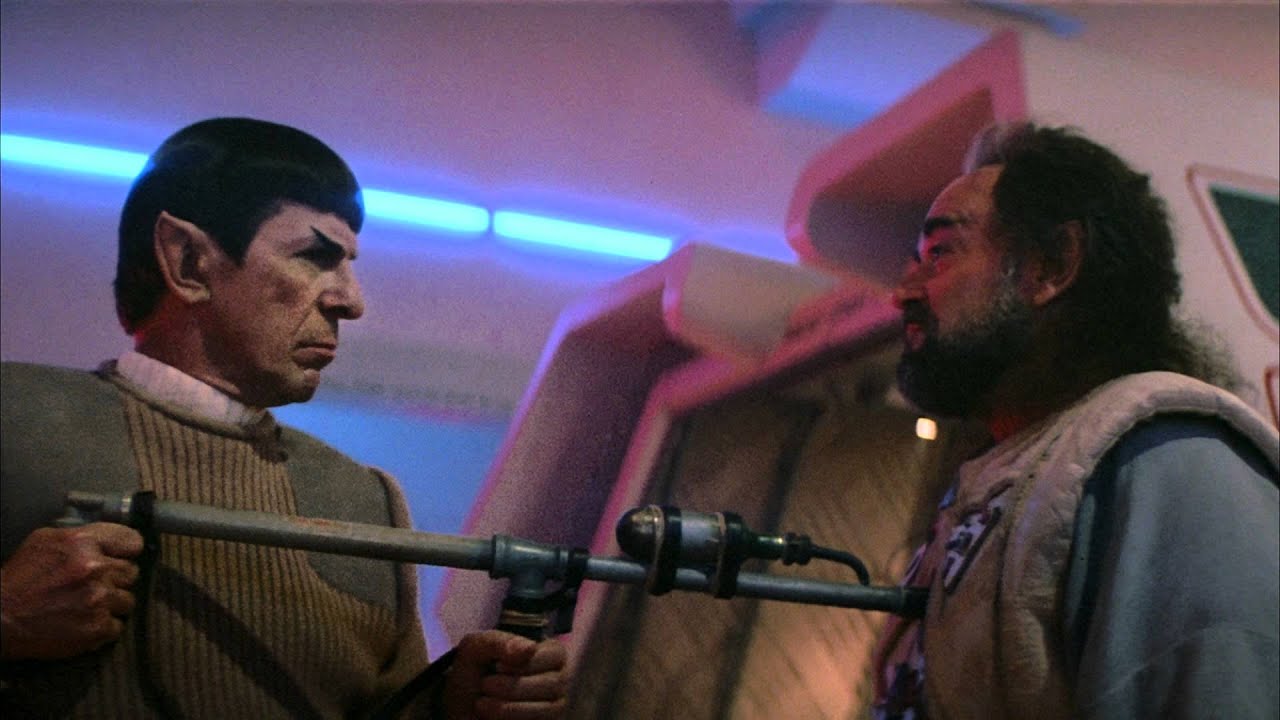
Star Trek V: The Final Frontier begins on a laughable, risible, note. After a prologue that vaguely introduces the film's villain, Laurence Luckinbill, we open on a mountain in California where a man is free climbing El Capitan. This handsome, in-shape, young man is nearly half way up the mountain when, in a scene of stunning incompetence, bad special effects, and remarkable arrogance, the strapping young climber is revealed to be the then nearly 60 year old, paunchy, William Shatner.
By Sean Patrick7 years ago in Futurism
Paul Darrow - Forever Avon
Paul Darrow is a name that, for a generation of science fiction fans, will be famous for one role. On the 9th of January 1978, Darrow made his debut appearance as Kerr Avon in the second episode of the BBC science-fiction series Blake's 7, and became a legend almost instantly. His cold, ruthless nature and his dry, sardonic wit made for a killer combination that appealed to viewers, and Darrow's performance was the icing on the cake. He quite literally became Avon, and, for four years, he gunned and quipped his way through the show, becoming its leading man for the last two series after the departure of Gareth Thomas. Whenever people think of Blake's 7, they think of Kerr Avon. And whenever anyone thinks of Kerr Avon, they think, and will always think, of Paul Darrow.
By Joseph A. Morrison7 years ago in Futurism
Review of J. Neil Schulman's 'The Fractal Man'
Alternate realities have become something of a vogue in science fiction, especially on television with Fringe and Counterpart. I've even tried my hand at it in a few short stories such as "The Other Car." But J. Neil Schulman has outdone all of this with his novel The Fractal Man, which for most of its 160 some odd pages—meant literally as well as a figure of speech here—is not only a masterpiece of alternate reality, but one of the best science fiction novels I've ever read, literally.
By Paul Levinson7 years ago in Futurism