
Journey to Proxima Centauri
"A Journey Beyond Imagination: Driving to the Nearest Star and Discovering the True Scale of the Universe"

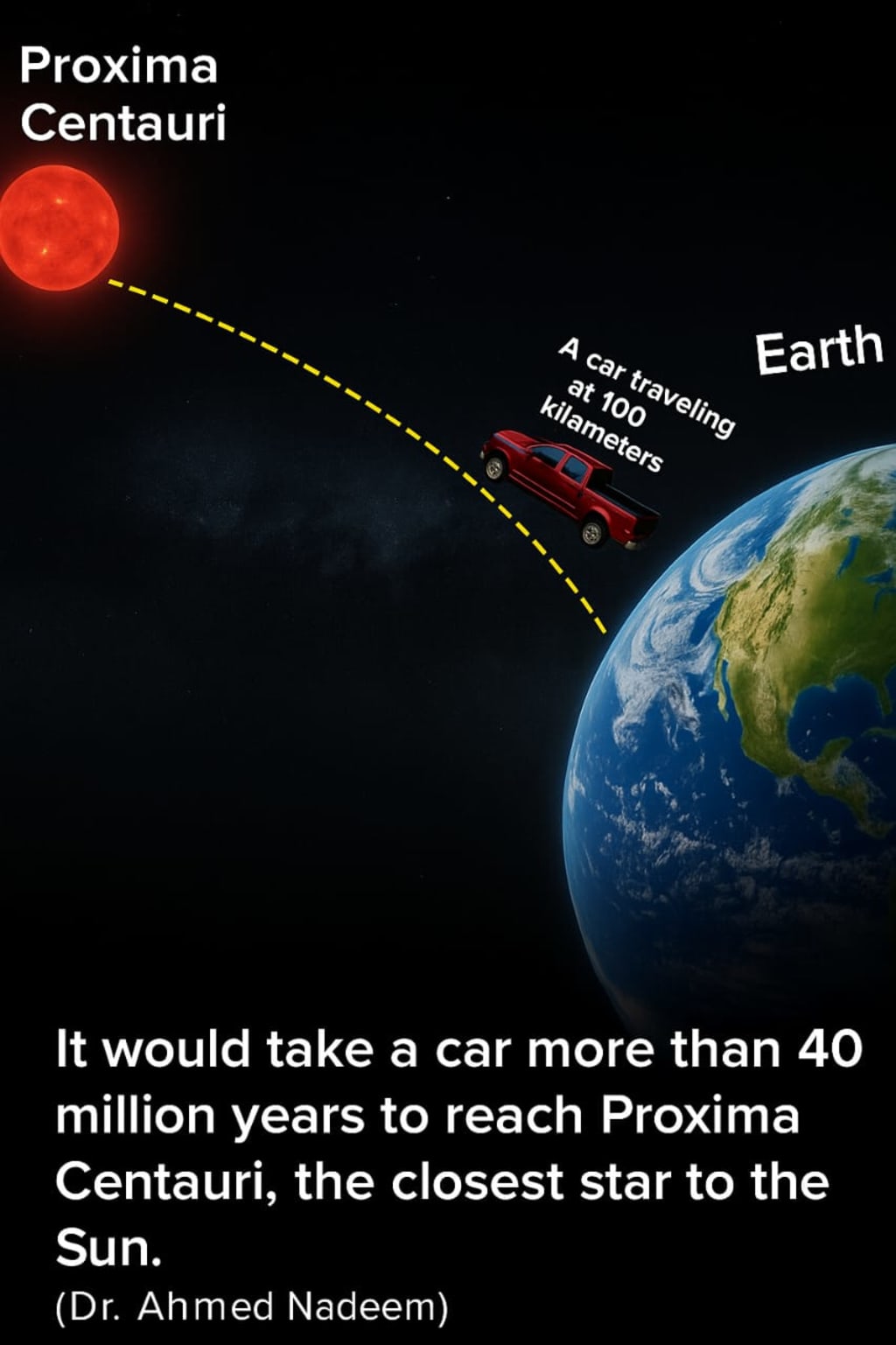
Journey to Proxima Centauri
At some point in life, you’ve probably sat in a car and traveled a long road or highway—maybe from New York to Chicago to visit family, from Houston to Los Angeles, or on a vacation to the Grand Canyon, Yellowstone, Yosemite, or the scenic Pacific Northwest. The miles pass by beneath your tires as the hum of the engine blends with your favorite playlist. While cruising steadily at around 60 mph (100 km/h) on a straight interstate, you may have found yourself glancing at your GPS and asking the age-old question: “How much farther to go?”
There are the familiar pauses on such trips—a coffee break at a rest stop, a stretch at a gas station, or a quick bite at a roadside diner. Despite the changing scenery, at some point, the journey starts to feel long. The landscape begins to blur, your body stiffens, and your thoughts drift. Time feels slower, and the horizon endlessly stretches ahead. And sometimes, it feels as though the trip might never end.
Now, imagine a different kind of road trip. You climb into your car, buckle your seatbelt, and press play on your favorite tunes. But this time, your destination isn’t a city or national park—it’s a star. A real one. A glowing dot in the night sky. And this road? It doesn’t have motels, gas stations, or rest stops. Just dark, infinite space.
Welcome to the ultimate road trip: a journey to Proxima Centauri, the closest star to Earth after the Sun.
How Far is Proxima Centauri?
Let’s start with the basics. Proxima Centauri is part of the Alpha Centauri star system, located approximately 4.243 light-years from Earth. But what does that mean in terms we can understand?
A light-year is not a measure of time—despite how it sounds. It’s actually a unit of distance, defined as the distance that light travels in one Earth year. Since light moves at around 300,000 kilometers per second (or roughly 186,000 miles per second), in one year it travels an astonishing 9.461 trillion kilometers—that’s 5.88 trillion miles.
So, when we say Proxima Centauri is 4.243 light-years away, we’re really saying:
> 4.243 × 9.461 trillion kilometers = approximately 40.14 trillion kilometers
(or about 24.94 trillion miles)
Let that number sink in: 40 trillion kilometers. That’s more than 266,000 times the distance between Earth and the Sun.
Driving to a Star
Now, let’s imagine you could drive to Proxima Centauri. Not in a rocket ship or a futuristic warp-speed craft—just a regular car, cruising steadily through space at 100 kilometers per hour (about 62 mph). That’s the speed of a responsible driver on a U.S. highway.
To find out how long such a journey would take, we apply a basic formula:
> Time = Distance ÷ Speed
Plugging in our numbers:
> 40,140,000,000,000 kilometers ÷ 100 km/h = 401,400,000,000 hours
That’s over 401 billion hours of driving—non-stop, with no bathroom breaks, no traffic lights, and no speeding.
To convert this into years, we divide by the number of hours in one year (about 8,766 hours):
> 401,400,000,000 ÷ 8,766 ≈ 45,788,284 years
That’s over 45 million years of continuous driving just to reach our nearest neighboring star.
Visualizing the Vastness
To visualize this mind-boggling distance, let’s scale things down. Imagine if the Sun were the size of a single pea. At that scale, Earth would be a tiny speck circling just a few inches away. And Proxima Centauri? It would sit roughly 125 miles (or 202 kilometers) away—like a pea-sized star sitting somewhere between New York City and Philadelphia.
And remember: that’s just the closest star. Our galaxy, the Milky Way, contains over 100 billion stars, many of them thousands of light-years away. And beyond our galaxy are billions of other galaxies—each teeming with stars, planets, dust, gas, and mysteries.
What This Means for Humanity
The time it would take to reach Proxima Centauri—45 million years—is staggering. For perspective, modern human civilization is only about 5,000 to 6,000 years old. Even Homo sapiens, our species, has only been around for about 300,000 years. In other words, if you started driving to Proxima Centauri when humans first appeared on Earth, you wouldn’t even be 1% of the way there.
This journey reveals something humbling and profound: The universe is unimaginably vast, and our current technology is incredibly slow compared to cosmic distances. Even the fastest spacecraft ever built—like NASA's Parker Solar Probe, traveling at over 700,000 km/h—would still take thousands of years to reach Proxima Centauri.
The Final Thought
So next time you're on a long drive—whether it’s across Texas, through the Rockies, or down Route 66—and you find yourself getting bored, remember this: even the longest road trip on Earth is nothing compared to a journey across the cosmos.
The universe is big. Really big. And while we may never drive to a star, imagining it helps us grasp just how small, and yet how curious and determined, we truly are.
About the Creator
Furqan Elahi
Writer of quiet thoughts in a loud world.
I believe stories can heal, words can build bridges, and silence is sometimes the loudest truth. On Vocal, I write to make sense of the unseen and give voice to the unsaid.
Keep reading
More stories from Furqan Elahi and writers in Futurism and other communities.
Matter’s Mirror Image Breaks: How a Tiny 5-Percent Difference at CERN Could Explain Why the Universe Exists
Introduction — Why This Discovery Matters to Everyone Why does anything exist? If matter and antimatter were created in equal amounts during the Big Bang, they should have annihilated each other into pure light—and you, I, and every star in the night sky would never have formed. Yet the cosmos is overflowing with matter. Last spring, physicists at CERN’s Large Hadron Collider beauty (LHCb) experiment finally caught a glimpse of how that imbalance may have arisen: they observed the first-ever difference in the way baryonic matter and antimatter break apart.
By Furqan Elahi6 months ago in Futurism
About Binding Prometheus
I want to start actively advocating on behalf of my own work, and the most valuable part of my canon is, without a doubt, Binding Prometheus, the play I have been working on since 2019 and only finished in 2023 as part of my MA. The play itself is an amalgamation of a million different inspirations. On one end, it evokes the Ancient Greek myth-play, deriving its own title from the earliest extant work of Western drama we have, Aeschylus’s Prometheus Bound. On the other end, it borrows significantly from the sci-fi bulwarks from over the years, namely Mary Shelley’s Frankenstein and Karel Capek’s Rossum’s Universal Robots. The play could be an episode of Black Mirror, I fear. I don’t know. I’ve only ever seen one episode of Black Mirror.
By Steven Christopher McKnight13 days ago in Futurism
Crowdfunding Market Companies Analysis 2025–2033
Introduction: A New Age of Democratized Capital The global crowdfunding industry has emerged as one of the most transformative forces in modern finance. By enabling individuals, entrepreneurs, and organizations to raise funds directly from a distributed pool of contributors, crowdfunding bypasses traditional intermediaries such as banks, venture capital firms, and institutional lenders. Over the last decade, this model has evolved from small community fundraisers into a multi-billion-dollar ecosystem that supports innovation, social impact, creative ventures, and business growth.
By Marthan Sira day ago in Futurism
Day 4 of Quitting
If this is how sobriety feels, maybe it’s better to go through life a little buzzed… this, along with other hits like, I want to kill myself, I wish I was dead, and I’m going to throw myself off a bridge have been the only thoughts on rotation these past few days. I promise myself that if, in a month, I still feel like this (‘this’ meaning despondent, full of rage, and simultaneously numb) I can go back to smoking. Until mid-February though? Nicotine is off the table.
By sleepy drafts6 days ago in Longevity


Comments
There are no comments for this story
Be the first to respond and start the conversation.