
James Webb Telescope Captures Potential Alien Structures
New images reveal anomalies that could indicate extraterrestrial life


There are moments in history when science forces us to rethink everything we know. This might be one of those times. The latest images from the James Webb Space Telescope have sparked a frenzy among astronomers, showing structures on a distant exoplanet that challenge everything we thought we understood about the universe. Could these be signs of life beyond Earth? Some experts believe the answer isn’t as far-fetched as it once seemed.
👽
The James Webb Space Telescope, our most powerful tool for peering into the cosmos, has already revealed groundbreaking discoveries. From capturing the birth of stars to offering glimpses into ancient galaxies, it has redefined how we see the universe. Now, it has turned its attention to a planet called K2-18 b, which is located about 120 light-years away in the Leo constellation. This exoplanet is unlike anything found in our solar system. It’s more than eight times the mass of Earth and orbits its star in a region where conditions could support life.
What makes K2-18 b especially intriguing is the chemical makeup of its atmosphere. Scientists have detected carbon dioxide and methane, two gases that often hint at biological processes. Even more intriguing is the possible presence of dimethyl sulfide. Here on Earth, dimethyl sulfide is almost exclusively produced by living organisms, mainly marine phytoplankton. If this gas is truly in K2-18 b’s atmosphere, it could be a major clue that something—perhaps even life—exists there.
👽
This discovery is thrilling, but it comes with plenty of questions. While dimethyl sulfide is an indicator of life on Earth, that doesn’t mean it has the same origin elsewhere. It’s possible that non-living chemical reactions could be producing this gas. Scientists are now racing to gather more data, hoping to confirm whether this detection is real and, if so, what it truly means.
Even without definitive proof of life, K2-18 b is a fascinating place. It’s classified as a Hycean world, a planet covered by a vast ocean beneath a thick, hydrogen-rich atmosphere. If life exists there, it would be in an environment drastically different from anything on Earth. The idea of alien organisms thriving in an ocean far beyond our solar system is both thrilling and humbling.
👽
For decades, astronomers have debated what it would take to confirm extraterrestrial life. Some argue that chemical signatures like methane and dimethyl sulfide are enough to suggest biological activity, while others insist that direct observation—perhaps through a future mission—is the only way to be sure. The truth likely lies somewhere in between. With technology advancing at an unprecedented pace, it’s possible that in the near future, we’ll get a clearer answer.

What’s undeniable is that the James Webb Space Telescope has revolutionized our understanding of exoplanets. Before its launch, we could only make rough guesses about the atmospheres of distant worlds. Now, we can detect molecules with incredible precision, inching closer to solving one of humanity’s biggest mysteries: Are we alone?
The implications of this discovery stretch far beyond science. If life exists elsewhere, it reshapes our understanding of biology, evolution, and even our place in the universe. The mere possibility forces us to reconsider long-held beliefs about how life begins and where it can thrive. It also raises ethical and philosophical questions about our role as explorers of the cosmos.
👽
For now, the scientific community remains cautiously optimistic. Researchers will continue to analyze the data, seeking to confirm whether these atmospheric signatures are truly biological or the result of non-living processes. Follow-up observations with the James Webb Space Telescope and other instruments could provide the clarity needed to settle the debate.
Regardless of the outcome, one thing is certain: The search for life beyond Earth is more exciting than ever. The universe is vast and filled with countless worlds, each holding the potential for discovery. Whether K2-18 b is home to alien life or simply a fascinating piece of cosmic history, its mysteries remind us of why we explore in the first place. The truth is out there, waiting to be found.
About the Creator
Ojo
🔍 I explore anything that matters—because the best discoveries don’t fit into a box...
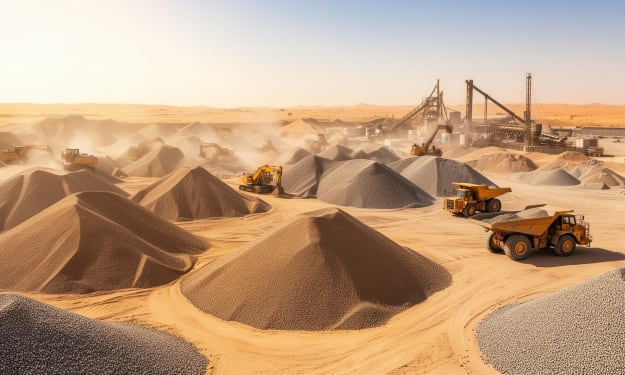
Saudi Arabia Industrial Sand Market 2026–2034: Construction Expansion, Foundry Demand & Energy Sector Applications
Saudi Arabia's industrial sand sector is moving fast, and the numbers back it up. Steady demand from mega-construction projects, expanding domestic glass production, and a push into unconventional gas development are all pulling the market in the same direction — upward. According to IMARC Group's latest research, the Saudi Arabia industrial sand market was valued at USD 81.82 Million in 2025 and is projected to reach USD 122.1 Million by 2034. The Eastern region leads with a 36% market share in 2025, anchored by oil and gas operations and major industrial infrastructure around Jubail. With Vision 2030 pumping over USD 1.3 trillion into economic transformation, this market shows no signs of slowing down.
By Kishan Kumar5 days ago in Futurism
Top 10 LLM Development Companies Transforming U.S. Enterprises
In 2026, the most valuable employee in many American companies isn’t human. It’s a language model. From drafting legal contracts in New York to automating customer support in Texas, LLMs are quietly reshaping how enterprises operate. But behind every successful deployment is a development partner — the firm that turns raw AI into real business outcomes.
By Ritu Singh2 days ago in Futurism



Comments
There are no comments for this story
Be the first to respond and start the conversation.