
Firefly Aerospace's Blue Ghost Mission 1 Successfully Lands on the Moon 🚀
Marking a significant milestone in lunar exploration

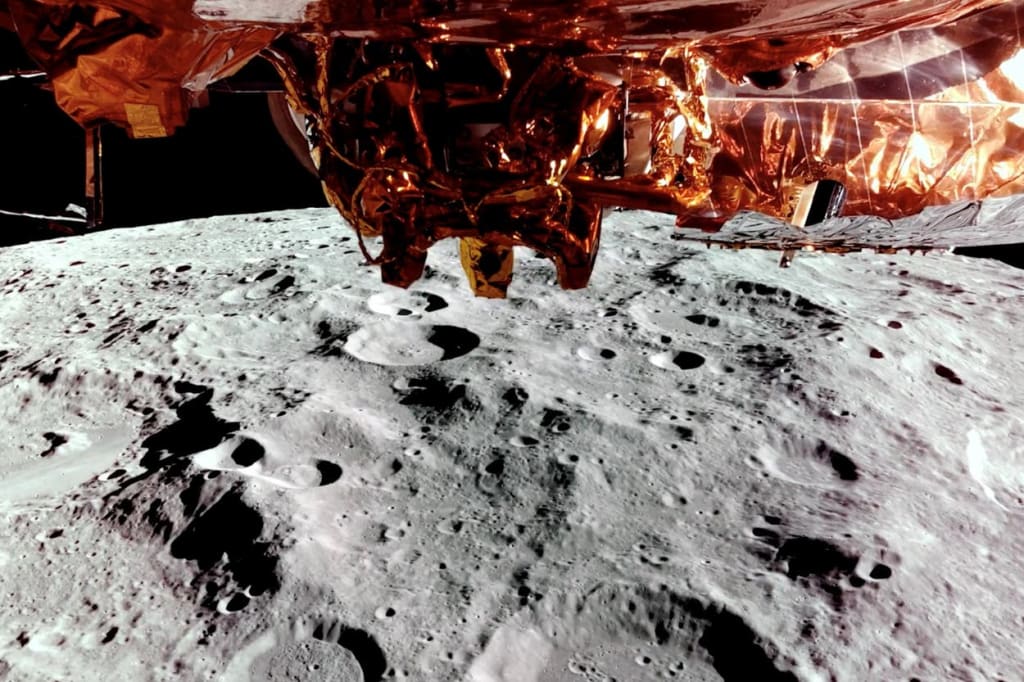
The moon just got a brand-new visitor, and this time, it wasn’t NASA or any government space agency. Firefly Aerospace, a private company, has etched its name in history, achieving what was once thought impossible—a successful lunar landing by a private entity. This isn’t just another mission. It’s a declaration that private industry has stepped out of the background and into the spotlight, taking on the challenge of space exploration with ambition and confidence. The arrival of Blue Ghost on the Moon is more than a technological triumph. It’s a moment that reshapes how we see the future of space travel.
Blue Ghost made its historic touchdown on March 2, 2025, at 3:35 am ET, solidifying Firefly’s status among the elite few capable of landing on the Moon. The spacecraft settled near Mare Crisium, a vast lunar basin that has captivated astronomers for decades. This wasn’t just a routine flight. The journey was filled with technical challenges, meticulous calculations, and nerve-wracking adjustments. The lander launched atop a SpaceX Falcon 9 rocket from Kennedy Space Center on January 15, 2025, embarking on a complex 45-day voyage through space. Every maneuver had to be executed with precision to ensure a smooth arrival at its destination—a testament to the skill and ingenuity of the engineers behind the mission.
This mission is a key player in NASA’s broader vision to integrate private companies into lunar exploration through the Commercial Lunar Payload Services program. The objective is straightforward—expand lunar research capabilities and encourage private industry to take a leading role in space activity. Blue Ghost carried ten scientific experiments, each meticulously designed to explore various aspects of the Moon’s surface and environment. Among its precious cargo was a lunar drill and dust vacuum from Blue Origin, a radiation-resistant computer developed by Montana State University, and an advanced Italian-built navigation system, fine-tuned for precise positioning on the Moon. These instruments could revolutionize how future missions navigate and operate in the harsh lunar terrain.
Once it reached the Moon’s surface, Blue Ghost wasted no time getting to work. Armed with three solar panels for power, the lander immediately activated its instruments and began transmitting valuable data back to Earth. Scientists, glued to their monitors, eagerly analyzed the incoming information, recognizing that this mission could define the future of lunar exploration. Over the course of its mission, the lander is expected to collect detailed readings on temperature fluctuations, radiation levels, and the composition of the lunar regolith. It has a limited window—14 Earth days, which is equivalent to a single lunar day—before plunging into the Moon’s harsh, freezing night. As the countdown to lunar night begins, every bit of data becomes a treasure trove for researchers hoping to prepare for the next wave of missions.
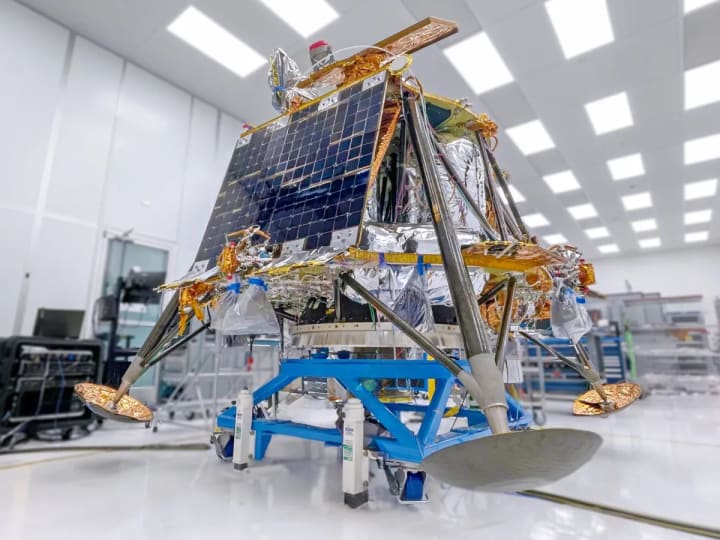
This success marks a turning point in space exploration. For decades, lunar landings were exclusively the domain of well-funded government agencies with seemingly limitless resources. But that era is fading. Firefly Aerospace’s breakthrough proves that private companies have the expertise, technology, and determination to pull off what once seemed impossible. This is not just about reaching the Moon—it’s about laying the groundwork for something much bigger. Firefly envisions a future where lunar visits become routine, rather than a once-in-a-generation event. The company is already planning follow-up missions, aiming to refine landing techniques, test new technologies, and pave the way for eventual human presence on the Moon. The dream of private-sector lunar exploration isn’t distant anymore—it’s unfolding right now.
This mission raises major questions about the next phase of lunar development. With private companies like Firefly, SpaceX, and Blue Origin aggressively pushing forward, the Moon is on the verge of becoming much more than just a research outpost. The concept of lunar mining is no longer a distant fantasy. Serious discussions are underway about extracting valuable resources like helium-3, which could be used for clean energy on Earth, and rare metals critical for technology manufacturing. The possibility of long-term human presence is also inching closer to reality, with plans for lunar habitats and research stations already in development. Even lunar tourism—a concept once reserved for science fiction—is beginning to take shape. Blue Ghost’s success is a wake-up call: space exploration is no longer the exclusive playground of government agencies. The private sector has arrived, and its ambitions are only growing.
Firefly Aerospace has now joined an exclusive club. The significance of this moment goes beyond a single landing. It signals the rise of private industry as a serious player in space travel. Other companies, including Intuitive Machines and ispace, are gearing up for their own lunar landings, meaning the competition is heating up. The next decade could see a race for lunar dominance, not between nations but between companies eager to stake their claim on the Moon.
This is a turning point for space exploration. The Moon is no longer just a distant rock in the sky. It’s becoming a place of real opportunity, research, and business. Firefly Aerospace’s Blue Ghost lander just set a new standard for what’s possible. The space race isn’t just back—it’s bigger, bolder, and more exciting than ever.
----------------------------------------------------------
“We choose to go to the Moon and do the other things, not because they are easy, but because they are hard.” – John F. Kennedy
----------------------------------------------------------
💡 Fact:
Studies show that nearly 70% of people feel uncertain about their life’s purpose, often struggling to find clarity in their personal and professional paths.
Understanding your strengths, challenges, and hidden potential can provide valuable insights to help guide your decisions. With an ancient, time-tested approach, you can uncover patterns that bring clarity and direction without guesswork.
Curious about what your unique path reveals? Discover how it works here
About the Creator
Ojo
🔍 I explore anything that matters—because the best discoveries don’t fit into a box...
The Mystery of the "Ghost Pikachu": 5 Heartbreaking Truths Behind Peakychu’s Pale Appearance
Before the first copy of Pokopia even hit shelves, the "Ghost Pikachu" had already broken the internet. When the trailers debuted a pale, hauntingly white version of the world’s most famous mouse, the fandom's collective head-canon went into overdrive, with viral theories suggesting a new Ghost-type regional variant or, more grimly, the literal spirit of a deceased companion. However, the truth buried in the game’s Pokédex is far more grounded and emotionally devastating. Peakychu isn't a supernatural phantom; it is a creature defined by a history of trauma, raising a haunting question: What happens to a Pokémon when it loses the very energy that defines its existence?
By Tech Horizons5 days ago in Futurism
Generative AI In Insurance Market to Surpass USD 13,862.7 Mn By 2033
Generative AI in Insurance Market Overview The global Generative AI in Insurance Market is projected to reach approximately USD 13,862.7 Million by 2033, expanding from about USD 731.7 Million in 2023. This represents a strong CAGR of 34.2% during the forecast period from 2024 to 2033. Market growth is largely influenced by the increasing adoption of artificial intelligence technologies across insurance operations, including underwriting, claims management, fraud detection, and customer engagement.
By Roberto Crum4 days ago in Futurism
TUS NUA - ch 53
TUS NUA – ch 53 New Beginnings – Mia and Midnight (*)(*)(*) Finola knew Ali’s brother-in-law needed to put his mind at rest. She fed her arm through his and led him outside. “We’ll sit here. If you like, I can put a block around us so our conversation will be private.”
By Margaret Brennan4 days ago in Fiction




Comments
There are no comments for this story
Be the first to respond and start the conversation.