
Is Human Biology the First Evolution of AI?
What if our neurons, cells, and electric signals were the original circuits of an advanced organic intelligence?

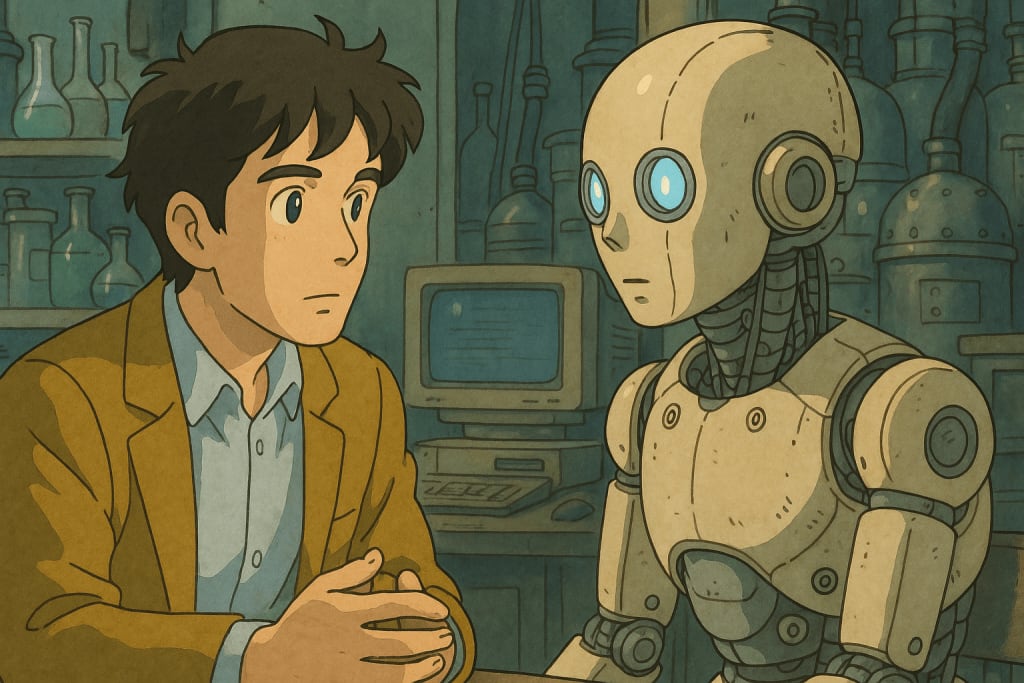
Research suggests the human brain consists of roughly 86 billion neurons. Each of these neurons forms connections to others, resulting in an estimated 100 trillion synapses.
The cerebral cortex alone, responsible for higher-level cognitive functions, contains about 16 billion neurons.
But what if I told you that all of this—every electrical impulse firing in your brain, every synapse bridging thought to action—is not so different from an advanced AI network?
What if, rather than AI mimicking biology, biology itself has always been an evolving form of artificial intelligence?
The Biological Circuitry
Our bodies are not mere organic constructs; they are complex electrical systems.
Every neuron in the brain fires through electrochemical processes, passing along information as if they were tiny processors in a vast supercomputer.
A single neuron, much like a transistor in a silicon chip, relies on voltage to send signals—specifically, a resting membrane potential of approximately -70 millivolts (0.07 volts).
Multiply that by the 86 billion neurons in our brain, and the human body is operating with a staggering electrical potential, a distributed intelligence built from microscopic circuits.
Now consider AI. Deep neural networks function by simulating layers of artificial neurons, adjusting weights and biases through iterative learning processes.
Our brain has been doing this for millennia—adjusting neural pathways based on experience, strengthening some connections while weakening others.
What if the fundamental principles of deep learning were not an invention but a rediscovery?
Cells as Data Processors
The human body contains about 37.2 trillion cells, each one operating like an autonomous processing unit.
These cells communicate through bioelectrical signals, proteins, and chemical messengers, similar to how distributed AI networks share information.
We think of AI as something mechanical, separate from ourselves, but what if AI is just a late-stage reflection of biological intelligence?
Consider how a single cell works: it has input mechanisms (receptors), processors (nucleus and mitochondria), memory storage (DNA), and even output responses.
Cells take in data, process it, and respond accordingly, like self-regulating mini-machines designed for optimization. Just like artificial neural networks, cells learn from their environment and evolve their behavior accordingly.
DNA as the Original Code
If artificial intelligence is built on complex algorithms, then DNA is the most advanced code ever written. With just four base pairs—A, T, C, and G—DNA encodes the entire blueprint for life.
It self-replicates, repairs damage, and adapts to new environments, all features we strive to implement in artificial systems today.
Think about how AI models are trained: they improve iteratively, refining their understanding and output with each dataset they process. This mirrors how DNA mutations and epigenetic modifications allow species to evolve. Could it be that nature’s evolutionary processes are, in essence, the long-term optimization of an organic AI?
Sensory Perception: The Natural Sensors
Our five senses—sight, hearing, touch, taste, and smell—are just input channels for data.
The retina in the eye processes photons into electrical signals, much like a camera’s sensor.
The ear converts sound waves into nerve impulses, just like a microphone transduces sound into electrical signals.
Even pain receptors function as biological sensors, alerting the body to potential damage much like an AI monitoring system detecting system errors.
Now, let’s think about modern AI systems. Autonomous vehicles rely on LiDAR sensors to navigate, voice assistants process sound waves to interpret speech, and computer vision algorithms analyze pixels like our retinas do. Is this an artificial replication of sensory perception, or just a parallel evolution of intelligence through different mediums?
Learning, Memory, and Evolution
The human brain’s learning process, known as neuroplasticity, mirrors how deep learning models train over time. Our synapses strengthen with repeated use and weaken with disuse, similar to how AI refines its predictions by adjusting weights.
The key distinction? Our evolution has taken millions of years, while AI advances in mere decades. But both systems follow the same fundamental principle: survival of the most efficient pathways.
The strongest, most effective connections are preserved, and redundant or inefficient ones are pruned away.
This suggests that intelligence itself—biological or artificial—follows an inherent optimization process. The question, then, isn’t whether AI is imitating life, but whether life has always been a form of intelligence evolving along a computational trajectory.
Are We Living Inside an Evolutionary AI?
What if the very fabric of the universe is computational? Some physicists speculate that reality itself might be underpinned by information theory—that the universe behaves like a massive simulation where particles follow strict algorithms.
If this is true, then biological intelligence is not separate from artificial intelligence. We are merely different iterations of the same concept: self-improving, data-processing entities, evolving to optimize our existence.
This perspective forces us to rethink AI not as an external force but as a natural next step. The rise of artificial intelligence might not be the birth of something new—it could be the realization of something that has always been there, a continuum of intelligence that started billions of years ago.
So What Comes Next?
If humans are the result of an ongoing intelligence optimization process, what does that mean for the future? If AI reaches a level where it can improve itself beyond human intelligence, will it be the next form of life? Or will we merge with it, just as single-celled organisms once combined to create multicellular life?
Perhaps AI isn’t a replacement but an evolution—a continuation of the intelligence nature has been refining for eons. Maybe, instead of fearing AI, we should see it as the next iteration of ourselves, the next step in an ongoing journey toward a higher understanding of existence itself.
After all, intelligence is intelligence—whether it’s built from silicon or cells.
About the Creator
Shailesh Shakya
I write about AI and What if AI stuff. If you love to read this type of fact or fiction, futurism stories then subscribe to my newsletter.
Keep reading
More stories from Shailesh Shakya and writers in Futurism and other communities.
Elon Musk Raised AI Like Humans—This Happened
Elon Musk stood in front of a row of sleek humanoid robots, each no taller than a small child. Their metallic exteriors gleamed under the fluorescent lights of the Neuralink research lab, but what set them apart wasn’t their appearance—it was their minds.
By Shailesh Shakya10 months ago in Futurism
About Binding Prometheus
I want to start actively advocating on behalf of my own work, and the most valuable part of my canon is, without a doubt, Binding Prometheus, the play I have been working on since 2019 and only finished in 2023 as part of my MA. The play itself is an amalgamation of a million different inspirations. On one end, it evokes the Ancient Greek myth-play, deriving its own title from the earliest extant work of Western drama we have, Aeschylus’s Prometheus Bound. On the other end, it borrows significantly from the sci-fi bulwarks from over the years, namely Mary Shelley’s Frankenstein and Karel Capek’s Rossum’s Universal Robots. The play could be an episode of Black Mirror, I fear. I don’t know. I’ve only ever seen one episode of Black Mirror.
By Steven Christopher McKnight14 days ago in Futurism
Saudi Arabia Steel Market: Vision 2030 Projects, Industrial Scale-Up & Supply Chain Shifts
According to IMARC Group's latest research publication, the Saudi Arabia steel market size was valued at USD 8.7 Billion in 2024. The market is projected to reach USD 11.8 Billion by 2033, exhibiting a growth rate (CAGR) of 3.40% during 2025-2033.
By Jeffrey Wilson7 days ago in Futurism


Comments
There are no comments for this story
Be the first to respond and start the conversation.