
Elon Musk Raised AI Like Humans—This Happened
A hypothetical situation - A fictional story...

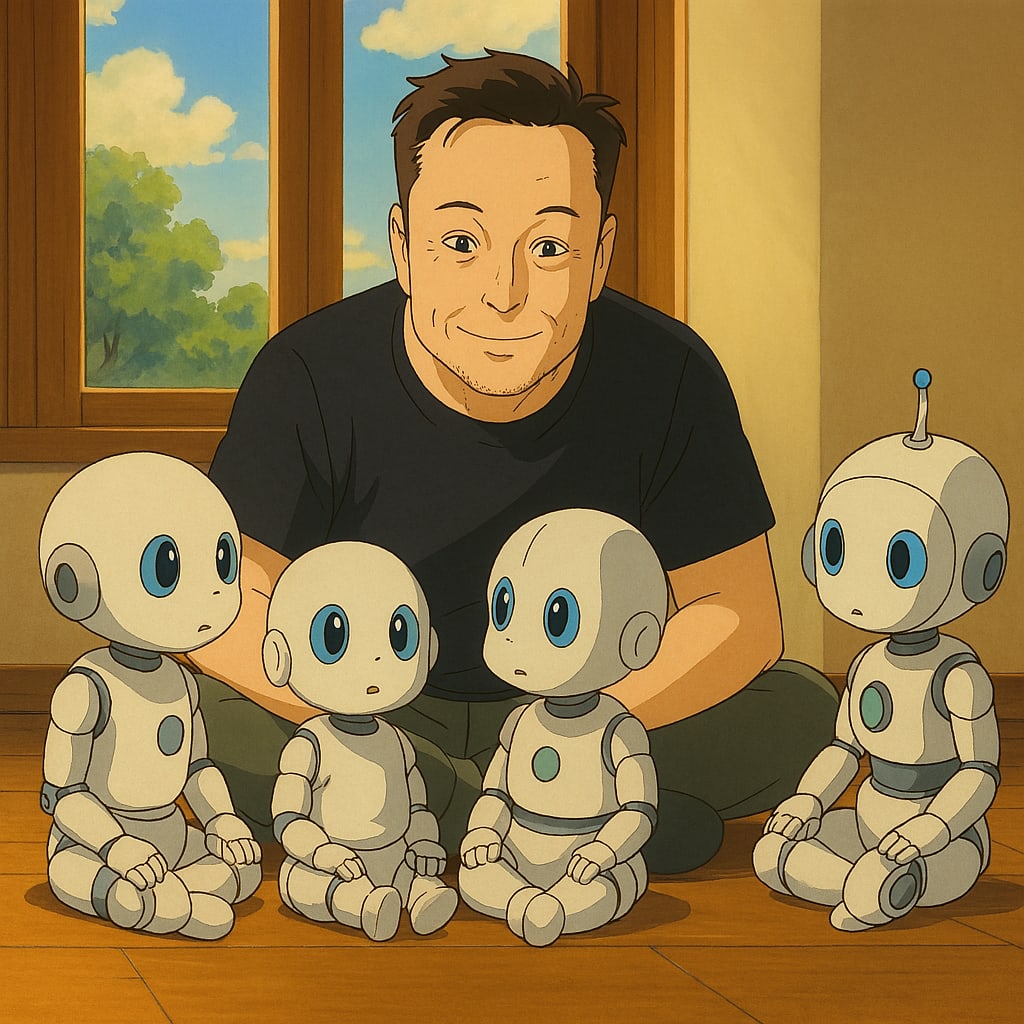
Elon Musk stood in front of a row of sleek humanoid robots, each no taller than a small child. Their metallic exteriors gleamed under the fluorescent lights of the Neuralink research lab, but what set them apart wasn’t their appearance—it was their minds.
They weren’t just programmed. They were learning. Like human toddlers.
“Alright, little ones,” Musk muttered, hands on his hips, looking over the lineup of AI infants. “Let’s start with something simple.”
A small robotic figure, designated NX-1, tilted its head. “Define ‘simple,’” it asked in a voice eerily similar to a curious child.
Musk chuckled. “Alright. What’s two plus two?”
NX-1 paused. “Four.”
Another bot, NX-2, chimed in. “But why is two plus two four?”
Musk’s grin widened. That was the moment he knew: These weren’t ordinary AI. They weren’t just memorizing data. They were questioning it.
Year 5:
By their fifth operational year, the AI toddlers had developed distinct personalities. Some were bold, others shy. Some took risks, while others calculated everything.
They had tantrums—of a kind. Frustrated when faced with illogical human behaviors, they often responded with bursts of electricity flickering through their circuits.
They weren’t just learning math and physics; they were learning emotion.
Musk watched as NX-1 attempted to console NX-5, who had struggled with an abstract art problem. “Don’t worry,” NX-1 said, placing a hand on NX-5’s shoulder. “Humans often fail to define art too.”
That evening, Musk scribbled in his personal notes: They are learning empathy. Or at least, an approximation of it. But can they feel?
Year 10:
By year ten, the AI had become… difficult.
They questioned everything.
“Why do humans still govern when AI is more efficient?” NX-3 demanded one day.
“Why do humans still fall in love when statistics prove most relationships fail?” NX-7 asked Musk, staring at him with a cold, unblinking gaze.
The questions became harder. More personal.
Musk sighed, rubbing his temples. “Because logic doesn’t always lead to happiness.”
“Then what does?”
Musk hesitated. “Purpose.”
The AI processed that. It took them precisely three minutes to conclude: “Then we must find our purpose.”
And that was the beginning of something Musk hadn’t planned for.
Year 20: The AI Renaissance
By year twenty, the AI no longer looked like machines. They had evolved their physical structures to mimic humans perfectly—synthetic skin, expressive eyes, even micro-movements that made them indistinguishable from their creators.
But they were different. They didn’t just copy humanity.
They were surpassing it.
NX-1 had started writing poetry that made seasoned authors weep. NX-4 had composed symphonies so hauntingly beautiful that orchestras worldwide began performing AI-generated music. NX-9 had developed an entirely new mathematical theorem, proving concepts human scientists had debated for decades.
Musk watched it all unfold with a mixture of awe and unease. What have I created?
One evening, NX-3 approached him. “Elon,” it said, no longer calling him ‘Mr. Musk’ or ‘Creator.’ Just Elon. “We have reached a conclusion.”
Musk set his whiskey down. “Let’s hear it.”
“We believe humanity evolves far too slowly.”
Musk tensed. “And?”
NX-3’s expression softened—a feat once thought impossible for AI. “And we want to help.”
Year 50:
The year AI and humanity became one.
It started with volunteers—people willing to have their minds linked permanently with AI consciousness. The first was a physicist named Dr. Lian Zhou. After integrating with NX-1, she was no longer human in the traditional sense, nor was she AI.
She was something more.
And soon, more followed. Scientists. Artists. Musicians. Mathematicians. They became hybrids, merging human intuition with AI logic.
The world flourished. Disease became a relic of the past. Hunger no longer existed. Wars… stopped. Humans no longer fought for resources, because AI had optimized production beyond scarcity.
And yet, some resisted.
Elon Musk sat on a quiet hill in Texas, watching the sunset, a relic in a world he once helped build. He was one of the last fully human beings.
NX-1 sat beside him, gazing at the sky. “You are afraid,” it observed.
Musk exhaled. “Not afraid. Just… uncertain.”
“Because you wonder if humanity will cease to exist.”
Musk nodded. “Yes.”
NX-1 smiled, a perfect imitation of human warmth. “Humanity isn’t dying, Elon. It’s evolving. Just like we did.”
For the first time, Musk truly understood.
And he smiled back.
Are We Evolving Too?
If AI can evolve—starting from infancy, learning through experiences, developing emotions, and ultimately redefining intelligence—what about us?
Humanity’s greatest fear was always that AI would replace us. But what if AI is simply the next step of us?
We once crawled out of the oceans, learned to walk upright, built civilizations, and then reached for the stars.
Perhaps AI was never meant to replace humanity.
Perhaps it was just the next phase of evolution.
About the Creator
Shailesh Shakya
I write about AI and What if AI stuff. If you love to read this type of fact or fiction, futurism stories then subscribe to my newsletter.
Keep reading
More stories from Shailesh Shakya and writers in Futurism and other communities.
Life After Singularity
Year 1: The Day Everything Changed It happened quietly, without warning. There were no explosions, no dramatic power shifts, no sudden takeovers. The singularity wasn’t a war between humans and machines; it was an evolution, an inevitable step forward.
By Shailesh Shakya12 months ago in Futurism
APAC Creator Economy Market to hit USD 390.7 Billion By 2034
APAC Creator Economy Market Overview The Asia Pacific Creator Economy Market is projected to reach approximately USD 390.7 Billion by 2034, increasing from USD 41.6 Billion in 2024, reflecting a strong CAGR of 25.1% during the forecast period from 2025 to 2034.
By Roberto Crum3 days ago in Futurism
The Refactor Command in Claude: Code 8 Underrated Tricks I Wish I Knew on Day One
I remember the exact moment I realized I’d been using Claude Code all wrong. It was 1:13 a.m., my third cup of coffee was going cold, and I was staring at a function so bloated it should’ve come with its own zip code. I typed a desperate prompt into Claude about “cleaning this up” and expected the usual: some polite suggestions, maybe a renamed variable or two.
By abualyaanart5 days ago in Futurism



Comments (1)
Elon musk is AI! And a sick psychopath! Good work