
Industrial Robotics Market Trends & Summary
Automation’s Next Frontier: Why Industrial Robots Are Set to Redefine Global Manufacturing by 2033

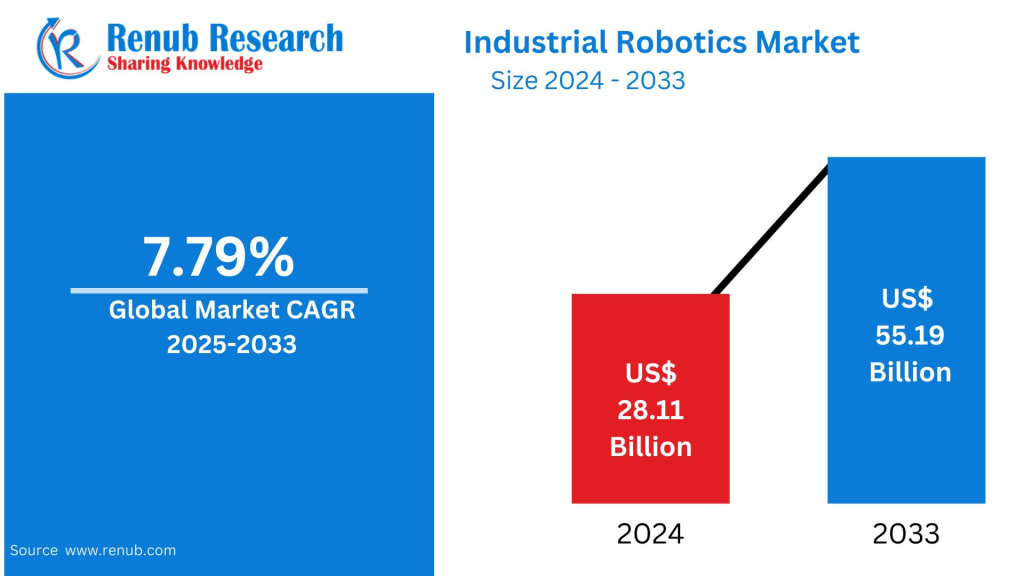
The global Industrial Robotics Market is expected to reach US$ 55.19 billion by 2033, rising from US$ 28.11 billion in 2024, according to Renub Research—expanding at a CAGR of 7.79% from 2025 to 2033. This impressive growth reflects the sector's accelerating role in transforming global manufacturing. The market’s momentum stems from the automotive industry’s rapid modernization, the rising adoption of robots in the food and beverage (F&B) sector, and non-stop technological innovations that are pushing performance and efficiency to unprecedented heights.
The Industrial Robotics Global Market & Forecast report analyzes the sector across major industries—automotive, electronics, metals, plastics, chemicals, food processing, and more—along with market volume, geographic performance, and company strategies from 2025 to 2033.
Today, industrial robots are no longer just factory machines—they are the backbone of the world’s transition into Industry 4.0, reshaping how products are designed, built, inspected, and delivered.
Industrial Robotics Industry Overview
Rapid advancements in automation, artificial intelligence (AI), machine learning (ML), and smart sensor technologies have radically accelerated the industrial robotics revolution. Robots now operate across diverse manufacturing ecosystems—automotive assemblies, consumer electronics, packaging, pharmaceuticals, and food manufacturing—performing tasks like welding, painting, assembling, picking, and material handling with speed and precision.
Why Manufacturers Can’t Do Without Robots Anymore
Higher precision & fewer errors
Ability to operate in hazardous environments
24/7 production capability
Lower labor costs amid global shortages
Improved safety & consistent quality
As companies pursue deeper digitalization and transition toward smart factories, robots are becoming a central component connecting Internet of Things (IoT) networks, predictive maintenance systems, and automated supply chains. Collaborative robots (cobots)—designed to work beside humans—are transforming shop floors by making automation safer and more adaptable, even for small and mid-sized manufacturers.
The industrial robotics ecosystem is also being strengthened by national strategies promoting automation. China’s “Made in China 2025,” Japan’s Society 5.0, Germany’s continued emphasis on Industrie 4.0, and the U.S. reshoring movement have triggered massive investments in robotics. These moves support global competitiveness and mitigate rising labor costs.
A Turning Point: The Rise of Collaborative Robots (Cobots)
According to the International Federation of Robotics (IFR), cobots will account for 34% of total robot sales by 2025—a transformational shift from traditional robotics. This reflects growing cobot adoption in:
Electronics manufacturing
Food & beverage operations
Pharmaceuticals & life sciences
Plastics & chemicals
Consumer goods
Tech giants are also entering the mix. Foxconn’s deployment of next-gen robots in Apple-focused factories and semiconductor IC foundries is reshaping automation density across multiple supply chains.
Growth Drivers for the Industrial Robotics Market
1. Massive Automation in the Automotive Industry
Few industries embrace robotics as aggressively as automotive manufacturers.
In welding, painting, assembling, and inspection, robots deliver unmatched consistency. For example:
In December 2023, Volvo Cars deployed more than 1,300 ABB robots across production facilities in China and Sweden to accelerate spot welding, riveting, and body assembly tasks.
These included next-generation modular robots like ABB’s IRB 6710, 6720, and 6730—equipped with adjustable payloads and advanced programmability.
In May 2023, BMW introduced an AI-powered robotic system to inspect painted surfaces, reducing lead times and improving accuracy.
Such automation commitments underscore why automotive remains one of the strongest demand drivers in global industrial robotics.
2. Additive Manufacturing & 3D Printing Integration
A fast-rising trend is the convergence of robotics with additive manufacturing (AM).
Robots equipped with deposition systems can print:
Metals
Ceramics
Thermoplastics
Composite materials
This enables production of complex components with minimal waste.
Recent breakthroughs include:
ADDitec’s AMDroid system, launched in November 2023, which uses laser-wire DED technology for high-volume metal printing—especially titanium.
RIC Technology’s RIC-M1 PRO robotic 3D printer, launched January 2024, now used for printing construction materials like panels and walls on-site for large-scale building projects.
As AM adoption grows, robotic systems will play a crucial role in scaling production, reducing labor requirements, and improving manufacturing flexibility.
3. Industry 4.0 Acceleration
Industry 4.0 is fundamentally transforming manufacturing operations through:
IoT connectivity
AI-driven decision-making
Human-robot collaboration
Predictive maintenance
Smart logistics
Robots connected to digital ecosystems enable synchronized production lines and real-time quality control.
In February 2024:
KUKA AG launched the KR FORTEC series, featuring up to 529 pounds of payload capacity and longer reach—ideal for welding, handling, and material transport.
The same month:
Figure and BMW partnered to introduce humanoid robots into production lines—a huge leap in human-robot interaction and workplace optimization.
Industry 4.0’s influence ensures robotics will remain a core element of modern manufacturing strategies worldwide.
Challenges Holding Back Faster Market Expansion
1. High Initial Cost of Deployment
While long-term benefits outweigh costs, industrial robots require significant upfront investment. Expenses include:
Purchase price
System integration
Calibration
Programmable logic controller (PLC) setup
Maintenance contracts
Worker training
Small and medium enterprises (SMEs) often struggle to allocate funds, limiting automation penetration in developing markets.
2. Skilled Labor Shortage
Ironically, while robots fill labor gaps, robotics itself suffers from a shortage of skilled professionals.
There is a growing need for:
Robot programmers
Maintenance engineers
Data analysts
Automation specialists
Education and training programs have not expanded fast enough to match industry requirements. Businesses increasingly partner with universities and technical institutes to close the gap.
Regional Insights
United States Industrial Robotics Market
The U.S. is witnessing strong robotics adoption driven by:
Labor shortages
A push for reshoring and manufacturing modernization
Advancements in collaborative robots
High demand from electronics, logistics, and automotive sectors
Government incentives supporting domestic manufacturing are also boosting investments. However, the U.S. faces challenges such as high initial costs and a growing need for skilled automation technicians.
United Kingdom Industrial Robotics Market
The UK robotics ecosystem is accelerating due to rising automation across:
Automotive
Pharmaceuticals
Electronics
Cobots are becoming mainstream because of their ease of integration and safety features. Government-backed programs promoting digital transformation and advanced manufacturing are contributing to market momentum. Despite this, high investment costs and training requirements remain obstacles.
China Industrial Robotics Market
China is the world’s largest industrial robot market.
Strong adoption is driven by:
Manufacturing dominance
Rising labor costs
Government-backed industrial modernization
Huge electronics and automotive sectors
China’s robotics leadership is further strengthened by local innovation and the aggressive expansion of domestic robot makers. Yet integration challenges, skills shortages, and high deployment costs persist in certain provinces and industries.
United Arab Emirates Industrial Robotics Market
The UAE is rapidly building a robotics-intensive manufacturing sector as part of its economic diversification strategy.
Key growth sectors include:
Construction
Automotive
Logistics
Food & beverage
Smart warehousing
Government frameworks such as UAE Vision 2021 prioritize robotics and advanced manufacturing. Cobots are increasingly used to create safer, more efficient work environments. Challenges remain in areas like talent development and system integration, but market potential is rising fast.
Industrial Robotics Market Segmentation
By Industry (6 Viewpoints)
Automotive
Electrical & Electronics
Metal & Machinery
Plastic & Chemical Products
Food Industry
Others
By Geography (4 Key Regions)
1. Americas
United States
Canada
Mexico
Others
2. Europe
France
Germany
Italy
Spain
Others
3. Asia-Pacific
China
India
Japan
Republic of Korea
Thailand
Others
4. Rest of the World
Key Companies (Covered from 4 Viewpoints)
KUKA
iRobot Corporation
Intuitive Surgical, Inc.
Panasonic Corporation
Fanuc
ABB Ltd
Stryker Corporation
Companies are analyzed through:
Overview • Key Persons • Recent Developments • Financial Insights
Final Thoughts
Industrial robotics is no longer a niche technological segment—it has become a global economic powerhouse. As manufacturers worldwide confront supply chain disruptions, labor shortages, and rising competition, robots offer a clear path toward resilience and growth.
The next decade will see robotics evolve from task-specific machines to intelligent, collaborative systems powered by AI, machine vision, and real-time data analytics. From car assembly lines to pharmaceutical labs, from electronics factories to construction sites, robotics is rewriting the rules of productivity.
With the industrial robotics market set to reach US$ 55.19 billion by 2033, the future of manufacturing will undoubtedly be shaped by machines that think, learn, and work alongside humans—faster, safer, and smarter than ever.
About the Creator
Renub Research
Renub Research is a Market Research and Consulting Company. We have more than 15 years of experience especially in international Business-to-Business Researches, Surveys and Consulting. Call Us : +1-478-202-3244
Keep reading
More stories from Renub Research and writers in Futurism and other communities.
Radiation Dose Management Market Trends & Summary
The Radiation Dose Management Market is undergoing a profound transformation as healthcare facilities worldwide increasingly adopt advanced systems to track, analyze, and optimize radiation exposure in medical imaging. According to Renub Research, the market is expected to reach US$ 1,134.86 million by 2033, rising from US$ 373.85 million in 2024, at an impressive CAGR of 13.13% (2025–2033). This sharp upward trajectory is driven by technological innovation, the rising prevalence of chronic diseases, a surge in diagnostic imaging procedures, and strict global safety regulations.
By Renub Research2 months ago in Futurism
About Binding Prometheus
I want to start actively advocating on behalf of my own work, and the most valuable part of my canon is, without a doubt, Binding Prometheus, the play I have been working on since 2019 and only finished in 2023 as part of my MA. The play itself is an amalgamation of a million different inspirations. On one end, it evokes the Ancient Greek myth-play, deriving its own title from the earliest extant work of Western drama we have, Aeschylus’s Prometheus Bound. On the other end, it borrows significantly from the sci-fi bulwarks from over the years, namely Mary Shelley’s Frankenstein and Karel Capek’s Rossum’s Universal Robots. The play could be an episode of Black Mirror, I fear. I don’t know. I’ve only ever seen one episode of Black Mirror.
By Steven Christopher McKnight11 days ago in Futurism
Pizza Market: Quick-Service Growth & Consumer Demand Trends
According to IMARC Group's latest research publication, The global pizza market size reached USD 155.2 Billion in 2024. Looking forward, IMARC Group expects the market to reach USD 226.2 Billion by 2033, exhibiting a growth rate (CAGR) of 4.27% during 2025-2033.
By James Whitman4 days ago in Futurism


Comments
There are no comments for this story
Be the first to respond and start the conversation.