
India Epoxy Resin Market Size & Forecast 2025–2033
Infrastructure boom, sustainability shift, and manufacturing surge accelerate India’s epoxy consumption


The India Epoxy Resin Market is experiencing a powerful industrial transformation. According to Renub Research, the market is projected to expand from US$ 169.4 Kilotons in 2024 to US$ 338.91 Kilotons by 2033, growing at a CAGR of 8.01% from 2025 to 2033.
India’s expanding infrastructure, rising electronics manufacturing, automotive lightweighting, renewable energy installations, and government-backed domestic production policies are pushing epoxy resins into mainstream industrial adoption. With sustainability becoming a central industrial mandate, demand is no longer limited to conventional synthetic epoxies — environmentally preferred, bio-based, and low-VOC (volatile organic compound) resins are fast becoming part of India’s long-term material strategy.
India Epoxy Resin Industry Overview
Epoxy resins are durable, chemically resistant, high-performance thermoset polymers extensively used in coatings, adhesives, composites, electronics, and building materials. India’s appetite for these materials is widening due to three key forces:
Rapid infrastructure development
Expansion of advanced manufacturing
Increasing private and public investments in renewables and industrial modernization
The government’s target to reach US$ 1 trillion in manufactured goods exports (declared in August 2021) has amplified demand for industrial raw materials, including epoxy resins. Programs such as Make in India, Aatmanirbhar Bharat, Smart Cities Mission, PM Gati Shakti, and Housing for All are creating direct demand for materials required in waterproofing, protective coatings, electrical insulation, wind turbine composites, and high-strength adhesives.
The real estate sector alone is expected to position India as the third-largest construction market globally, approaching a massive US$ 1 trillion valuation during the forecast period. Incentives such as the Pradhan Mantri Awas Yojana (PMAY) — offering interest subsidies of 3–4% for home loans up to ₹9–12 lakh — continue to boost residential construction, thereby increasing consumption of epoxy-based coatings, sealants, and structural adhesives.
Key Growth Catalysts in the India Epoxy Resin Market
1. Expansion of High-Consumption End-Use Industries
India’s strongest epoxy-consuming sectors—construction, automotive, electronics, and energy—are displaying uninterrupted expansion:
Construction: Epoxy is widely used in floor coatings, corrosion-resistant surfaces, waterproofing, grouts, and structural adhesives.
Automotive: Lightweight epoxy composites replace heavier metal parts, improving fuel efficiency while providing corrosion resistance.
Electronics: Epoxy ensures insulation and protection in semiconductors, PCBs, transformers, LED encapsulation, and switchgear.
Energy & Renewables: Expansion in wind power, solar platforms, and EV infrastructure is driving epoxy demand for turbine blades, composites, and electrical insulation materials.
With continued FDI inflows and automation in Indian manufacturing, epoxy demand links directly to industrial growth, making it one of the strategic materials of the decade.
2. Government-Driven Industrial Self-Reliance
Policies encouraging domestic production have reduced dependency on imports while strengthening local raw material and resin manufacturing capacity.
The push includes:
✅ Localized chemical production hubs
✅ Incentivized manufacturing corridors
✅ Infrastructure overhauls (ports, roads, industrial clusters)
✅ Reduced dependence on imported formulated resins
Epoxy resin, being a core industrial input for paints, electronics, composites, and adhesives, has found strong government support due to its strategic relevance across defense, energy, transportation, and export-driven manufacturing.
3. Sustainable & Bio-Based Epoxy Adoption
India is tightening environmental regulations, which is shifting demand from solvent-based formulations to:
Low-VOC epoxy resins
Solvent-free systems
Bio-derived epoxy alternatives
Recyclable & less toxic formulations
End-user sectors—especially in construction and coatings—are prioritizing safety-certified, environmentally compliant solutions. Manufacturers investing in eco-friendly formulations are experiencing faster commercial adoption, expanding both demand depth and product differentiation.
Market Challenges Hindering Growth
1. Competition from Alternative Materials
Epoxy resin competes with lower-cost or faster-processing substitutes such as:
Polyurethane
Polyester resins
Bio-based polymers
While epoxy resins offer superior chemical resistance and bonding properties, competitors sometimes offer benefits like:
Faster curing times
Lower costs
Higher flexibility
Greater UV/weather resistance (in select cases)
This increases pressure on epoxy manufacturers to innovate continuously in formulation and performance.
2. Lack of Skilled Application Workforce
Although demand exists, epoxy application requires trained professionals for:
Surface preparation
Accurate resin-hardener mixing
Coating uniformity
Curing oversight
Limited access to trained applicators in Tier-2, Tier-3, and rural markets often leads to improper product application, resulting in inefficiencies, reduced performance, and slower material adoption rates.
India Epoxy Resin Market – Regional Performance Insights
East India
States like West Bengal, Odisha, and Jharkhand are gradually emerging as industrial demand pockets due to:
Growth in mining and power generation
Heavy infrastructure investments
Rising construction activity
Epoxy is being increasingly used for anti-corrosion coatings, industrial flooring, and composite reinforcements. However, gaps in supply chain reliability and skilled labor availability still limit full-scale adoption.
West India (Market Leader)
The western region, led by Maharashtra and Gujarat, dominates India’s epoxy resin consumption due to:
Dense industrial ecosystems
Large auto & chemical manufacturing clusters
Ports supporting resin and raw material logistics
Presence of both domestic and multinational epoxy producers
This region also leads in innovation, sustainability adoption, and high-performance specialty resin deployment.
North & South India
North India (Delhi NCR, Haryana, Punjab) shows consistent demand from construction, electronics manufacturing, and infrastructure projects.
South India (Tamil Nadu, Karnataka, Telangana) is driven by electronics, automotive, renewable energy, and industrial manufacturing, making it another high-growth zone for epoxy-based composites and coatings.
Market Segmentation Overview
By Raw Material
DCEBA
DGEBF
Novolac
Aliphatic
Glycidylamine
Others
By Application
Paints & Coatings
Electrical & Electronics
Construction
Wind Turbines
Composites
Adhesives
Others
By Region
East
West
North
South
Competitive Landscape & Key Players
Major companies influencing India’s epoxy resin supply chain include:
Company Key Expertise
3M High-performance adhesives, specialty coatings
Aditya Birla Chemicals Domestic epoxy resin production leader
Atul Ltd Specialty chemicals & resins
BASF SE Coatings, industrial formulations
Daicel Corporation Polymer chemistry expertise
DuPont Advanced industrial composites
Kukdo Chemical Co. Ltd. Global epoxy manufacturing capacity
Huntsman International LLC Specialty resin systems
Macro Polymers Pvt Ltd Industrial resin formulations
Nan Ya Plastics Corporation Laminates & epoxy compounds
Olin Corporation Global epoxy resin producer
Westlake Corporation (Hexion) Market leadership in resins & composites
Each company is actively strengthening local distribution, manufacturing, product innovation, and sustainability initiatives to secure long-term foothold in India.
What Lies Ahead? Market Outlook 2033
With accelerating adoption across industries, India’s epoxy resin ecosystem is transitioning from demand expansion to value creation and innovation. The next decade will be shaped by:
🔹 High-performance composites replacing conventional materials
🔹 Sustainability-certified resin formulations becoming mainstream
🔹 Rapid electronics manufacturing scaling demand for insulation materials
🔹 Wind and EV infrastructure boosting resin composites
🔹 Domestic production reducing import dependency
Final Thoughts
India’s epoxy resin market is no longer a niche raw material segment—it's a core enabler of industrial expansion, infrastructure transformation, and next-gen manufacturing capability. As sustainability priorities grow and domestic chemical production scales, epoxy resins will remain a cornerstone of India’s material evolution.
With a forecasted volume surge to 338.91 Kilotons by 2033 and continued investments in industrial self-sufficiency, India is on the path to becoming a global epoxy consumption and manufacturing hotspot.
About the Creator
Renub Research
Renub Research is a Market Research and Consulting Company. We have more than 15 years of experience especially in international Business-to-Business Researches, Surveys and Consulting. Call Us : +1-478-202-3244
Keep reading
More stories from Renub Research and writers in Futurism and other communities.
North America Automotive Robotics Market Set to Hit $7.09 Billion by 2033 as Smart Factories Redefine Auto Manufacturing
The automotive manufacturing sector in North America is undergoing a seismic transformation. These assembly lines – once dominated by human operators and manual workflows – are now evolving into ultramodern robotic workplaces powered by artificial intelligence (AI), machine learning (ML), and smart sensors. As automakers accelerate toward electric vehicles (EVs), autonomous driving systems, and mass production efficiency, robotics has emerged as the backbone of the next industrial revolution.
By Renub Research2 months ago in Futurism
About Binding Prometheus
I want to start actively advocating on behalf of my own work, and the most valuable part of my canon is, without a doubt, Binding Prometheus, the play I have been working on since 2019 and only finished in 2023 as part of my MA. The play itself is an amalgamation of a million different inspirations. On one end, it evokes the Ancient Greek myth-play, deriving its own title from the earliest extant work of Western drama we have, Aeschylus’s Prometheus Bound. On the other end, it borrows significantly from the sci-fi bulwarks from over the years, namely Mary Shelley’s Frankenstein and Karel Capek’s Rossum’s Universal Robots. The play could be an episode of Black Mirror, I fear. I don’t know. I’ve only ever seen one episode of Black Mirror.
By Steven Christopher McKnight16 days ago in Futurism
Health Insurance Market: Preventive Care Focus, Value-Based Models & Industry Trends
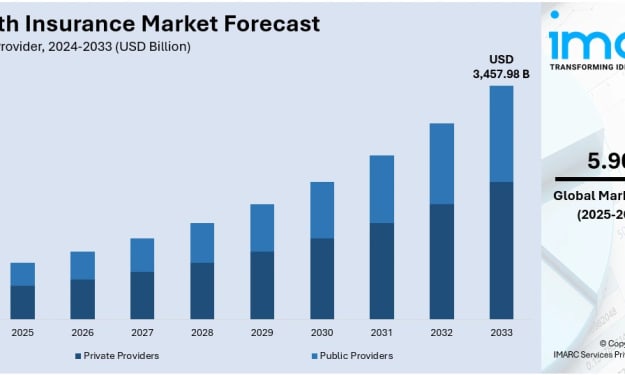
According to IMARC Group's latest research publication, global health insurance market size reached USD 1,949.84 Billion in 2024. Looking forward, IMARC Group expects the market to reach USD 3,457.98 Billion by 2033, exhibiting a growth rate (CAGR) of 5.90% during 2025-2033.
By Andrew Sullivan4 days ago in Futurism



Comments
There are no comments for this story
Be the first to respond and start the conversation.