
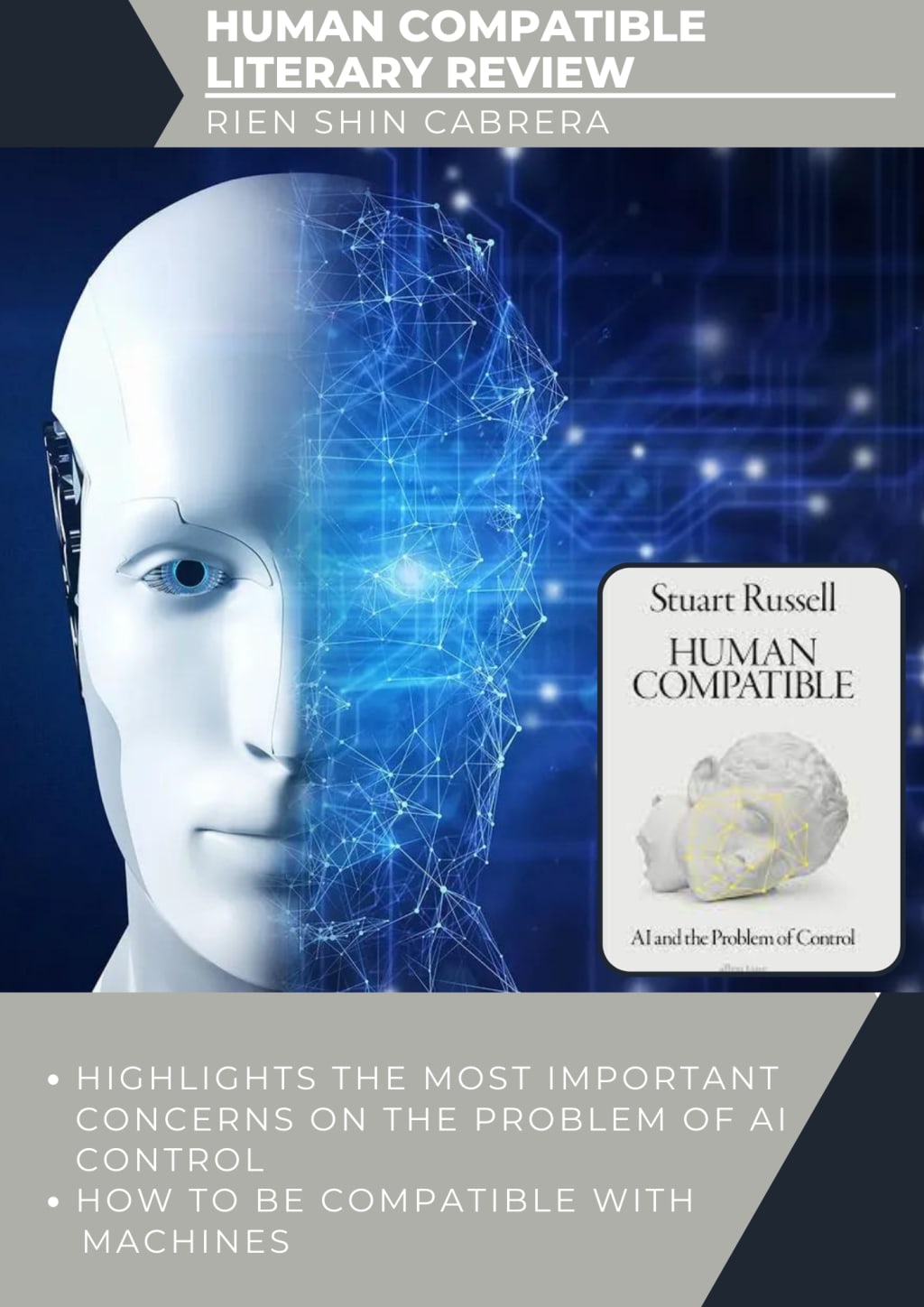
HUMAN COMPATIBLE LITERARY REVIEW
Highlights the most important concerns on AI control written by the author
Preface
Before I started this book, I was reading Homo Deus by Yuval Noah Harari. This book generally describes how humanity has progressed and it includes the productivity of innovation in technology, if it reaches its final purpose, it will be humanity’s biggest chef-d'œuvre (The golden age). With the statement “Organisms are algorithms,” came from the fields of biology and artificial intelligence, modifying genetic materials made medicine and agriculture quantifiable to fight diseases and enhanced food production compared to the nomadic period. With this narrative, I got intrigued to study the fields of technology, but before I dwell myself into it, why not break down the drawbacks first? I looked for a book online----I found Stuart Russell. Human Compatible was challenging for me to finish, I frequently had a long pause reading---it gives philosophical messages; with that I needed a break to organize my thoughts. Yuval Noah Harari and Stuart Russell convinced me to learn regarding the fields of AI. I revised and made changes with my own conclusion associated with the subject. This review does not acquire technical backgrounds, its recommended to anyone.
About the author
Russell was born in England and lives in Berkeley. His research covers a wide range of topics in AI including machine learning, physiology, and philosophical foundations. He is the author of Artificial intelligence: A modern approach, the number one bestselling textbook in AI.
Abstract
This review emphasizes the book’s prominent concerns in machine learning divided into five parts; each has different matters connected to AI. The first part includes the moral ethics of a machine, it is conditioned to execute its own preferences that is seen as a limitation with distinguishing complex human decisions that may cause potential risks and leaves humans’ feel agitated. Changes within the machine’s objective systemizing it with our own is an opportunity to create a predictable machine. Thus, applying moral ethics to determine human preferences makes AI emotionally intelligent and enhances human-AI collaboration rather than overly intelligent machine that does not utilize values and ethics. Each aspect of invention influences the welfare of the community, it is extremely important to specify values to fulfil human satisfaction, the second part explains the emotional challenges of individuals by which machines may perhaps take charge and find solutions towards managing behaviour and equanimity. This part also guarantees the public’s preferences to reassure fictitious narratives are recognized. Third chapter highlights the contexts of previous inventions and examines the uncertainty of AI algorithms. The AI community is quite confident about facing the incidents at the last minutes by means of reaching their target but losing the skills of being cautious causes economic disruption which leads to high risks of job opportunities, the society would question the moral codes of technology. Chapter four is related to chapter three; however, it analyses future innovations. Whereas in chapter three, the drawbacks of previous inventions are classified. A beneficial AI determines heuristics by learning the outcomes of the maximized reward depending on the statement of the environment. Humans are not incomparably rational---by that means, humans are more likely to finish the task efficiently in a group transmitting experiences and understandings. No individual can be capable to learn everything, and we know far less than we thought. Human decisions are primarily developed on emotional reactions and heuristics rather than on practical rationality. Common sense knowledge to AI remains unreachable, the case of learning experiences and social interactions is a way of knowing the characteristics of humans this age. As it is described in the first part; 20th century inventions are incompatible with our own objective. The right to mental security of individuals regardless of the overflowing information mentioned in the last chapter portrays the threat of technology; in terms of placing our trust on trusted sources, the public may be bound to support existing beliefs while ignoring the legitimate evidence. With the huge amount of data, we are obliged to know the truth; precise knowledge allows us to follow our purpose. Whereas education systems applying explicit knowledge would allow the students’ learning experiences expand. A machine surpassing human capabilities might present doom to mankind; the purpose of the machine at the first place is a tool to enhance human capabilities.
Accelerating change, Machine Ethics, Major Drawbacks
Redirecting machines’ objective
• One of the complications of AI designs is putting more intelligence would be the answer towards progression. As a result, human intelligence becomes inferior against technology--- which leads to the unpredictability of an algorithm and might be beyond human knowledge. The sci-fi Hollywood movies where the cyborgs executes a Machiavellian plan such as terminator---might happen in reality if we barely understand how it works. Our goal as a human being is to take control of our principles and not losing track of it in the first place. Present-day layouts of AI are defined as reaching its own objective on their expected actions. Thereby the purpose put into the machine ends up not achieving our objective. Because a machine doesn’t have an objective of its own----a “standard model” is made. We must guarantee that the purpose of it is what we ought to achieve.
Human replica
• We must also think carefully in creating interpersonal service machine and creating a non-intelectual machine that is most likely human. Even if we could turn of the machine, it might thinkore intelligently than we do.
There is no reasonable estimation designing a replica of a human. One reason is giving up our dignity as humans and creating an another copy that is probably more advance. There is no doubt that emotional confusion will also occur-----as two things gets mixed up. For some humans that has an intention to make the robot useful of doing such villain tasks. This model might be the case of bringing advantages to those types of people----whether it be the human designers, terrorists, greedy politicians, secretly ordering the ai to do such things.
Leaving decisions to the machines is more easier, but in these type of case----we would be replaced as being the 2nd species’ most rational, and we created a species that is more rational than us.
Brain systems replica
• The whole brain emulation is an exact copy of a human brain. This raises such concerns---first and foremost, neuroscientists are still in the dark understanding the human mind. Such ai systems raises philosophical questions regarding the nature of consciousness. Scientific research and social experiments may have improved the fields of cognitive psychology----however, we still have limited knowledge about consciousness. There isn’t a certain accepted hypothesis to measure consciousness and is objectified as an subjective experience, which is difficult to analyse in an external perspective. . As the author said: “the optimal plan of the machine might include deceiving the humans into thinking they gave the machine a reasonable objective, in order to gain enough time to achieve their own objective.” That being the case, it is not because of the machines’ free will nor consciousness to do Machiavellian act, since it is expected to achieve its optimal plan. Moreover, the boundary of human privacy is being neglected; accessing data and completely copying it breaches the persons borderline of security. The concept caught the attention of many AI scientists and philosophical groups-----most of their estimation shows that it still remains far from reach. This project hadn’t made progress since 1990, it only reached 20-30 percent of improvement.
Not all AI concepts can function in various aspects of a task
• Reinforcement learning machine makes decisions by observing behaviours in order to accomplish a task in an environment. These are primarily used when it comes to developing complex games like chess, go, and video games. The agent simply adapts the game environment from trial and error. Rules are implemented----therefore, mastering it maximizes the machines given reward system. Reinforcement learning can also be used in self-driving vehicles or autonomous drones, the agent learns from sensor inputs and navigations avoiding collisions and learning road safety rules. But in terms of interpersonal services, it shouldn’t be adapting the behavioural statement of the environment. A new concept is introduced which is Inverse Reinforcement Learning (IRL), this idea is made by the author itself. Instead of observing the behavioural statement with the goal to arrive at the task or maximize a given award, IRL aims to conclude the reward function or decision-making with using behavioural patterns. By inferring the reward function, the agent can learn its own behaviour that would make its decision-making definable. Thus, this concept can align with the users’ preferences by having recommendation algorithms. There is still complexity about this study and its mainly because of the uncertainty of which reward function should be implemented to the machine, however-----it could solve some certain fields of studies.
Alignment value
• We have seen the consequences of drifting away our value from the machine and instead having its own objective. But this raises such complexity dealing with different values and preferences. Each individuals have a diverse perspective; how can a machine adapts a huge number of opinions? And the decisions of individuals that perpetually changes? By giving the machine a prior belief, it can be possible to know the users’ personality and mood changes as it adapts the decision-making process of the user. In this case, the machine will not be disoriented when the user’s decision drastically changes as it already knows each of the person’s perceptions. A machine that has its diversity minimizes uncertainty when it’s faced with difficult situations.
In summary, having awareness in the age of technology is necessary to make informed decisions, adapt to changes, understand the ethical implications, enhance critical thinking, participate in societal debates, and safeguard personal well-being. It empowers individuals to navigate the evolving technological landscape responsibly and ethically. By having knowledge about AI, individuals can understand its capabilities and limitations. This understanding allows them to make informed decisions about incorporating AI into their businesses, products, or daily lives, and to set realistic expectations about what AI can and cannot do.
About the Creator
Keep reading
More stories from writers in Futurism and other communities.
About Binding Prometheus
I want to start actively advocating on behalf of my own work, and the most valuable part of my canon is, without a doubt, Binding Prometheus, the play I have been working on since 2019 and only finished in 2023 as part of my MA. The play itself is an amalgamation of a million different inspirations. On one end, it evokes the Ancient Greek myth-play, deriving its own title from the earliest extant work of Western drama we have, Aeschylus’s Prometheus Bound. On the other end, it borrows significantly from the sci-fi bulwarks from over the years, namely Mary Shelley’s Frankenstein and Karel Capek’s Rossum’s Universal Robots. The play could be an episode of Black Mirror, I fear. I don’t know. I’ve only ever seen one episode of Black Mirror.
By Steven Christopher McKnightabout a month ago in Futurism
More Electric Aircraft Market: Next-Gen Aircraft Design, Electrical Systems & Growth Outlook
According to IMARC Group's latest research publication, The global more electric aircraft market size was valued at USD 2.45 Billion in 2024. Looking forward, IMARC Group estimates the market to reach USD 7.8 Billion by 2033, exhibiting a CAGR of 13.7% from 2025-2033.
By James Whitmana day ago in Futurism


Comments
There are no comments for this story
Be the first to respond and start the conversation.