
How to Transition from a Data Background into Marketing Analytics
For data professionals looking to make the leap into marketing analytics, here's your practical guide.


If you already know your way around SQL, Excel, Power BI, or Tableau—you’re not starting from zero. You’re already ahead.
But marketing analytics isn’t just about dashboards. It’s about understanding the customer journey, uncovering insights that drive growth, and helping businesses make better decisions.
So how do you make the leap?
Here’s a high-value, no-fluff roadmap to help you go from “data person” to high-impact marketing analyst.
Step 1: Shift Your Thinking From Data to Growth
Marketing analytics is less about perfect data and more about business impact.
Ask yourself:
- What does this data mean in the context of the funnel?
- How does this metric connect to revenue or retention?
- What action can we take because of this insight?
Start practicing this mindset now, even in your current role. Learn to tell stories with data, not just report on it.
Step 2: Learn the Language of Marketing
Marketing analytics has its own core concepts. Get familiar with:
- Customer journey/funnel: Awareness → Acquisition → Activation → Retention → Revenue
- Metrics: CAC, LTV, CTR, CVR, bounce rate, churn rate
- Channels: Paid, organic, email, referral, lifecycle
- Attribution: Last-touch, first-touch, linear, data-driven
- Lifecycle segmentation: Cohorts, personas, journey stages
These aren’t hard to learn—but they are critical for translating data into business insight.
Step 3: Pick One Vertical to Go Deep In
Start with breadth, then go deep in one area. These are solid entry paths:
- Acquisition analytics: Understand traffic sources and cost-effectiveness of marketing channels
- Retention analytics: Work with cohort analysis, churn modeling, and user segmentation
- Experimentation (A/B testing): Dive into testing design, lift analysis, and statistical significance
- Product/behavioral analytics: Use event-based data to map user flows and conversion blockers
Choose based on your interests and the problems your company is trying to solve.
Step 4: Build a Portfolio of Strategic Projects
Start documenting:
- Dashboards that influenced decision-making
- Funnel analyses that identified drop-off points
- Campaign performance breakdowns with insights and actions
- Test plans and analysis of experiment results
Your goal: show you’re not just a data person—you’re a data-driven strategic partner for stakeholders.
Step 5: Learn the Tools Marketers Use
You already know SQL and Power BI. Add:
- Google Analytics 4 (GA4): Industry-standard for digital performance
- Looker Studio: For accessible dashboards shared across teams
- Amplitude or Mixpanel: For event-based, product-focused analytics
- CRM platforms (e.g., HubSpot or Salesforce): For lead lifecycle and campaign data
You don’t need to master them all. But exposure builds fluency.
Step 6: Certifications That Are Actually Worth It
These free or low-cost options will build credibility and signal intent:
🧠 General Marketing Analytics
- Google Data Analytics Certificate (Coursera)
- Google Marketing Platform Certification (Google Skillshop)
🧪 Experimentation / CRO
- CXL Institute – Free Mini Courses
- A/B testing, optimization, analytics fundamentals
- Optimizely Academy
- Platform-specific but great for testing concepts
📊 Attribution & Performance Marketing
- Google Analytics Certification (Skillshop)
- Meta (Facebook) Marketing Analytics Cert
Pick one and complete it. Put it on LinkedIn. Talk about what you learned.
Step 7: Get Embedded in the Ecosystem
You don’t grow in a vacuum.
- Subscribe to newsletters like Experimentation Career
- Follow thought leaders on LinkedIn in marketing analytics, experimentation, growth
- Join ADPList as a mentee or book informational chats
The more immersed you are, the faster your transition.
You’re Closer Than You Think
You already speak the language of logic, structure, and systems. Marketing analytics is just about learning how those systems play out in human behavior and business growth.
The transition isn’t about becoming someone new. It’s about translating the skills you already have into a new context.
Start today.
And if you want tactical content, templates, and mentorship to accelerate your shift into experimentation and analytics:
👉 Subscribe to Experimentation Career
Talk soon,
Atticus
💼 Connect with me on LinkedIn so we can stay in touch!
About the Creator
Experimentation Career
Helping students & early career pros land $100K+ roles in analytics, marketing, and experimentation. Hiring manager at NRG (Fortune 500, $28B+ revenue).
Keep reading
More stories from Experimentation Career and writers in Futurism and other communities.
A Reader Asked Me: Is CRO/Experimentation the Right Starting Point for a Career in Marketing Analytics?
If you're exploring a career in marketing analytics, you're probably wondering: “Should I start with CRO or experimentation? Or would it be smarter to begin with something like acquisition analytics, retention analysis, or attribution modeling?”
By Experimentation Career12 months ago in Futurism
Fluid Loss Additives Market Outlook: Drilling Efficiency Enhancement and Oilfield Services Growth Opportunities
According to IMARC Group's latest research publication, The global fluid loss additives market size was valued at USD 318.42 Million in 2025. Looking forward, IMARC Group estimates the market to reach USD 409.06 Million by 2034, exhibiting a CAGR of 2.82% from 2026-2034.
By James Whitman6 days ago in Futurism
Australia Textile & Apparel Market: Sustainable Fashion, E-commerce Growth & Fabric Innovation
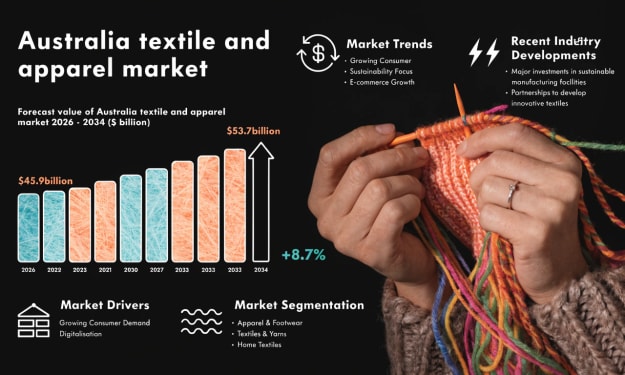
According to IMARC Group, the Australia textile and apparel market reached a value of USD 30.3 Billion in 2025 and is projected to reach USD 45.7 Billion by 2034, growing at a compound annual growth rate (CAGR) of 4.66% during 2026–2034. The market is evolving as consumer preferences increasingly favor sustainable fashion, innovative fabric technologies and digitally driven retail experiences. Rising disposable incomes and changing lifestyle trends are encouraging consumers to spend more on clothing, footwear and fashion accessories. At the same time, growing awareness about environmental sustainability is driving demand for eco-friendly textiles, recycled fabrics and ethically produced garments. The rapid expansion of e-commerce platforms and online fashion marketplaces is also transforming how consumers shop for apparel, enabling brands to reach wider audiences across Australia. As fashion companies adopt new production technologies and sustainable manufacturing practices, the textile and apparel sector is undergoing significant transformation.
By Kevin Cooper5 days ago in Futurism



Comments
There are no comments for this story
Be the first to respond and start the conversation.