
How the Universe Could Have Emerged from "Nothing": The Mystery of Creation
Space

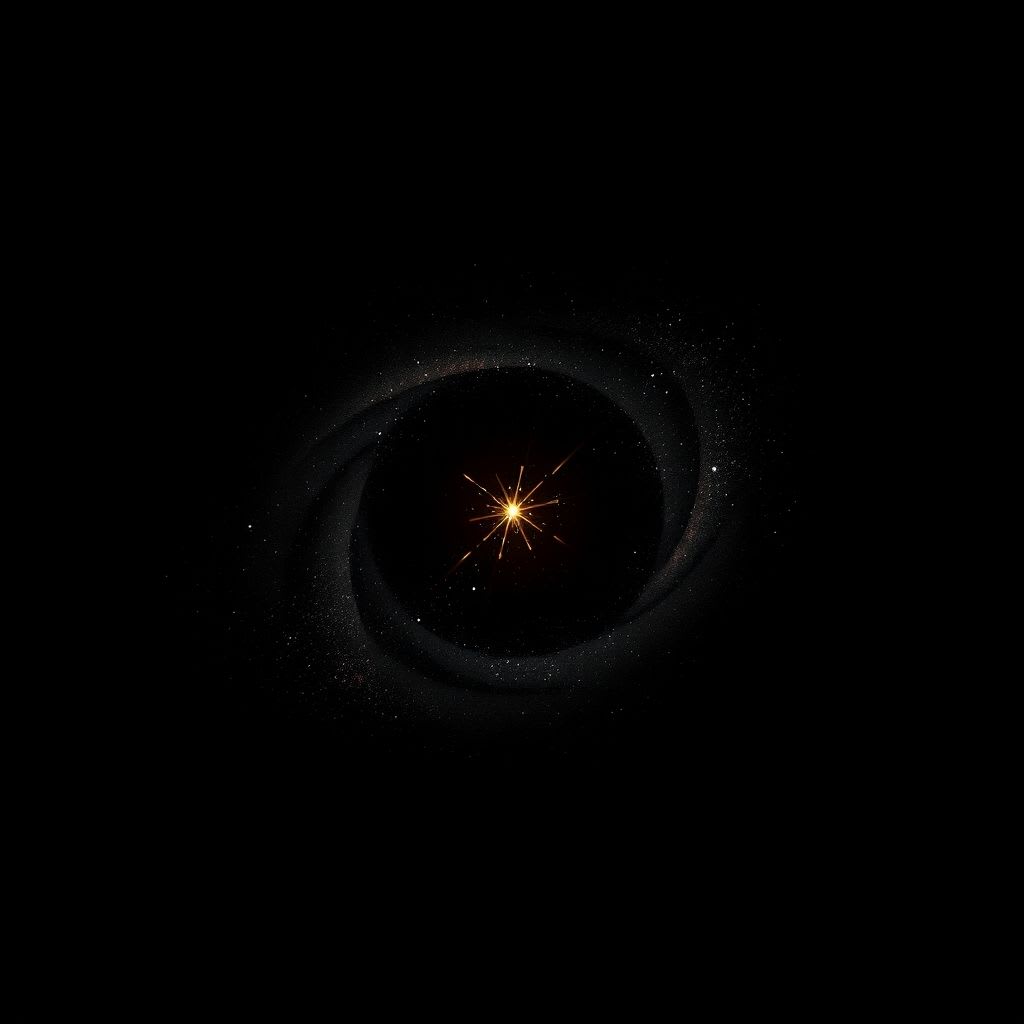
One of the most captivating and at the same time deeply unsettling questions humanity has ever asked is this: How did it all begin? Where did the Universe come from? What existed before it? And is it really possible that everything we see, such as stars, galaxies, time, and space itself, once emerged from literally nothing?
This is not just a philosophical puzzle. It lies at the very heart of cosmology, physics, and metaphysics. While the idea of the Universe popping into existence from "nothing" may sound absurd at first, modern science offers several astonishing hypotheses that make this "nothing" far more fascinating than one might imagine.
What Do We Mean by "Nothing"?
When we say "nothing," we usually picture a complete void with no light, no matter, and no movement. But in physics, even empty space is not truly empty. According to quantum mechanics, what we think of as a vacuum actually teems with tiny, fleeting energy fluctuations, brief flashes where particles spontaneously appear and disappear.
Now, imagine not just empty space, but the absence of space, time, physical laws, and even the logic of existence itself. This is the true philosophical "nothing." Here is where things become truly magical.
Quantum Fluctuations and Birth from the Void
One of the most widely discussed scientific ideas is that our Universe may have arisen from a quantum fluctuation. At the microscopic scale, the laws of quantum mechanics allow energy to borrow existence for a very short time. Occasionally, this borrowed energy might grow into something far bigger, and some theories suggest that it could even become a whole Universe.
From this perspective, the Universe is a gigantic quantum fluctuation that for some reason did not collapse back into nothingness but instead began to expand. And here we are billions of years later, looking up at the night sky and asking questions.
Everything from Nothing: Lawrence Krauss's Hypothesis
Physicist Lawrence Krauss popularized the idea in his book "A Universe from Nothing." He suggests that physical laws themselves can give rise to something without any external cause. In other words, if you have quantum fields and gravity, you do not need a creator for the Universe to come into being; it can emerge spontaneously.
Krauss argues that the laws of nature are woven into the very fabric of "nothing." Much like mathematical truths exist independently of humans, physical laws could operate even without space and time. They simply were possible, and that is enough.
Cosmic Inflation and the Multiverse
Some theories propose that our Universe is just one bubble in a vast ocean of a multiverse. According to the eternal inflation scenario, new universes constantly form in this cosmic ocean, each beginning as a vacuum fluctuation. Our Universe might have been born as a splash against a deeper nothingness, a kind of cosmic foam from which new realities occasionally bubble up.
Of course, this is speculative. We cannot directly observe other universes, but mathematically the idea fits surprisingly well.
What Came Before?
Here lies the real mind-bender. According to the Big Bang model, time and space themselves began at the very instant the Universe was born. Thus, the question "What came before?" may be meaningless, like asking what is north of the North Pole.
If time did not exist, then "before" did not exist either. So the Universe did not appear after something; it appeared as the very beginning of existence itself.
Will We Ever Know?
Right now, it is quite possible we never will. Our telescopes can only observe a limited portion of the Universe, the so-called observable Universe. We cannot look beyond the horizon or back to a moment when time was less than a trillionth of a trillionth of a second old. All we have are mathematical models, physics, and a relentless desire to understand.
But even if we never learn exactly how the Universe came into being, the very act of questioning opens infinite horizons, cosmic and personal. Perhaps the most profound thing is not that the Universe arose from nothing, but that from this nothingness emerged consciousness capable of asking such a question.
In the end, the mystery of the Universe's origin may remain elusive, but our curiosity and wonder continue to light the way, just like the stars born from that first cosmic spark of "nothing."
About the Creator
Keep reading
More stories from Holianyk Ihor and writers in Futurism and other communities.
What Would Happen If the Earth Suddenly Stopped Spinning?
Earth is spinning at an incredible speed around 1,670 kilometers per hour (over 1,000 mph) at the equator. Yet we don’t feel it. Like passengers on a smooth, fast-moving train, we’re moving with the planet, unaware of the tremendous velocity beneath our feet. But what if one day, Earth’s rotation came to a sudden stop? What would happen if the world hit the cosmic brakes?
By Holianyk Ihor7 months ago in Futurism
About Binding Prometheus
I want to start actively advocating on behalf of my own work, and the most valuable part of my canon is, without a doubt, Binding Prometheus, the play I have been working on since 2019 and only finished in 2023 as part of my MA. The play itself is an amalgamation of a million different inspirations. On one end, it evokes the Ancient Greek myth-play, deriving its own title from the earliest extant work of Western drama we have, Aeschylus’s Prometheus Bound. On the other end, it borrows significantly from the sci-fi bulwarks from over the years, namely Mary Shelley’s Frankenstein and Karel Capek’s Rossum’s Universal Robots. The play could be an episode of Black Mirror, I fear. I don’t know. I’ve only ever seen one episode of Black Mirror.
By Steven Christopher McKnight18 days ago in Futurism
Gaming Peripherals Market Size and Forecast 2025–2033
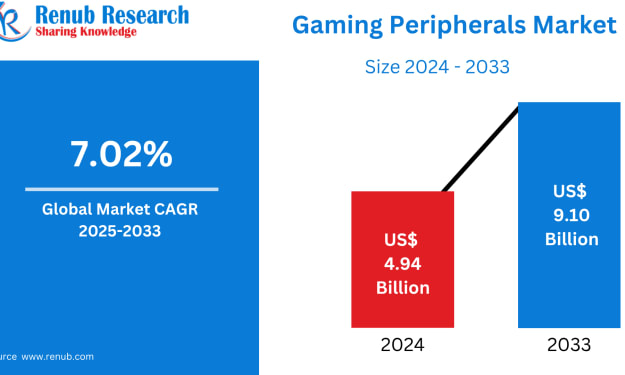
Gaming Peripherals Market: An Industry in Rapid Transformation The global gaming peripherals market is entering a decisive growth phase as gaming continues to evolve from a leisure activity into a mainstream form of digital entertainment and professional competition. According to Renub Research, the Gaming Peripherals Market is expected to grow from US$ 4.94 billion in 2024 to US$ 9.10 billion by 2033, registering a compound annual growth rate (CAGR) of 7.02% from 2025 to 2033. This expansion reflects not only the surging popularity of gaming worldwide but also the rising demand for high-performance devices such as gaming mice, mechanical keyboards, headsets, controllers, and other immersive accessories.
By Aaina Oberoi6 days ago in Futurism



Comments (1)
The idea of the universe emerging from quantum fluctuations is mind-blowing. I've always been fascinated by this concept.