
What Would Happen If the Earth Suddenly Stopped Spinning?
Space

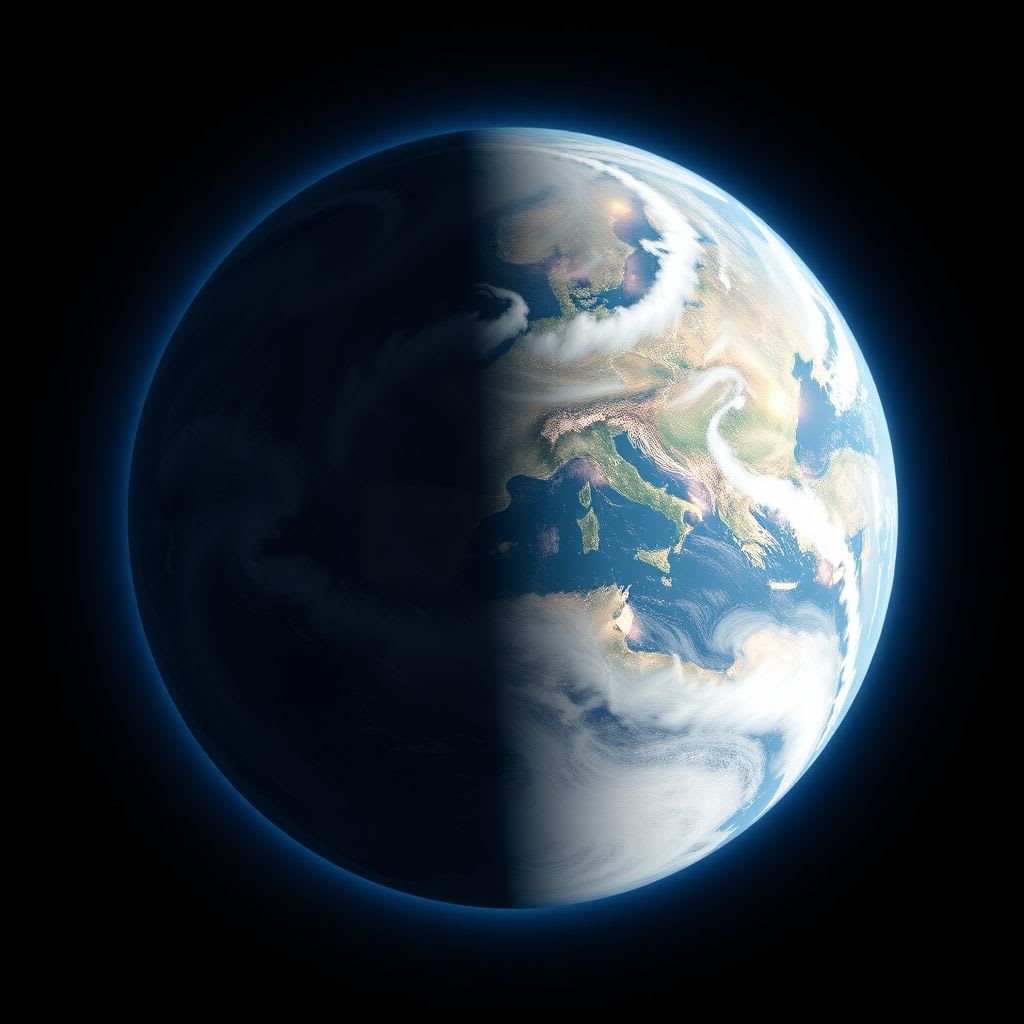
Earth is spinning at an incredible speed around 1,670 kilometers per hour (over 1,000 mph) at the equator. Yet we don’t feel it. Like passengers on a smooth, fast-moving train, we’re moving with the planet, unaware of the tremendous velocity beneath our feet. But what if one day, Earth’s rotation came to a sudden stop? What would happen if the world hit the cosmic brakes?
The answer is as dramatic as it is terrifying. The consequences would be catastrophic not just for civilization, but for the planet itself. Let’s take a journey through this thought experiment and uncover the chain reaction that would follow if Earth stopped spinning.
1. Instant Catastrophe: When Inertia Strikes
If the Earth were to stop rotating suddenly, everything on its surface not solidly anchored to the bedrock would keep moving at the original rotational speed about 1,670 km/h. That includes oceans, the atmosphere, buildings, trees, and people.
It would be like slamming on the brakes in a speeding car but for an entire planet. The results would be apocalyptic:
- Winds of over 1,600 km/h would sweep across continents, flattening cities like paper houses.
- Mega-tsunamis with waves kilometers high would surge across coastlines as ocean water continued its momentum.
- Massive earthquakes would ripple across the globe as tectonic plates suddenly shifted.
- Volcanoes could erupt due to the immense geological stress.
In just minutes, Earth would be unrecognizable.
2. A New Geography: Oceans Rush to the Poles
Right now, the Earth’s rotation creates a centrifugal force that causes the equator to bulge slightly. This bulge helps keep oceans more evenly distributed. If the planet stopped spinning, Earth would gradually return to a more spherical shape.
As a result:
- Water currently held near the equator would migrate toward the poles, flooding the Arctic and Antarctic regions.
- Equatorial regions like Central Africa, Brazil, and Indonesia could dry out and expand into vast land masses.
- The entire map of Earth would be redrawn, with new coastlines and massive land upheavals.
What is now beach could become desert. And the frozen poles? Possibly warm and underwater.
3. Six-Month Days and Nights
With no spin, Earth would stop having a 24-hour day-night cycle. Instead, one side of the planet would face the Sun continuously, while the other would be cast in permanent darkness like how the Moon always shows the same face to Earth.
This would lead to:
- Unbearable heat on the Sun facing side deserts would scorch, water would evaporate, and life would struggle to survive.
- Freezing darkness on the night side temperatures would plummet, oceans could freeze, and ecosystems would collapse.
- Only a narrow "twilight zone" between the two extremes would offer livable conditions a thin ring of habitability slowly shifting as Earth orbited the Sun.
Imagine a world where survival means living in perpetual dusk, always on the move, chasing that delicate balance between fire and frost.
4. The Collapse of Earth’s Magnetic Field
Earth’s magnetic field the shield that protects us from solar radiation is generated by the spinning of molten iron in the planet’s outer core. If the rotation stops, that dynamo effect would eventually fade.
Consequences include:
- Radiation bombardment from solar winds and cosmic rays, increasing the risk of cancer and genetic mutations.
- Atmospheric erosion, as solar particles strip away the upper layers of our protective envelope.
- Communication chaos, since satellites and electronics rely on protection from geomagnetic storms.
Without the magnetosphere, Earth would become far less hospitable possibly even uninhabitable over time.
5. Collapse of Ecosystems and Civilization
The combination of extreme temperatures, radiation, environmental destruction, and lack of sunlight would make Earth's ecosystems unrecognizable.
- Plants relying on daily sunlight cycles would wither and die.
- Animals would fail to adapt to permanent day or night.
- Humans would lose agriculture, clean water, infrastructure, and possibly hope itself.
Even with advanced technology, maintaining any form of civilization would be a struggle. It would be a world of bunkers, artificial lighting, and desperate innovation.
But What If the Rotation Slowed Gradually?
If Earth’s rotation slowed down over millions of years, the effects would still be dramatic but perhaps survivable.
- Days and nights would stretch to weeks, then months.
- Weather patterns would change drastically.
- Human civilization might adapt using new technologies, energy sources, and architecture.
- Some regions would become uninhabitable, forcing mass migrations.
With enough time, we could prepare for the changes. But life on Earth would be fundamentally different.
Final Thoughts: A Planet in Perfect Motion
Earth’s rotation is more than just a celestial quirk it is the engine of our daily lives. It shapes our weather, controls our biological clocks, powers the magnetic field, and keeps the natural world in balance.
A sudden stop would be catastrophic. A gradual one would be transformative. In either case, it's a stark reminder of how much we rely on something we never feel a silent, steady spin that makes life on Earth possible.
So the next time you watch a sunrise, remember: that breathtaking view is made possible by a planet turning beneath your feet. Let’s hope it keeps spinning smoothly and silently for a very long time.
About the Creator
Keep reading
More stories from Holianyk Ihor and writers in Futurism and other communities.
Where Are the Oldest Particles in the Universe?
When we think of ancient things, our minds usually wander to fossils, ancient ruins, or long extinct creatures. But the concept of "old" goes far beyond Earth's surface. What if we told you that some of the oldest pieces of the universe are still around and might even be inside you? The story of the oldest particles in the cosmos is a journey through time, stretching all the way back to the first fractions of a second after the Big Bang.
By Holianyk Ihor7 months ago in Futurism
About Binding Prometheus
I want to start actively advocating on behalf of my own work, and the most valuable part of my canon is, without a doubt, Binding Prometheus, the play I have been working on since 2019 and only finished in 2023 as part of my MA. The play itself is an amalgamation of a million different inspirations. On one end, it evokes the Ancient Greek myth-play, deriving its own title from the earliest extant work of Western drama we have, Aeschylus’s Prometheus Bound. On the other end, it borrows significantly from the sci-fi bulwarks from over the years, namely Mary Shelley’s Frankenstein and Karel Capek’s Rossum’s Universal Robots. The play could be an episode of Black Mirror, I fear. I don’t know. I’ve only ever seen one episode of Black Mirror.
By Steven Christopher McKnight17 days ago in Futurism
Egypt Meat Market: Urban Consumption Growth, Price Volatility & Industry Outlook
According to IMARC Group's latest research publication, Egypt meat market size reached USD 5.00 Billion in 2024. The market is projected to reach USD 5.90 Billion by 2033, exhibiting a growth rate of 1.91% during 2025-2033.
By Abhay Rajput6 days ago in Futurism




Comments
There are no comments for this story
Be the first to respond and start the conversation.