
How the Moon Influences Earth: The Invisible Threads of Gravity and Light
Space

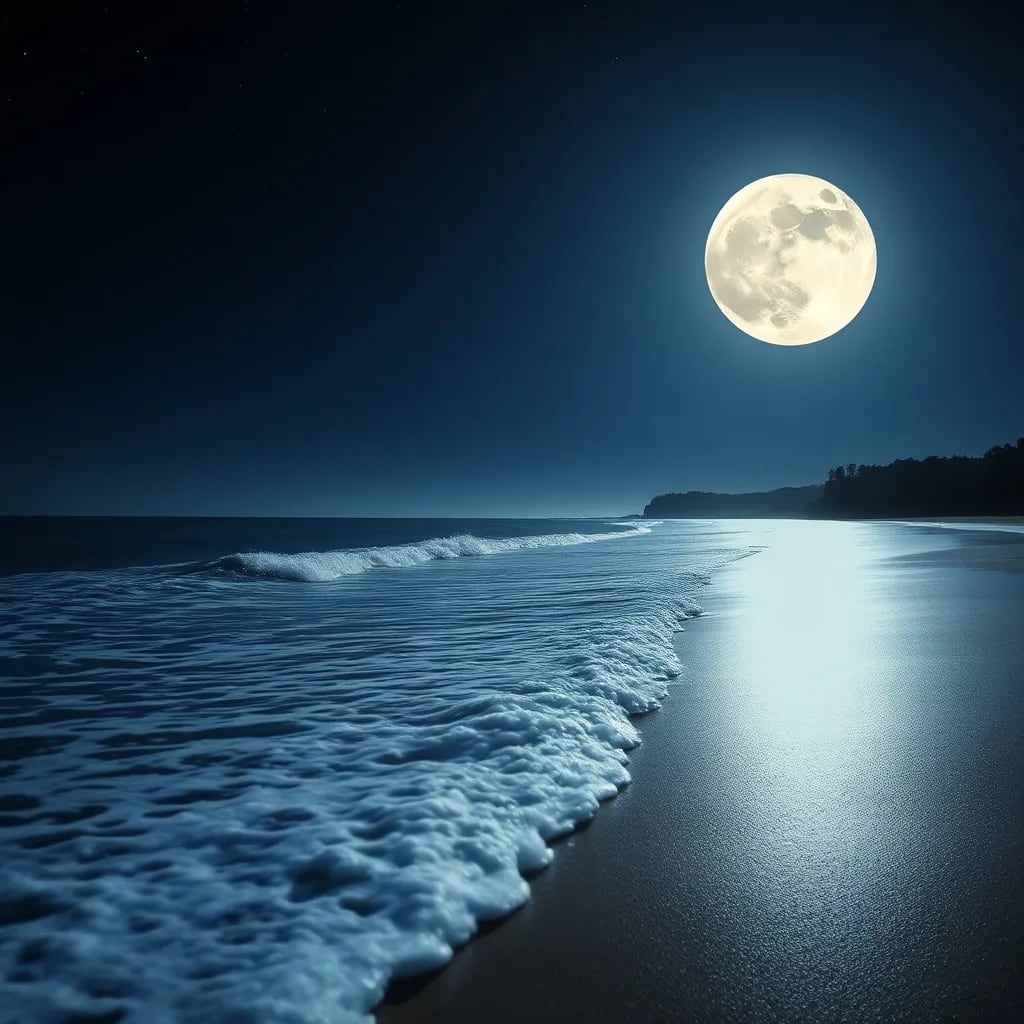
The Moon is far more than a glowing nightlight hanging in the sky. For poets and lovers, it’s a symbol of beauty and mystery but scientifically, it's a vital player in Earth’s natural systems. From ocean tides to climate stability and even the biological rhythms of life, the Moon’s influence is both profound and far-reaching. If our celestial neighbor were to vanish, Earth would become an entirely different and far less hospitable place.
Tides: The Breathing Pulse of the Oceans
Perhaps the most obvious and dramatic effect of the Moon is the ebb and flow of tides. The Moon’s gravitational pull tugs at Earth’s oceans, causing the water to bulge in the direction of the Moon. As the Earth rotates, these tidal bulges move across the globe, creating the rhythmic rise and fall of sea levels we experience each day.
Interestingly, there are two high tides every 24 hours one on the side facing the Moon, and one on the opposite side. This occurs due to the interplay of gravity and the inertia of water. Without the Moon’s steady pull, many marine ecosystems that rely on tidal cycles would collapse. Creatures like crabs, mussels, and many types of fish time their spawning and feeding around these tidal changes.
The Stability of Earth’s Axis
The Moon plays a crucial role in stabilizing the tilt of Earth's axis, which currently sits at about 23.5 degrees. This tilt is responsible for our seasons. Without the Moon, the tilt could wobble chaotically, ranging from nearly no tilt to extreme angles. That kind of instability would wreak havoc on Earth’s climate.
Imagine deserts becoming frozen wastelands, or the equator transforming into an arid, lifeless zone. Seasonal patterns would become unpredictable, agricultural systems would fail, and the global ecosystem could be thrown into chaos. The Moon acts like a steadying hand, preventing these wild swings and helping maintain a habitable planet.
Slowing Down Earth’s Spin
The Moon is gradually slowing Earth’s rotation. Through a process called tidal friction, the Moon’s gravitational pull causes a drag on the Earth’s spin, making our days ever so slightly longer over time. Billions of years ago, a single day on Earth lasted only about 5 or 6 hours. Today, it's 24. In the distant future, days will continue to grow longer a slow but relentless transformation.
This deceleration impacts everything from atmospheric circulation to ocean currents. If the Earth were spinning too fast, hurricane force winds would be the norm, and the planet's surface would be far less stable for life to thrive.
Moonlight and Biological Rhythms
Although the Moon doesn’t produce its own light, its reflected glow has a surprising impact on life. Many species from coral to insects, birds to fish use the Moon’s phases as a biological calendar. Coral reefs, for example, often spawn en masse during full moons, synchronizing their reproductive efforts to maximize success.
Even humans are subtly affected by the lunar cycle. Studies suggest that people may experience lighter sleep or increased restlessness during full moons, although the exact reasons are still debated. The term lunacy itself derives from “luna,” the Latin word for Moon, hinting at ancient beliefs linking the Moon to shifts in mood and behavior.
In coastal communities, traditional fishing practices still rely on lunar calendars to predict the best times to catch certain species. These time tested methods show just how intertwined human life has become with the Moon’s cycles.
The Moon as Earth’s Cosmic Shield
The Moon doesn’t just affect life it protects it. Its presence helps shield Earth from potential collisions with space debris. Thanks to its gravity and position, the Moon diverts or absorbs some meteoroids and asteroids that might otherwise crash into our planet. The pockmarked surface of the Moon tells a silent story of countless impacts that Earth has been spared.
Without the Moon’s protective presence, Earth would be far more vulnerable to cosmic hazards some of which could have extinction level consequences.
Conclusion: Our Celestial Partner
The Moon is not just a barren rock orbiting Earth. It’s a stabilizer, a timekeeper, a protector, and even a muse. Its gravitational embrace maintains the balance of our climate, shapes ocean behavior, and supports countless lifeforms including us. The Moon’s invisible threads connect it intimately to the rhythms of our world.
Next time you look up at the full Moon glowing in the night sky, remember: it’s not just a beautiful sight. It’s an ancient partner quietly holding Earth steady, guiding the tides, marking time, and watching over the fragile web of life it helps sustain. Without it, the Earth would spin into a far more uncertain future.
About the Creator
Keep reading
More stories from Holianyk Ihor and writers in Futurism and other communities.
Antigravity Effects: Hypotheses and Scientific Dreams That Could Reshape the Future
Imagine a world where cars float silently above the roads, buildings hover effortlessly in the sky, and spacecraft lift off without the thunderous roar of rocket engines. This is the vision that has captivated both scientists and science fiction writers for decades a vision built around the elusive concept of antigravity.
By Holianyk Ihor6 months ago in Futurism
About Binding Prometheus
I want to start actively advocating on behalf of my own work, and the most valuable part of my canon is, without a doubt, Binding Prometheus, the play I have been working on since 2019 and only finished in 2023 as part of my MA. The play itself is an amalgamation of a million different inspirations. On one end, it evokes the Ancient Greek myth-play, deriving its own title from the earliest extant work of Western drama we have, Aeschylus’s Prometheus Bound. On the other end, it borrows significantly from the sci-fi bulwarks from over the years, namely Mary Shelley’s Frankenstein and Karel Capek’s Rossum’s Universal Robots. The play could be an episode of Black Mirror, I fear. I don’t know. I’ve only ever seen one episode of Black Mirror.
By Steven Christopher McKnight16 days ago in Futurism
UAE Mental Health Market: Rising Awareness, Service Expansion & Growth Outlook
According to IMARC Group's latest research publication, UAE Mental Health Market size reached USD 13.10 Billion in 2024. Looking forward, IMARC Group expects the market to reach USD 28.26 Billion by 2033, exhibiting a growth rate (CAGR) of 8.92% during 2025-2033.
By Abhay Rajput4 days ago in Futurism


Comments
There are no comments for this story
Be the first to respond and start the conversation.