
Antigravity Effects: Hypotheses and Scientific Dreams That Could Reshape the Future
Space


Imagine a world where cars float silently above the roads, buildings hover effortlessly in the sky, and spacecraft lift off without the thunderous roar of rocket engines. This is the vision that has captivated both scientists and science fiction writers for decades a vision built around the elusive concept of antigravity.
We currently live in a world where gravity is an inescapable and fundamental force. But what if we could somehow reduce its pull or even cancel it out entirely? While no theory has yet been proven, scientific discussions and experimental research continue to explore the wild possibilities. Let’s dive into some of the most intriguing hypotheses behind antigravity and discover which ones might just leap from fiction into fact.
What Is Antigravity?
Antigravity refers to a hypothetical force or mechanism that counteracts gravity. In science fiction, it’s often portrayed as a sleek technology that allows machines and objects to levitate or fly without the need for engines or fuel. But in physics, the concept is far more complex and deeply tied to the fabric of spacetime, mass, and energy.
Unlike magnetism or lift generated by wings, antigravity (if it exists) would involve manipulating the gravitational field itself. It’s not just floating it’s altering the most fundamental interactions in the universe.
Hypothesis #1: Negative Mass
One of the most hotly debated ideas in theoretical physics is the concept of negative mass. This type of matter would behave in the opposite way from normal matter. For example, if you tried to push an object with negative mass, it wouldn’t move away it would accelerate toward you.
Such behavior could, in theory, produce antigravitational effects, especially when combined with positive mass. There have been experiments with Bose Einstein condensates that simulated certain aspects of negative mass behavior, but these are still far from being practical or scalable technologies.
Some physicists suggest that negative mass might occur in extreme environments, such as near black holes or during the birth of the universe. If this form of matter does exist, it could open the door to revolutionary propulsion and levitation technologies.
Hypothesis #2: Manipulating Spacetime Itself
Einstein’s theory of general relativity tells us that gravity isn’t just a force it's the curvature of spacetime caused by mass and energy. If we could somehow manipulate this curvature, we might be able to reduce or neutralize gravity around an object.
Certain theories propose the use of exotic matter or vacuum energy to create localized "bubbles" of warped spacetime, where gravity behaves abnormally. These ideas are also behind the famous "warp drive" concepts popularized by Star Trek. While the energy requirements for such manipulation are astronomical, they provide a fascinating glimpse into the potential mechanics of antigravity.
Hypothesis #3: Superconductivity and Gravity Shielding
In the 1990s, Finnish scientist Eugene Podkletnov claimed he had created an antigravity effect using a rotating superconducting disk. According to his controversial experiment, objects placed above the disk lost up to 2% of their weight.
Although no other research group has successfully replicated these results under controlled conditions, the claim sparked serious debate. The idea of superconductors interacting with gravitational fields remains an area of speculative research.
While most physicists remain skeptical, superconductivity continues to intrigue researchers as a possible key to gravity manipulation especially if paired with other exotic materials or quantum effects.
Hypothesis #4: Dark Matter and Dark Energy
Roughly 95% of the universe’s mass-energy content is invisible and mysterious classified as dark matter and dark energy. These phenomena are known to influence cosmic expansion and galactic motion, but their true nature is still unknown.
Some theorists speculate that if we could understand and harness dark energy, which appears to "push" the universe apart, we might learn how to locally repel gravitational forces. In essence, this could be the foundation for devices that float, hover, or lift objects without traditional propulsion true antigravity platforms.
Of course, this remains speculative until we unlock the secrets of dark energy itself, but the potential implications are enormous.
Real-World Research and Government Interest
As fantastical as antigravity sounds, it hasn’t escaped the attention of major institutions. In the U.S., agencies like NASA and DARPA have at times funded studies under the umbrella of "breakthrough physics", which included investigations into gravity modification and propulsion beyond traditional models.
Meanwhile, more grounded applications like magnetic levitation (maglev) trains offer a taste of what frictionless motion can look like. Though maglev isn’t antigravity per se, it demonstrates the power of levitation technology and encourages further exploration into minimizing energy costs for lift and movement.
Science Fiction or Science Future?
For now, antigravity exists primarily in the realm of hypothesis, simulation, and fiction. But history is filled with technologies that were once deemed impossible flight, electricity, and even space travel.
It’s not unreasonable to imagine that in the future, we might not only resist gravity but actively control it, much like we manipulate electromagnetism today. Such a breakthrough would transform transportation, architecture, and space exploration possibly even redefine the limits of human civilization.
Suggested Image for the Article:
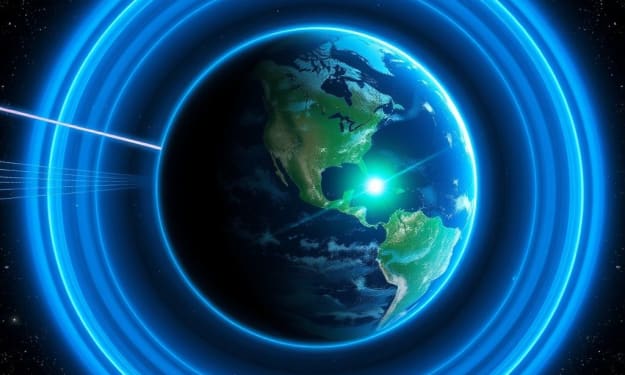
A futuristic scene featuring a sleek, disk shaped craft levitating silently above the ground. The craft emits a soft blue glow from its underside, hinting at some unknown antigravitational force. In the background, a team of scientists in high tech suits observes from a raised platform. Towering futuristic buildings stretch into the sky, and dramatic clouds swirl above, creating a sense of awe and possibility.
About the Creator
Keep reading
More stories from Holianyk Ihor and writers in Futurism and other communities.
The Secrets of Earth’s Magnetic Field: The Planet’s Invisible Shield
Deep beneath our feet, thousands of kilometers below the surface, lies one of the greatest and most mysterious forces of our planet Earth’s magnetic field. Though invisible and imperceptible to our senses, this powerful shield plays a critical role in protecting life on Earth. It shields us from solar storms, deflects harmful cosmic radiation, and even helps animals navigate across the globe. But what exactly is it? Where does it come from? And what secrets is science still trying to uncover?
By Holianyk Ihor6 months ago in Futurism
About Binding Prometheus
I want to start actively advocating on behalf of my own work, and the most valuable part of my canon is, without a doubt, Binding Prometheus, the play I have been working on since 2019 and only finished in 2023 as part of my MA. The play itself is an amalgamation of a million different inspirations. On one end, it evokes the Ancient Greek myth-play, deriving its own title from the earliest extant work of Western drama we have, Aeschylus’s Prometheus Bound. On the other end, it borrows significantly from the sci-fi bulwarks from over the years, namely Mary Shelley’s Frankenstein and Karel Capek’s Rossum’s Universal Robots. The play could be an episode of Black Mirror, I fear. I don’t know. I’ve only ever seen one episode of Black Mirror.
By Steven Christopher McKnight15 days ago in Futurism
CBRN Defense Market: National Security, Risk Preparedness & Industry Expansion
According to IMARC Group's latest research publication, The global CBRN defense market size was valued at USD 21.55 Billion in 2024. Looking forward, IMARC Group estimates the market to reach USD 33.11 Billion by 2033, exhibiting a CAGR of 4.64% during 2025-2033.
By James Whitmana day ago in Futurism


Comments
There are no comments for this story
Be the first to respond and start the conversation.