
How Scientists Will Bring Dinosaurs Back to Life Again
Exploring the Science, Challenges, and Ethics Behind Dinosaur De-Extinction


You might have heard the name of Dinosaurs; a huge & giant animal which was eradicated from the face of earth thousands of years ago. With immense and broad research from scientists about this animal, recently, the scientists have implemented some techniques which they try to find the Dinosaurs DNA and other fossils & bring them back to life. In this article, you'll learn all about the new theories and improvements regarding this how they can be returned to the earth again and start life as other animal have.
A Prehistoric Dream Reimagined
Dinosaurs—those giant creatures that once roamed Earth millions of years ago—have fascinated humans for centuries. From Hollywood thrillers like Jurassic Park to scientific documentaries, the idea of bringing dinosaurs back to life seems like pure fiction. But what if it’s not? With advances in genetic engineering, cloning, and ancient DNA research, scientists are exploring ways to revive extinct species—and dinosaurs are at the center of this bold ambition.
In this article, we’ll explore how scientists are trying to make dinosaurs viable again, what technologies are involved, what the biggest challenges are, and whether it’s even ethical or realistic.
1. The Science Behind De-Extinction
De-extinction is the process of resurrecting extinct species using biotechnology. It doesn’t mean literally raising the dead but using genetic engineering to recreate species that are biologically close to those lost.
While some extinct animals like the woolly mammoth have relatively well-preserved DNA, dinosaurs present a much bigger challenge. Dinosaurs went extinct about 66 million years ago, and DNA degrades over time. So, one of the main obstacles is the lack of complete, usable dinosaur DNA.
2. Can We Really Find Dinosaur DNA?
Despite the discovery of some soft tissues in fossilized dinosaur bones (like blood vessels and proteins), no scientist has ever extracted intact dinosaur DNA. The oldest DNA recovered so far comes from a mammoth that died about 1 million years ago—far younger than any dinosaur.
However, some scientists believe that under the right conditions—such as fossils preserved in amber or permafrost—it might one day be possible to recover enough genetic material to piece together parts of a dinosaur’s genome.
3. The Alternative: Reverse Engineering Dinosaurs
Since direct cloning from dinosaur DNA seems unlikely with current technology, some scientists are turning to reverse engineering. This method involves modifying the DNA of modern animals—especially birds, which are direct descendants of dinosaurs—to recreate ancient traits.
A famous project known as the “Chickenosaurus” is led by paleontologist Jack Horner. His team is working to genetically modify chicken embryos to express traits like:
Tails (like their dinosaur ancestors)
Teeth
Clawed hands instead of wings
The idea is to “reactivate” dormant dinosaur-like genes that still exist in modern birds, essentially bringing back the physical features of ancient dinosaurs.
4. Genetic Tools Making It Possible
Two main technologies are making these efforts possible:
CRISPR-Cas9 Gene Editing: This tool allows scientists to precisely cut and edit DNA sequences. With CRISPR, scientists can modify the genome of a bird embryo to switch on or off specific ancient traits.
Synthetic Biology: This involves building or redesigning organisms at the genetic level. Scientists could potentially recreate extinct genes using the closest available relatives and synthetic DNA sequences.
Together, these tools give researchers hope of reviving at least dinosaur-like creatures.
5. Ethical and Ecological Questions
Even if it becomes technically possible to bring dinosaurs or other extinct animals back, should we?
Here are some of the major concerns:
Habitat: Dinosaurs lived in a completely different ecosystem. Today’s Earth may not be suitable for them.
Safety: Introducing large predators into modern ecosystems could be dangerous.
Animal Welfare: Creating hybrid or resurrected creatures may involve suffering or deformities.
Distraction from Conservation: Critics argue we should focus on saving endangered species instead of resurrecting extinct ones.
6. What Comes Next?
Currently, scientists are focusing on species that went extinct recently and have close living relatives—such as the dodo bird, passenger pigeon, or Tasmanian tiger. Dinosaurs remain a long-term and speculative goal.
Still, every breakthrough in genetics brings us closer to what once seemed impossible. If scientists can fully decode bird genomes, identify ancestral traits, and safely modify embryos, a dinosaur-like creature may one day walk the Earth again—not as a monster from a movie, but as a real scientific marvel.
A Glimpse Into the Prehistoric Future
The idea of bringing dinosaurs back to life is no longer just science fiction. With powerful tools like CRISPR, synthetic biology, and the growing knowledge of evolutionary genetics, the groundwork is being laid for a future where extinct creatures—or at least their modern versions—might once again roam the Earth.
But this journey is filled with scientific, ethical, and ecological challenges. Whether dinosaurs ever come back or not, the pursuit itself is pushing the boundaries of what humanity can achieve through science.
About the Creator
Keramatullah Wardak
I write practical, science-backed content on health, productivity, and self-improvement. Passionate about helping you eat smarter, think clearer, and live better—one article at a time.
Keep reading
More stories from Keramatullah Wardak and writers in Futurism and other communities.
World Without Jobs
For decades we have imagined a future where technology makes life easier, people work less, and machines do the boring tasks for us. But what if the future takes a darker turn? What if the machines we built to help us end up replacing us completely? Artificial Intelligence is no longer a distant idea from sci-fi movies. It is here, rapidly evolving, and silently eating the global job market. The world stands at the edge of the most dramatic economic transformation ever seen: a future without jobs.
By Keramatullah Wardak4 months ago in Futurism
Australia Luxury Fashion Market: Rising Affluent Demand, Digital & Retail Expansion & Sustainability Trends
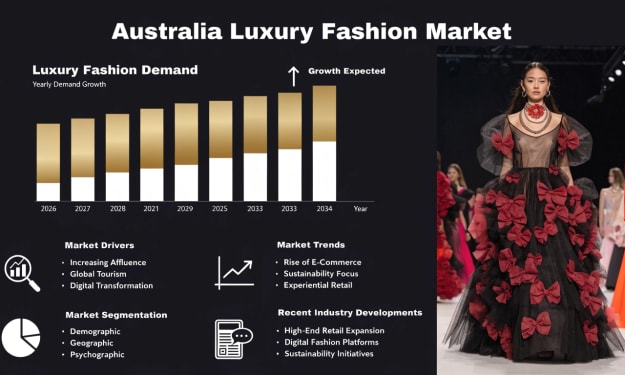
According to IMARC Group, the Australia luxury fashion market reached USD 5.2 Billion in 2025 and is projected to grow to USD 6.8 Billion by 2034, exhibiting a compound annual growth rate (CAGR) of 2.95% during 2026–2034. The steady expansion of the market reflects rising disposable incomes, growing affluent consumer segments, and evolving lifestyle aspirations across Australia. Luxury apparel, footwear, handbags, and accessories are increasingly viewed as lifestyle investments rather than occasional indulgences. As digital retail channels expand and sustainability becomes central to brand positioning, Australia luxury fashion market share continues to evolve within a competitive global landscape.
By Kevin Cooperabout 22 hours ago in Futurism
Australia Home Improvement Services Market: Renovation Demand, Consumer Spending & Service Innovation
According to IMARC Group, the Australia home improvement services market reached USD 10.8 Billion in 2025 and is projected to grow to USD 15.3 Billion by 2034, exhibiting a compound annual growth rate (CAGR) of 3.82% during 2026–2034. The market’s steady expansion reflects sustained renovation activity and evolving housing preferences across Australia. Rising property values, higher homeownership rates, and increasing disposable incomes are encouraging homeowners to invest in remodeling, maintenance, and aesthetic upgrades. Government incentives supporting energy-efficient retrofits and sustainable housing improvements further reinforce the Australia home improvement services market share, positioning the sector as a resilient component of the broader construction and services ecosystem.
By Shrestha Roy5 days ago in Futurism



Comments
There are no comments for this story
Be the first to respond and start the conversation.