
How Many Stars Are in the Milky Way? Unveiling the Mystery of Our Galactic Home
Space


By gazing into the night sky, we’re only scratching the surface of something far greater.
Stars those tiny, twinkling points of light in the night sky each represent a blazing sun, many with planetary systems of their own. Yet everything we see with the naked eye belongs to just one galaxy: our own, the Milky Way. But how many stars does our galaxy truly contain? The answer is both fascinating and elusive.
Welcome to the Milky Way
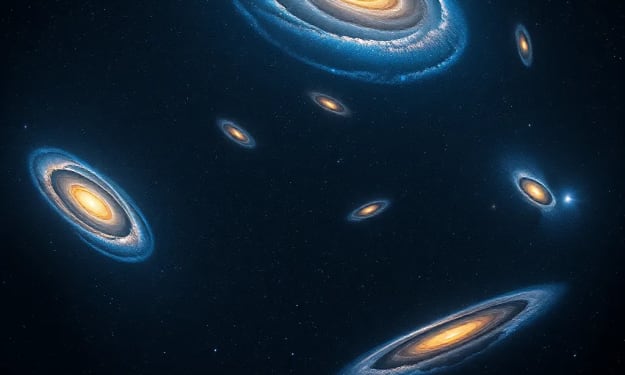
The Milky Way is a spiral galaxy stretching roughly 100,000 light years across. It features a dense central bulge, sprawling spiral arms, and a vast spherical halo made up of stars, globular clusters, and dark matter. Our own Solar System resides in a relatively quiet region about 27,000 light years from the galactic center, nestled within a spiral arm known as the Orion Arm.
From our position inside the Milky Way, it’s impossible to see the galaxy in full. But through decades of astronomical observations and ingenious calculations, scientists have pieced together an increasingly detailed picture of our galactic neighborhood.
Estimating the Star Count: The Galactic Guesswork
Currently, astronomers estimate that the Milky Way contains somewhere between 100 billion and 400 billion stars. That’s a wide range why such uncertainty?
The main challenge is that many stars are too faint or obscured to be easily observed, even with powerful telescopes. Dense clouds of cosmic dust block visible light from reaching us, and the galaxy’s vast scale makes full accounting difficult. So instead of direct counting, scientists rely on several clever strategies:
1. Local Star Density
Astronomers count the number of stars in a defined area around the Sun typically a few dozen light years in each direction. They then extrapolate this data across the entire volume of the Milky Way, adjusting for known variations in star density across regions.
2. Stellar Population Models
By examining the types and distributions of stars main sequence stars, red giants, white dwarfs, etc. scientists estimate the total population based on mass, brightness, and evolutionary models. Smaller, dimmer stars like red dwarfs dominate the population, even though they’re harder to detect.
3. Galactic Mass Calculations
Astronomers estimate the total mass of the galaxy (including dark matter), subtract the known contributions from gas, dust, and dark matter, and then calculate how much mass must be in ordinary stars. This provides an indirect but insightful way to estimate the number of stars.
What Counts as a Star?
This is where things get a little tricky. Bright stars like our Sun make up only a small portion of the galactic population. The vast majority are red dwarfs small, cool stars that burn their fuel slowly and live for trillions of years. These stars are faint and easily overlooked but are likely the most numerous in the Milky Way.
Then there are brown dwarfs substellar objects too massive to be planets but too small to sustain hydrogen fusion. Whether to count these as stars is still debated. Including them in the tally would significantly increase the total number of star like objects.
Why the Star Count Matters
Understanding how many stars are in the Milky Way is about more than just satisfying cosmic curiosity. It has real implications for several key areas of science:
- Planetary Systems & Life: More stars mean more chances for planets, and potentially, life. With hundreds of billions of stars, even a small fraction with habitable worlds means we’re looking at a galaxy full of possibilities.
- Galactic Evolution: The birth and death of stars drive the chemical evolution of galaxies. Heavy elements formed in stars eventually become part of new stars, planets, and even life.
- Dark Matter & Structure: By knowing how mass is distributed among stars, gas, and dust, we can better understand the mysterious dark matter that holds galaxies together and influences their rotation.
Gaia and the Future of Star Mapping
The European Space Agency’s Gaia spacecraft is revolutionizing our understanding of the Milky Way. Launched in 2013, Gaia has measured the positions, motions, and characteristics of over a billion stars, creating the most detailed 3D map of our galaxy ever made.
Although this represents only a fraction of all stars, Gaia’s data allows astronomers to refine their models, fill in missing gaps, and eventually arrive at a much more accurate estimate of the galaxy’s total star count.
Conclusion: A Sky Full of Secrets
We live in a galaxy brimming with stars hundreds of billions of them, each with its own story, age, and potential companions. Some are hot and massive, living brief but brilliant lives; others are dim and ancient, quietly glowing for eons.
As inhabitants of a tiny rocky world in one of the Milky Way’s spiral arms, we are part of something vast, complex, and beautiful. The night sky, though it shows us only the barest glimpse, hints at the staggering scale of the galaxy around us.
The exact number of stars may remain uncertain for now, but one thing is clear: we are surrounded by a cosmic multitude, and our quest to count and understand them is one of the greatest adventures in human history.
About the Creator
Keep reading
More stories from Holianyk Ihor and writers in Futurism and other communities.
What Lies Between Galaxies? Unveiling the Mysteries of Intergalactic Space
A Journey into the Hidden Fabric of the Universe When we look up at the night sky, the vast darkness between galaxies might seem like an endless void cold, empty, and silent. But this impression couldn't be further from the truth. Intergalactic space is not just a vacuum between islands of stars; it is a dynamic, structured, and surprisingly rich part of our cosmos. In fact, some of the most important elements that shape the universe are found in the regions between galaxies.
By Holianyk Ihor7 months ago in Futurism
About Binding Prometheus
I want to start actively advocating on behalf of my own work, and the most valuable part of my canon is, without a doubt, Binding Prometheus, the play I have been working on since 2019 and only finished in 2023 as part of my MA. The play itself is an amalgamation of a million different inspirations. On one end, it evokes the Ancient Greek myth-play, deriving its own title from the earliest extant work of Western drama we have, Aeschylus’s Prometheus Bound. On the other end, it borrows significantly from the sci-fi bulwarks from over the years, namely Mary Shelley’s Frankenstein and Karel Capek’s Rossum’s Universal Robots. The play could be an episode of Black Mirror, I fear. I don’t know. I’ve only ever seen one episode of Black Mirror.
By Steven Christopher McKnight18 days ago in Futurism
Business Information Market Size to Surpass USD 85.9 Billion by 2033 Driven by Digital Intelligence & Enterprise Demand
Increasing data-driven decision-making, rising regulatory complexity, and growing need for competitive intelligence are accelerating demand for business information solutions, supported by digital transformation, expanding enterprise analytics adoption, and greater reliance on real-time insights across industries. According to IMARC Group's latest research publication, global business information market size reached USD 53.3 Billion in 2024. Looking forward, IMARC Group expects the market to reach USD 85.9 Billion by 2033, exhibiting a growth rate (CAGR) of 5.18% during 2025-2033.
By Suhaira Yusuf6 days ago in Futurism


Comments
There are no comments for this story
Be the first to respond and start the conversation.