
How Fast Have Humans Really Accelerated Objects — and How Much Does Time Slow Down at Those Speeds?
Space

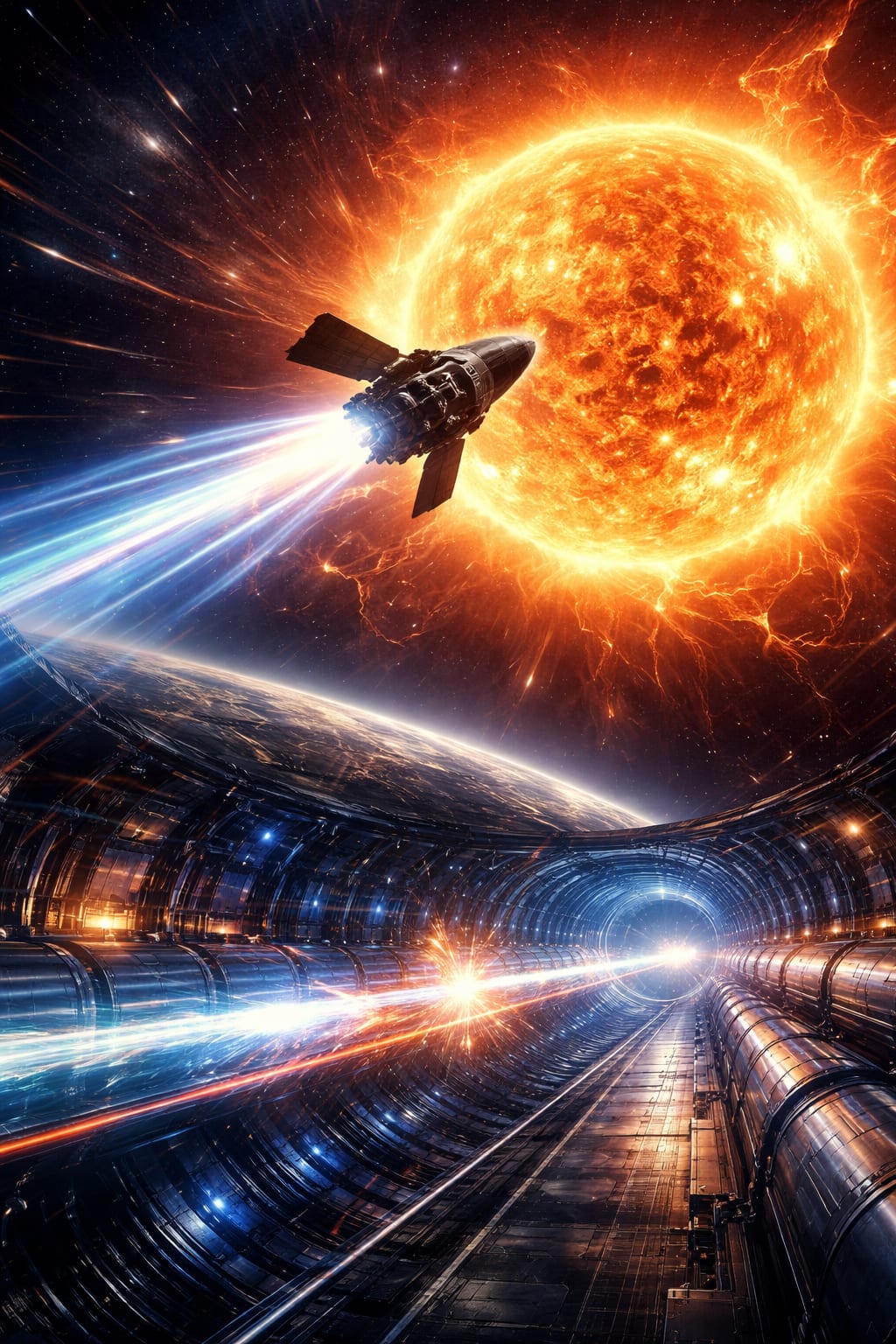
Humanity has not yet built a starship that cruises at a significant fraction of the speed of light. However, we have accelerated certain objects to velocities so extreme that time itself measurably slows down. The answer to the question “What is the fastest object humans have ever accelerated?” depends on what we mean by “object.” For spacecraft, the numbers are impressive but not relativistic. For subatomic particles, the story becomes profoundly different.
Let us examine both cases carefully.
The Fastest Human-Made Spacecraft
The current speed record for a macroscopic human-made object belongs to Parker Solar Probe, launched by NASA in 2018. During its close approaches to the Sun, the probe reaches speeds of roughly 190–200 kilometers per second (about 430,000–450,000 miles per hour).
This is an extraordinary engineering achievement. For context:
- It travels from New York to Los Angeles in under 20 seconds.
- It moves around the Sun faster than any previous spacecraft.
- It exceeds the escape velocity of Earth by nearly an order of magnitude.
Yet in relativistic terms, this is still modest. The speed of light is approximately 300,000 kilometers per second. The Parker Solar Probe’s top speed corresponds to about:
0.00067 times the speed of light (0.067%)
At this velocity, relativistic effects are negligible.
The resulting time dilation is on the order of 0.000022%. If the spacecraft traveled at that speed for a full year, its onboard clock would differ from an Earth-based clock by only fractions of a second.
Other spacecraft, such as Voyager 1 or New Horizons, move significantly slower. Even ambitious nuclear propulsion concepts would not bring us anywhere near meaningful relativistic time dilation.
In short: for large engineered objects, humanity has not yet reached speeds where time noticeably slows down.
---
The True Speed Champions: Subatomic Particles
The situation changes dramatically inside particle accelerators.
At CERN, home of the Large Hadron Collider (LHC), protons are accelerated to approximately:
0.999999991 times the speed of light
That number deserves attention. It is only a few meters per second slower than light itself.
At these speeds, the Lorentz factor (γ) is about 7000.
What does that mean physically?
It means time for those protons passes 7000 times more slowly relative to observers in the laboratory. If 7000 seconds pass in the lab frame, only one second passes for the proton.
This is not theoretical speculation. It is directly measured and confirmed in high-precision experiments. The energies required to reach this regime are enormous: each proton in the LHC carries several tera-electronvolts (TeV) of energy. The closer a particle approaches the speed of light, the more energy is required — and the energy demand rises steeply.
Experimental Proof of Time Dilation
Time dilation is not merely a mathematical prediction from **Albert Einstein**’s 1905 theory of special relativity. It is observed routinely.
A classic example involves muons produced in Earth’s upper atmosphere by cosmic rays. A muon at rest has a lifetime of only about 2.2 microseconds. At that lifetime, it should decay long before reaching Earth’s surface.
Yet large numbers of muons are detected at ground level.
Why? Because they travel at relativistic speeds. Their internal “clocks” run more slowly relative to Earth observers. Time dilation extends their effective lifetime, allowing them to survive the journey.
Particle accelerators reproduce and measure this effect with extraordinary precision. The lifetime of unstable particles increases exactly in accordance with the Lorentz factor predicted by relativity.
How Time Slows at Different Speeds
To understand the scale of relativistic effects, consider these examples:
- At **0.1c** (10% of light speed), time slows by about 0.5%.
- At **0.5c**, time slows by roughly 15%.
- At **0.9c**, time passes at less than half the normal rate.
- At **0.99c**, time slows by a factor of about 7.
- At LHC speeds (~0.999999991c), time slows by a factor of ~7000.
The progression is nonlinear. Small increases near light speed produce dramatic changes in time dilation.
Why We Cannot Go Faster Than Light
Special relativity imposes a strict limit: no object with mass can reach, let alone exceed, the speed of light.
As velocity increases:
- The required energy grows rapidly.
- The Lorentz factor increases without bound.
- The energy demand approaches infinity as velocity approaches light speed.
This is why even the most advanced accelerator facilities cannot push particles beyond light speed. They can only approach it asymptotically.
For macroscopic spacecraft, the energy requirements would be staggering. Accelerating even a modest spacecraft to 10% of light speed would require energy comparable to the annual output of entire nations.
Implications for Interstellar Travel
If a spacecraft could somehow reach 0.9c, time dilation would become meaningful. Astronauts might experience only 10 years of travel while decades pass on Earth. At 0.99c, the disparity grows even larger.
From the traveler’s perspective, interstellar journeys become shorter. From Earth’s perspective, they remain extremely long.
However, achieving such speeds with massive spacecraft remains far beyond our current propulsion technology.
The Bottom Line
Humanity’s fastest macroscopic object — the Parker Solar Probe — reaches about 0.067% of the speed of light, where time dilation is practically negligible.
But inside particle accelerators like those at CERN, we routinely accelerate protons to 99.9999991% of light speed, where time slows by a factor of roughly 7000.
We have already learned how to nearly “freeze time” — but only for subatomic particles.
For spacecraft and human travelers, relativistic speeds remain a technological frontier rather than a present-day reality.
About the Creator
Keep reading
More stories from Holianyk Ihor and writers in Futurism and other communities.
Exoplanets That Can Preserve Their Atmospheres for Billions of Years
When astronomers talk about potentially habitable worlds, the discussion often centers on surface temperature, liquid water, and orbital distance. Yet there is a more fundamental requirement that receives less public attention: atmospheric longevity. A planet may lie in the so-called habitable zone, but if it cannot retain its atmosphere over geological timescales, its prospects for long-term stability diminish dramatically.
By Holianyk Ihor6 days ago in Futurism
Australia Wallpaper Market: Interior Design Trends, Construction Activity & Product Innovation
According to IMARC Group, the Australia wallpaper market was valued at USD 47.51 Million in 2025 and is projected to reach USD 62.80 Million by 2034, growing at a compound annual growth rate (CAGR) of 3.15% during 2026–2034. While relatively niche compared to broader construction materials, wallpaper is gaining renewed relevance in the evolving interior décor landscape across Australia. Once considered a traditional decorative solution, wallpaper is now re-emerging as a design-forward alternative to paint, supported by advancements in digital printing, texture innovation and eco-friendly materials. As construction activity remains steady and consumers increasingly invest in personalized living spaces, wallpaper is carving out a distinctive role in residential and commercial interior design.
By Shrestha Roya day ago in Futurism
Why Data Transparency Matters More Than Price Talk in Crypto Markets?
As cryptocurrency markets continue to evolve, access to reliable data has become one of the most important factors shaping informed participation. While price movements often attract the most attention, deeper insights into blockchain activity, governance, and network behavior are increasingly central to understanding how these ecosystems function.
By Muhammad Irfan Afzala day ago in Futurism




Comments
There are no comments for this story
Be the first to respond and start the conversation.