
Colonizing the Moons of Uranus and Neptune: Life on the Edge of the Solar System
Space

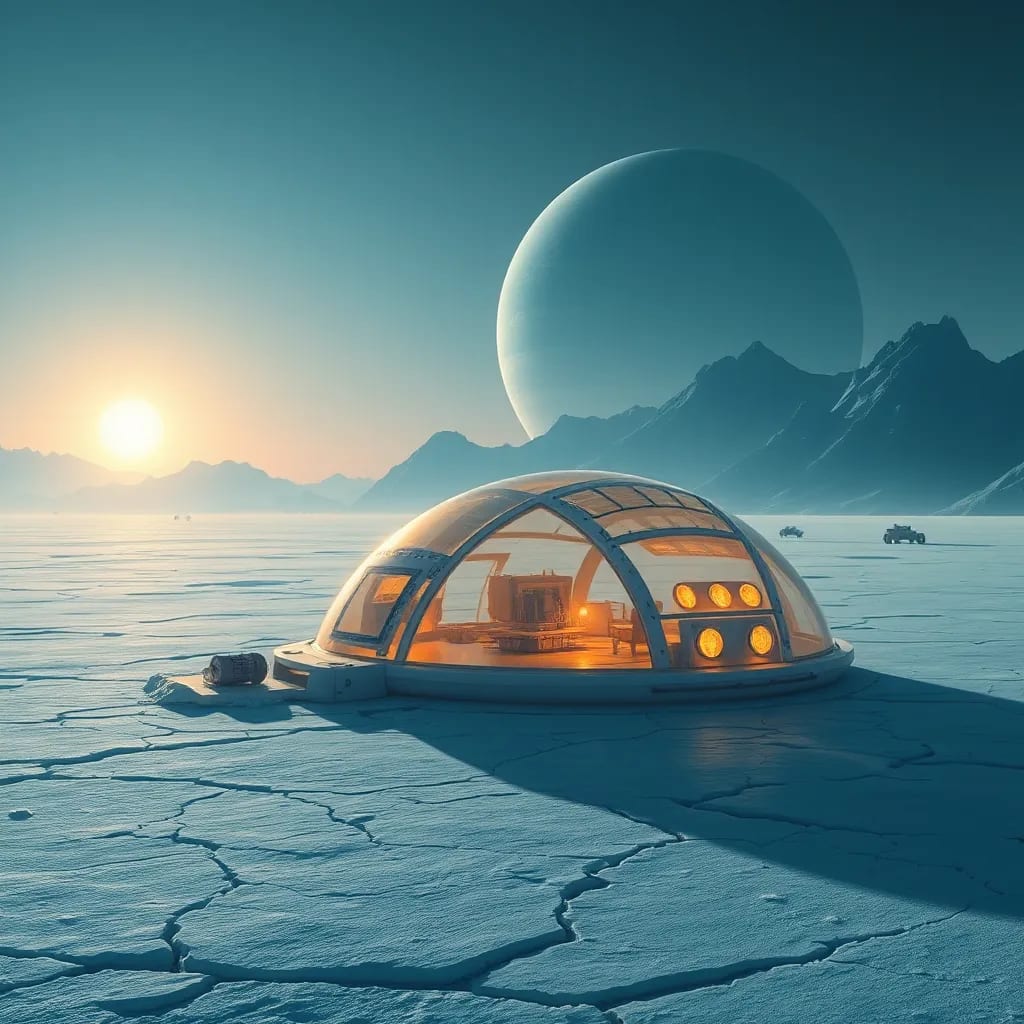
When most people imagine humanity colonizing space, they picture bustling cities on Mars, mining stations on the Moon, or scientific outposts on the icy moons of Jupiter and Saturn. But what if we dared to look even farther beyond Saturn’s majestic rings, past the edge of the familiar Solar System, to worlds so distant that the Sun appears as a pale star in the sky?
These worlds are the moons of Uranus and Neptune icy, remote, and seemingly inhospitable. Yet, with the right technology, they might become the most extraordinary human outposts in the cosmos.
The Frozen Jewels of Distant Giants
Uranus and Neptune are ice giants massive planets made mostly of volatile compounds like water, methane, and ammonia. And orbiting around them are dozens of moons, many with fascinating landscapes and geological histories.
The most intriguing candidates for colonization include:
- Triton (Neptune) — The largest moon of Neptune and likely a captured dwarf planet from the Kuiper Belt. Its surface is covered in nitrogen ice, and scientists suspect a hidden ocean beneath the crust. Triton also has active geysers, making it one of the most dynamic bodies in the outer Solar System.
- Oberon, Titania, Umbriel, Ariel, and Miranda (Uranus) — Icy moons with signs of ancient tectonic activity, deep canyons, and possible subsurface oceans.
- These moons are not warm, cozy havens — Triton’s surface temperature hovers around –235 °C (–391 °F) — but they are rich in resources that could support human life.
Why Colonizing Them Might Be Possible
At first glance, the idea sounds like pure science fiction. However, these moons offer several potential advantages:
1. Abundant Ice and Water
Ice is everywhere, providing a reliable source of water for drinking, growing food, and extracting oxygen. Hydrogen from water could also be used as rocket fuel, making these moons refueling stations for deep-space missions.
2. Energy Sources
While sunlight is weak this far from the Sun, colonies could use:
- Compact nuclear reactors (similar to those that power NASA’s Voyager probes).
- Thermoelectric generators exploiting temperature differences.
- Possible geothermal energy, especially on geologically active Triton.
3. Scientific Opportunities
These moons could serve as unique laboratories for studying planetary formation, the history of the outer Solar System, and the mysteries of icy worlds. If subsurface oceans exist, they might even harbor microbial life.
4. Strategic Outposts
A base in the outer Solar System could serve as a staging ground for missions to the Kuiper Belt or even interstellar space and as a safe haven should a catastrophe strike Earth.
The Big Challenges
Of course, colonizing the moons of Uranus and Neptune wouldn’t be easy:
- Extreme Distance — At current spacecraft speeds, reaching Neptune could take 12–15 years. Faster propulsion systems, such as nuclear thermal or fusion engines, would be essential.
- Intense Cold and Darkness — Habitats would need to be completely insulated and equipped with reliable heating systems.
- Radiation — While Uranus and Neptune’s magnetic fields are not as harsh as Jupiter’s, radiation shielding would still be necessary.
- Logistics — Supplies from Earth would take years to arrive. Colonies would need to be as self-sufficient as possible.
What Life Could Look Like
Imagine domed settlements beneath layers of protective ice, where the faint sunlight is amplified by mirrors and artificial lighting fills the living spaces. Farms inside pressurized greenhouses could grow food year-round, powered by nuclear energy.
On Triton, colonists might harness geysers for nitrogen processing, while on Miranda, settlements could be built within colossal canyons natural shields from cosmic radiation and micrometeorites. Beneath the ice, submarines could explore pitch-black oceans, searching for alien life in a place where no sunlight has ever reached.
A Future Beyond the Sun’s Warmth
Colonizing the moons of Uranus and Neptune won’t happen in the next few decades. It’s a project for a future where humanity has mastered advanced propulsion, autonomous life-support systems, and large-scale space infrastructure.
But if we succeed, these remote worlds could become stepping stones to the stars outposts of life where none was meant to be.
After all, humanity’s true home might not be tied to the warmth of the Sun. Some of our greatest adventures may await us in the frozen, silent realms at the far edge of the Solar System.
About the Creator
Keep reading
More stories from Holianyk Ihor and writers in Futurism and other communities.
Neutrino Observatories in Deep Space: Eyes That See Through the Stars
Far across the cosmos, billions of light-years away, events of unimaginable power unfold supernova explosions, neutron star collisions, and energy bursts from supermassive black holes. Most of these cosmic cataclysms remain hidden from traditional telescopes, their signals swallowed by gas, dust, and distance.
By Holianyk Ihor5 months ago in Futurism
About Binding Prometheus
I want to start actively advocating on behalf of my own work, and the most valuable part of my canon is, without a doubt, Binding Prometheus, the play I have been working on since 2019 and only finished in 2023 as part of my MA. The play itself is an amalgamation of a million different inspirations. On one end, it evokes the Ancient Greek myth-play, deriving its own title from the earliest extant work of Western drama we have, Aeschylus’s Prometheus Bound. On the other end, it borrows significantly from the sci-fi bulwarks from over the years, namely Mary Shelley’s Frankenstein and Karel Capek’s Rossum’s Universal Robots. The play could be an episode of Black Mirror, I fear. I don’t know. I’ve only ever seen one episode of Black Mirror.
By Steven Christopher McKnight18 days ago in Futurism
Global Pepperoni Food Market Size and Forecast, 2025–2033
Market Snapshot: Growth in a Familiar Favorite The Global Pepperoni Food Market is set to record steady growth from US$ 1.96 billion in 2024 to US$ 2.43 billion by 2033, expanding at a CAGR of 2.40% during 2025–2033. This trajectory reflects the enduring popularity of pepperoni as a core ingredient in pizza and convenience foods, alongside incremental innovation in packaging, flavor, and product formats. While the category is mature in several Western markets, emerging economies, premiumization, and the expansion of protein-forward snacking are providing new avenues for value creation.
By jaiklin Fanandish6 days ago in Futurism




Comments
There are no comments for this story
Be the first to respond and start the conversation.