
How Earth’s First Proteins May Have Formed in Water.
A Breakthrough in the Mystery of Life’s Origins

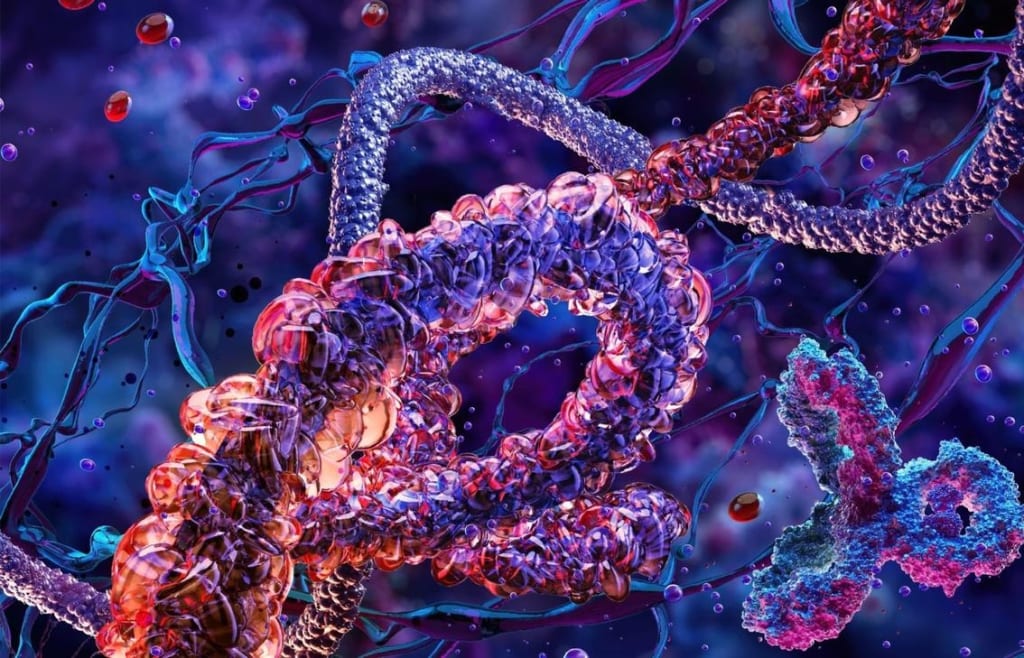
For centuries, humanity has asked one of the most profound questions of all time: How did life begin on Earth? While modern biology gives us incredible insights into cells, DNA, and evolution, the earliest steps—how simple molecules transitioned into complex living systems—remain one of science’s greatest mysteries.
A groundbreaking new study published in Nature by a team from University College London (UCL) may have unlocked an important piece of this puzzle. Their research shows how the first proteins—the molecular machines of life—could have formed naturally in water-based environments without the help of enzymes or complex cellular machinery. This discovery doesn’t just answer an age-old question, it reshapes how we think about the chemical origins of life itself.
The Mystery of the First Proteins
Proteins are essential for nearly every process in living organisms. They serve as enzymes, build structures, and carry out communication within cells. But here’s the problem: proteins are made of amino acids, which must be carefully arranged and connected. Today, this happens with the help of RNA and ribosomes inside cells. But billions of years ago, before cells even existed, how could these proteins have possibly formed?
This “chicken and egg” problem—proteins are needed to build proteins—has puzzled scientists for decades. The latest findings from UCL provide a fascinating answer: proteins may have formed through simple reactions in water, powered by basic chemistry and the right environmental conditions.
The UCL Discovery: A Simple Pathway to Proteins
The research team, led by Professor Matthew Powner, demonstrated that amino acids can directly attach to RNA molecules in neutral water conditions—without any advanced enzymes. Even more exciting, these reactions produced protein-like structures in surprisingly high yields.
The process works in two steps:
1. Activation of amino acids – The scientists turned amino acids into a “reactive” form by giving them extra chemical energy.
2. Attachment to RNA – These activated amino acids then linked themselves to specific spots on RNA strands. The most remarkable detail? They preferred to bind at the ends of RNA strands, which helped preserve the genetic information stored within.
In their experiments, the researchers achieved an impressive 76% success rate when attaching the amino acid arginine to RNA. That’s a huge leap in demonstrating how early chemistry could lead to the building blocks of proteins.
Why Sulfur Chemistry Was Key
One of the most fascinating aspects of this discovery is the role of sulfur compounds, specifically thioesters. These molecules act like little chemical engines, driving reactions that wouldn’t normally happen easily in water.
Thioesters are not only effective but also prebiotically plausible—meaning they could have been present on early Earth. Previous studies suggest that compounds like pantetheine (a building block of Coenzyme A, vital in metabolism today) may have also formed naturally in those ancient conditions.
This connection bridges the gap between modern biochemistry and the primitive chemistry of Earth’s early environment.
From Amino Acids to Peptides: Building the First Protein Chains
Once amino acids attached to RNA, something even more incredible happened. In the presence of a mild oxidant, these amino acids linked together into short chains called peptides. Peptides are essentially tiny proteins, and they represent one of the earliest forms of biological function.
This pathway shows how RNA could act as a scaffold, holding amino acids in place while they formed the first primitive proteins. In essence, RNA may have been the original matchmaker between genetic information and functional proteins.
Freshwater Pools: The Birthplace of Life?
Many origin-of-life theories suggest that life may have started in the deep ocean, near hydrothermal vents. But this new research points to a different setting: freshwater environments like small pools, lakes, or shorelines.
Why freshwater? Because the reactions studied by UCL worked best under neutral pH conditions, unlike the salty and extreme conditions of the ocean. Even more intriguing, the researchers discovered that freezing temperatures—just below 20°F (−7°C)—made the reactions more efficient. When water freezes, it pushes dissolved molecules closer together, creating the perfect environment for chemistry to happen.
This suggests that icy lakes or seasonal ponds on early Earth could have been cradles of life, providing the right balance of water, minerals, and natural cycles to spark the first proteins.
The Bridge Between Chemistry and Biology
What makes this study so revolutionary is how it solves a major problem in biology: how did coding for proteins begin before the ribosome existed?
Today, ribosomes are essential for reading RNA and building proteins. But billions of years ago, life couldn’t rely on such complex machines. The UCL research shows that RNA itself could have directed amino acids into place, making the first peptides without ribosomes.
This means there may have been a stage in evolution we could call the RNA–peptide world—a time when RNA didn’t just store information but also helped create functional molecules. Over time, these interactions could have evolved into the highly organized genetic code we see in life today.
Toward the First Genetic Code
The fact that amino acids attached specifically at the ends of RNA strands hints at the beginnings of a genetic coding system. Sequence-specific pairing may have allowed early RNA molecules to guide which amino acids connected, creating the first crude form of “instructions.”
This is a giant leap toward understanding how random chemistry turned into organized, coded biology. It also strengthens the idea that the genetic code and proteins co-evolved, rather than appearing independently.
Why This Discovery Matters
This breakthrough matters for several reasons:
It provides real experimental evidence for how proteins could have formed naturally in water.
It connects primitive Earth chemistry with the highly advanced processes inside cells today.
It narrows down the possible environments where life could have begun, pointing strongly toward freshwater pools and icy conditions.
It offers hope for studying life beyond Earth—because if simple chemistry can produce proteins here, it may also happen on planets with similar conditions.
Final Thoughts: A Step Closer to Understanding Life’s Origins
The origin of life is one of humanity’s greatest unsolved mysteries, but step by step, science is piecing the puzzle together. This study by Professor Powner and his team at UCL shows us that the first proteins may not have needed anything complex—just water, amino acids, RNA, and a little help from sulfur chemistry.
From humble chemical beginnings in freshwater pools, life may have taken its very first steps toward the complex biology we see today.
And perhaps most inspiring of all—this research reminds us that the building blocks of life are not mystical or unreachable. They are written into the chemistry of our planet, waiting for the right conditions to spark into something extraordinary.
Science News
Biology Discoveries
Evolution of Life
Nature Research
Space and Life Origins
About the Creator
NextGen Mobile Tech
- I review the latest smartphones, mobile accessories, and tech essentials to help you make smart buying decisions. Explore my curated kits for phones and gear here: [Kit.co link].
Keep reading
More stories from NextGen Mobile Tech and writers in Futurism and other communities.
Scientists Uncover a 520-Million-Year-Old Fossilized Larva with Its Brain Intact
When we think of fossils, we often picture giant dinosaur skeletons or ancient plants trapped in stone. But a discovery in China has stunned scientists because it’s not about size—it’s about detail. Researchers recently unearthed a fossilized larva dating back 520 million years, and what makes this find extraordinary is that its brain, nervous system, digestive glands, and circulatory traces are still preserved. This tiny creature, no bigger than a poppy seed, has become one of the most important keys to unlocking the mysteries of early animal evolution.
By NextGen Mobile Tech5 months ago in Futurism
About Binding Prometheus
I want to start actively advocating on behalf of my own work, and the most valuable part of my canon is, without a doubt, Binding Prometheus, the play I have been working on since 2019 and only finished in 2023 as part of my MA. The play itself is an amalgamation of a million different inspirations. On one end, it evokes the Ancient Greek myth-play, deriving its own title from the earliest extant work of Western drama we have, Aeschylus’s Prometheus Bound. On the other end, it borrows significantly from the sci-fi bulwarks from over the years, namely Mary Shelley’s Frankenstein and Karel Capek’s Rossum’s Universal Robots. The play could be an episode of Black Mirror, I fear. I don’t know. I’ve only ever seen one episode of Black Mirror.
By Steven Christopher McKnight17 days ago in Futurism
Device-as-a-Service Market: Transforming Enterprise Hardware Solutions
📌 Market Overview The Device‑as‑a‑Service (DaaS) market refers to a subscription‑based IT delivery model where organizations procure hardware (like computers, laptops, tablets, and smartphones) paired with software, maintenance, support, and lifecycle management services under one contract. Instead of purchasing devices outright, enterprises outsource procurement, updates, security, and end‑of‑life recycling to DaaS providers. This model shifts traditional capital expenditures (CapEx) to predictable operating expenses (OpEx), helping businesses scale and modernize IT infrastructure efficiently.
By James Smith3 days ago in Futurism
Miss Persephone's Manual to a Seemingly Ordinary Life
Miss Persephone was found at the dining table, her blue eyes swollen, her tears arriving and retreating like the tides of the ocean. Earlier that day, her family had visited her in the retirement home where she had lived for eight years. It was her eightieth birthday.
By Imola Tóth3 days ago in Fiction


Comments
There are no comments for this story
Be the first to respond and start the conversation.